
A Distributor Sells What Moves, Not What Is Best
Two valves sit on the same counter at a distributor's branch. One is a better piece of engineering: tighter tolerances, a superior alloy, a longer service life in a punishing application. The other is ordinary, the kind that has shipped from that branch for fifteen years. A plant calls in an order. The counter pulls the ordinary one without a second thought.
Nothing about that choice is irrational. The branch is not blind to quality. It is responding to something the manufacturer of the better valve usually cannot see from where it stands.
A distributor does not get paid to be right about products. It gets paid to move volume across a finite amount of attention, inventory, and counter time. Those are the constraints that decide what ships.
The Trap of Building the Better Thing
Manufacturers tend to believe that a superior product earns its own demand. Build the thing that performs better, present it well, and the channel will carry it because carrying it is the obvious commercial move.
The presentation lands. The distributor is interested, sometimes genuinely impressed. And then nothing ships for months.
The mistake is treating the distributor's interest as the same thing as the distributor's ability to act. They are not the same. Interest is a feeling about the product. Action is a function of the distributor's own economics, which the product does not change.
A branch stocks a finite number of SKUs and gives counter attention to the lines that turn. A new line, however good, asks the branch to allocate shelf space, working capital, and the salesperson's recommendation to something with no proven velocity. That is a cost the branch carries before it sees a single reorder.
Interest is a feeling about the product. Action is a function of the distributor's own economics.
So the better valve sits. Not because anyone decided against it. Because nobody had a reason strong enough to displace what already moves.
Two Forces Decide What the Channel Carries
What the distributor sells is governed by two numbers, and a product that does not satisfy both will not get attention no matter how good it is.
The first is velocity. How fast does the item turn? Shelf space is finite and capital is tied up in everything sitting on it. A line that moves slowly costs the branch carrying cost, occupies space a faster line could use, and earns no goodwill with the customer who wants what they asked for, now. Velocity is what lets the distributor recover its money and reorder.
The second is margin per unit of attention. Not headline margin. Margin against the effort it takes to sell, stock, and support the line. A product that requires the salesperson to explain something new, to justify a switch, to manage an unfamiliar return, costs attention that could have gone to three easy sales. High margin on a hard sell can lose to thin margin on an easy one.
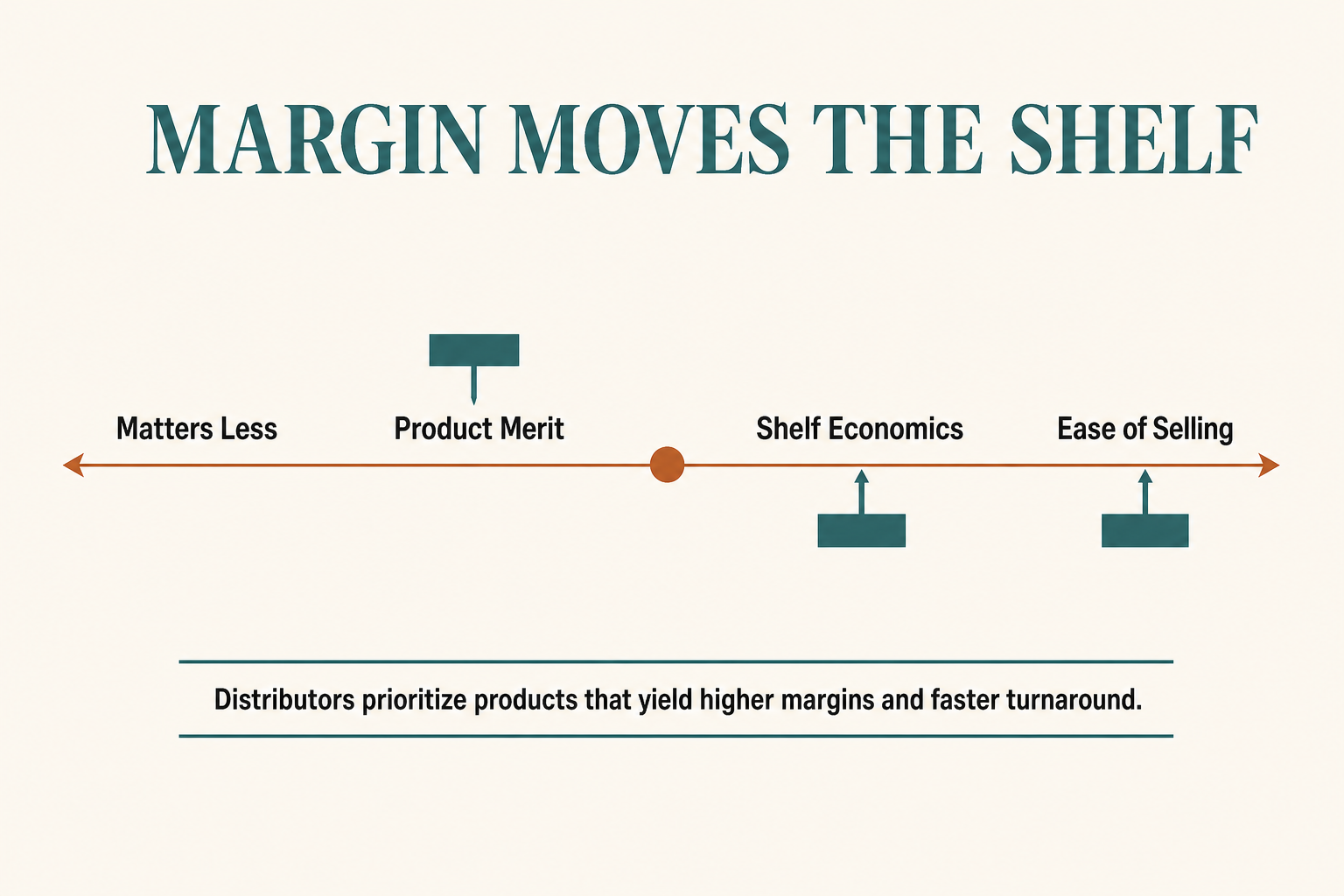
Put those together and the picture is clear. The distributor allocates its scarce attention to whatever returns the most per unit of effort and turns fast enough to keep the capital working. Product quality only matters where it moves one of those two numbers.
This is where the thesis lands. A distributor does not sell what is best. It sells what moves, and what moves is decided by velocity and margin per unit of attention, not by engineering merit.
Product quality only matters where it moves velocity or margin per unit of attention. Where it does neither, it is invisible to the channel.
Which means the manufacturer's real job is not to prove the product is better. It is to give the channel a reason that operates on velocity or attention. Sometimes that reason lives inside the distributor. More often, in critical-service goods, it lives somewhere the distributor cannot reach alone.
The Valve the Distributor Wanted but Could Not Buy
A maker of specialty and alloy valves, the kind that go into critical service where a failure is not a small thing, came into the U.S. market believing the work was to get in front of the right distributor and present well.
The presentation went to a Fortune 500 distributor, and it landed. They were genuinely interested. The product was right for the applications they served.
Then they said the thing that reframed the whole entry. Go get this approved by our customers, the end users, so that we can buy it.
The distributor liked the valve and still could not purchase it. The permission to buy did not live in the room. It lived downstream, with the plants and operators who would not allow an unapproved specialty valve into service. Approval ran months for some, years for others. Until that cleared, the valve had no velocity the distributor could count on, because no end user could pull it.
The distributor liked it and still could not buy it, because the permission to buy lived downstream.
The original effort had gone into knocking on distributor doors, selling to preference. The real work was to understand the approval path and follow it, so that demand existed for the distributor to fill. Preference was never the lever. Permission was.
How to Tell If You Are Selling to Preference
Before you read a warm distributor meeting as progress, work through where the actual permission and the actual velocity live.
- Who approves? Does the person who likes your product also have the authority to buy it, or does permission sit with someone downstream you have not met?
- What turns? Have you given the channel a reason rooted in velocity, or are you asking it to carry slow inventory on the strength of quality alone?
- What does it cost to sell? Does your product make the salesperson's day easier or harder, and have you counted margin against effort, not just headline margin?
- Where does demand originate? Is there a pull from the end user that the distributor simply fills, or are you asking the distributor to create demand it has no incentive to create?
- What is the approval timeline? For critical-service goods, have you mapped the qualification path and its real duration before you treated the channel as the obstacle?
- Are you confusing interest with ability? When a distributor says yes, are you certain that yes means they can act, or only that they would if they could?
The channel does not reward the better product. It rewards the product that gives it a reason to move, and that reason is almost never the engineering.
Build the thing that performs. Then go find where the permission and the velocity actually live, because that, not the meeting, is the market.