
A Full Calendar Can Still Be Unprofitable
Two owners hold the same report. Both calendars are full, green from the first of the month to the last, not a gap to be found. One owner looks at it and feels safe. The other looks at it and starts asking what those nights actually cost to fill.
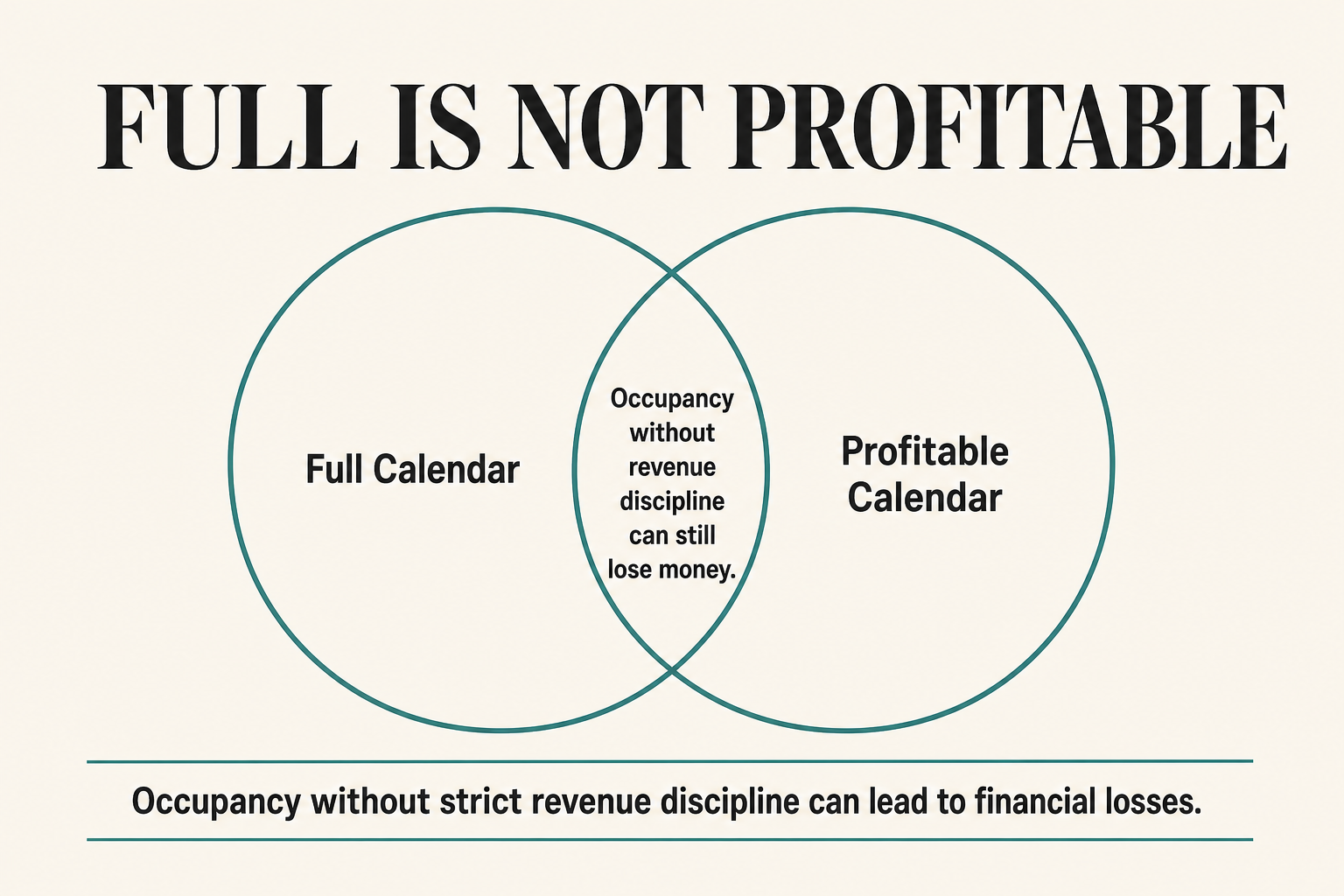
A full calendar is the easiest thing in this business to be proud of and the easiest thing to misread. It tells you the property is desirable enough to move. It does not tell you what you gave up to move it, who you moved it to, or whether the guest who slept there last night will ever think of you again. Occupancy is a count. It answers one question and quietly hides several more.
The owner who reads it as a finish line stops there. The owner who reads it as a starting point keeps going.
What Occupancy Hides
Occupancy measures whether the rooms filled. It says nothing about the rate they filled at, the discount that closed them, the fees the platform skimmed off the top, or the wear those particular guests left behind.
You can fill a calendar by pricing into the floor. Drop the nightly rate far enough and almost anything books. The number on the report looks identical to the number you would get from disciplined pricing, but the money underneath is not the same money, and neither is the guest.
This is where the say-do gap lives. Owners say they run a premium property. Then they price it like a commodity the moment a soft week appears, terrified of an empty night, and the discount teaches the market exactly what the place is worth.
A booked night at the wrong rate, to the wrong guest, on the wrong terms, is not revenue. It is motion mistaken for progress.
A booked night at the wrong rate, to the wrong guest, on the wrong terms, is not revenue. It is motion mistaken for progress.
The cost of a full calendar shows up later, off the report. It shows up in the cleaning crew finding more than they expected. It shows up in a guest who booked on price alone, treated the house like a price-alone purchase, and left without a memory worth keeping. You filled the night. You spent the asset to do it.
Price the Calendar With Intent
Start with a simple separation. Every booking carries two values, and they are not the same.
The first is the revenue from that stay: the rate, minus the fees, minus the cost of turning the house over after them. The second is what that guest is worth over time: whether they come back, whether they bring a group, whether they become the kind of relationship that books a wedding party or a yearly family gathering without ever opening a search bar.
A commodity booking has only the first value. A relationship booking has both. The whole job of pricing with intent is to stop treating those two as interchangeable just because they fill the same square on the calendar.
The platforms push you toward the first value and away from the second. They reward availability and price competitiveness, they own the search visibility, they own the communication layer, and they own the guest's memory of where they stayed. Fill your calendar entirely through that machine and you have built a business that looks healthy and is structurally fragile. You are visible, you are busy, and you are replaceable.
Pricing with intent means deciding, before the soft week panics you, which nights you will hold at rate and which guest you are actually trying to attract. It means a slightly emptier calendar at a defended rate can beat a full one at a discounted rate, because the empty night costs you nothing but opportunity, while the cheap night costs you the brand and the cleanup and the guest who will never return.
A slightly emptier calendar at a defended rate can beat a full one at a discounted rate.
The number to protect is not occupancy. It is profit per booking and, underneath that, the lifetime value of the guests your pricing pulls in. Price for volume and you get volume. Price for the relationship and you get a different business entirely, one the platform cannot quietly take from you.
What a Real Inquiry Looks Like
There is a tell, and once you see it you cannot unsee it.
A commodity guest asks one thing. Is it available, and how much. The conversation is a transaction from the first word, and the only lever you have is price. Compete there and you compete with everyone.
A relationship guest opens differently. They do not ask if the dates are open. They explain what they are trying to create: a milestone birthday, a women's retreat, a family gathering large enough that the setting has to be right. They are telling you the purpose before they ask the price, because for them the price is downstream of whether the place fits the moment.
That inquiry is worth more, and it is worth more precisely because it cannot be served by a template. A budget operator sends an automated reply and is finished. At the premium end, the response itself is part of the product. Answer the actual concern, understand the group, give honest guidance about whether the setting works. Not concierge theater. Just thoughtful where it counts.
For a milestone gathering, the tone of your response is part of what they are buying.
Those guests do not show up on the occupancy report any differently than anyone else. One green square looks like every other green square. But one of those squares brings a guest who books again next year and tells three friends, and the other brings a guest who chose you because you were three percent cheaper and will leave for the next operator who undercuts you. The calendar cannot tell them apart. The pricing decision that filled the night is what decided which one you got.
What to Check Before You Celebrate a Full Calendar
- Do you know your profit per booking, not just your occupancy rate, for the last full season?
- When a soft week appears, do you defend the rate or discount on reflex to avoid an empty night?
- What share of last year's nights came from guests you have a direct relationship with, versus guests the platform owns?
- Can you tell, from your inquiries, which guests are buying a setting and which are buying a price?
- Does the guest who booked at your lowest rate cost you more to serve and recover from than the spread is worth?
- If the platform changed its rules tomorrow, how much of your calendar would survive?
- Are you pricing the next twelve months for volume, or for the relationships you actually want?
Occupancy tells you the rooms filled. It will never tell you whether you should have filled them, at that rate, for that guest, and that is the only question worth pricing around.
A full calendar is evidence of demand. Profit is evidence of judgment. Confuse the two and you can stay busy all the way to the bottom.