
A Person Is Not a System
Every business has someone who just knows. The dispatcher who can look at the board and tell you which truck to pull. The estimator who quotes a job in his head and lands within two percent. The woman in receivables who remembers which customer pays late and which one is about to go under. They are the reason things work. They are also the reason no one ever wrote down how things work.
Owners love these people, and they should. A person who absorbs complexity and makes it disappear is worth more than the title on their badge. But love is not the same as understanding. And what the owner usually does not understand is what that person is actually holding.
The Person Who Holds It All Together
Watch what happens when that person takes two weeks off. The questions start on day three. Someone calls the owner to ask how the Henderson account gets billed. Nobody knows where the spare key to the back gate is. A shipment goes out wrong because the person who always catches it was not there to catch it.
The work did not get harder. The knowledge just left the building.
This is the quiet trap of the heroic individual. They are so good at smoothing over the gaps that the gaps never get fixed. Every save they make is also a problem hidden. The better they are, the less anyone notices what the business is missing, because the business is not missing it. The person is supplying it, daily, out of their own head.
Every save the hero makes is also a problem hidden.
So the owner has a business that runs, and no idea why it runs. That is not the same as a business that works.
What a System Actually Is
Here is the distinction that owners blur, and it costs them when they try to grow or sell.
A person performs a task. A system makes the task repeatable by anyone of normal competence. The difference is not the quality of the work. The difference is whether the knowledge lives in a head or lives in the process.
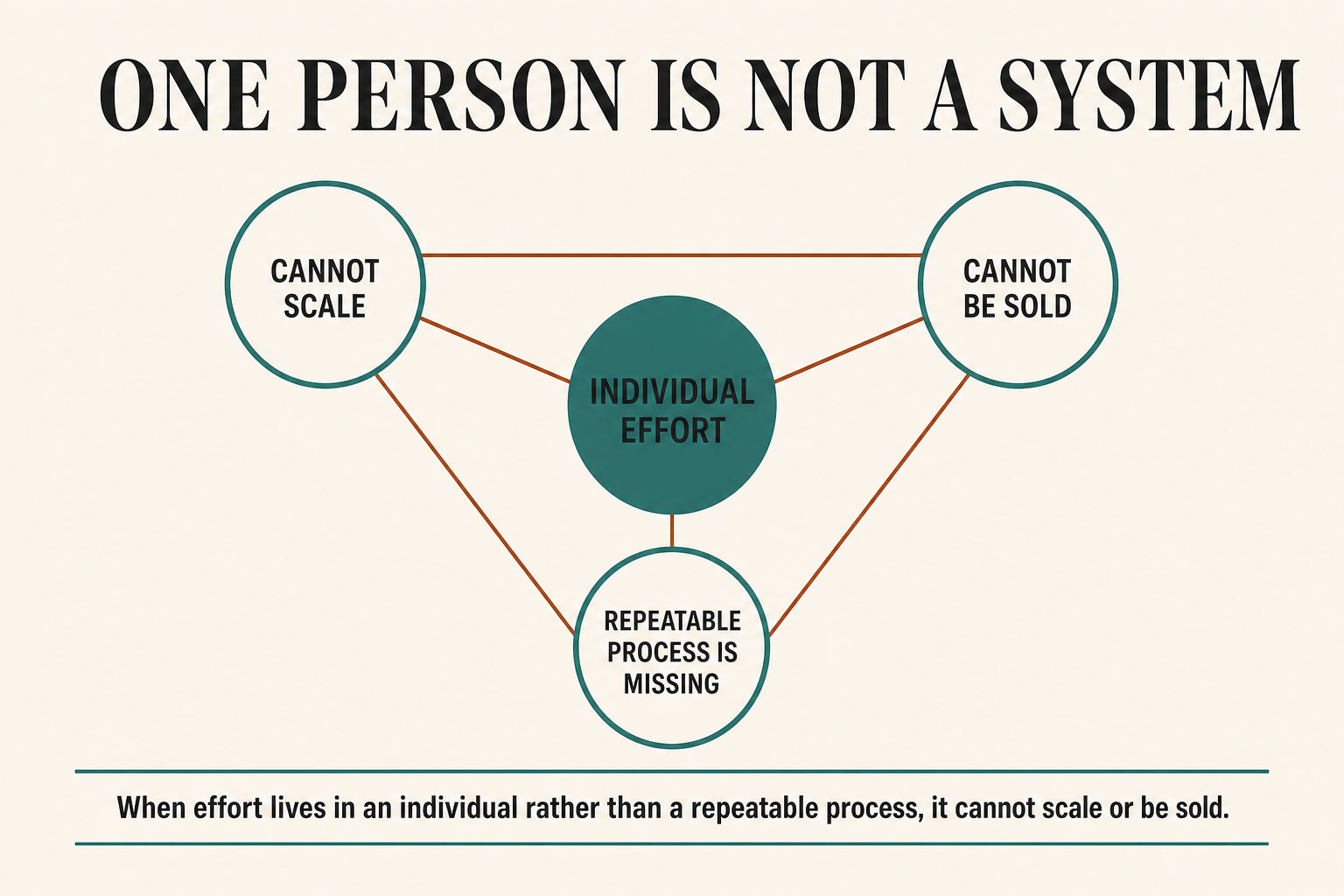
You can test it with one question. If you handed this job to a capable stranger on Monday, would the work still come out right by Friday? If the answer depends on who you hand it to, you have a person, not a system. If the answer is yes regardless of who shows up, you have a system, and the person becomes leverage instead of a single point of failure.
A system has three properties the hero does not.
- It is visible. The steps exist outside anyone's memory, on paper or in software, where they can be seen, taught, and corrected.
- It is transferable. A new hire can run it without absorbing years of context first.
- It survives the exit. When the person leaves, the capability stays.
The hero fails all three. Their method is invisible, locked in judgment they cannot fully explain. It is not transferable, because the next person would need the same years to build the same instinct. And it does not survive their exit, because the day they walk out, the capability walks with them.
If the answer depends on who you hand it to, you have a person, not a system.
None of this means the person is the problem. The person is doing exactly what good people do. The problem is the owner who mistook a talented individual for an installed capability, and built the next stage of the company on top of a single human being who can quit, burn out, or get poached.
The Christmas That Exposed It
In 1996 I was running an online art-supply retailer, MisterArt.com, with somewhere between forty and sixty thousand SKUs, every one digitized, photographed, and copywritten from nothing. There was no Shopify, no Stripe, no playbook. We wrote the cart ourselves. We wrote code to drive modems out to the credit-card processors for authorizations. Everything was home grown.
For most of the year, the warehouse ran fine. We printed paper pick lists, the pickers grabbed the orders, the boxes went out. The people were good. They knew the shelves. They knew the workarounds.
Then Christmas came, and the volume exposed everything the good people had been quietly covering.
The pick lists were not even in an efficient order, so pickers wandered the aisles, doubling back, relying on memory to fill the gaps the list left open. At normal volume their skill absorbed the inefficiency. At peak volume there was no skill fast enough. The machinery was the bottleneck, and the machinery had never existed, because people had been standing in for it.
The fix was not to hire faster pickers. It was to build the system the people had been substituting for. We brought in first-generation Symbol scanners, programmed to route the picker to the right location and validate each pick by scanning the shelf and then the UPC. The knowledge that had lived in the pickers' heads now lived in the process.
At normal volume their skill absorbed the inefficiency. At peak volume there was no skill fast enough.
The next spike, the same people moved far more product, because they were no longer the system. They were running one.
How to Tell If This Is You
You do not find these single points of failure by looking at the org chart. You find them by looking at what would break if one person disappeared tomorrow.
- Name the three people whose two-week absence would generate panic. Why those three, and what exactly do they hold?
- For each one, could you write down what they do well enough for a stranger to follow it? If not, you have a person, not a process.
- Where in the business does growth currently depend on one individual working harder, rather than on a method that scales?
- What does your best person fix so quietly that you have stopped noticing the problem exists?
- If you tried to sell tomorrow, which capabilities would a buyer be paying for, and which would walk out the door at closing?
- When demand doubles, what breaks first, and is it a person or a process?
A great employee is an asset. A great employee no one can replace is a liability wearing an asset's clothes.
The job is not to need fewer good people. It is to make sure the company owns the capability, not just rents it from whoever currently holds it in their head.