
A Price Objection Is Never About Price
A purchasing manager holds your quote, looks at the number, and tells you it is too high. The competitor comes in lower. The conversation cools.
Most sellers hear that and reach for the discount. They sharpen the pencil, find a few points to give back, and call it negotiation. Sometimes it works. Usually it does not, and even when it does, the deal that closes on price is the deal that leaves on price the next time someone undercuts you.
Here is what nobody pauses to ask. If the number were the whole problem, why did the buyer take the meeting at all? He saw your price range before he sat down. He came anyway.
The word "expensive" is doing work. It is standing in for something the buyer has not said, and often cannot say cleanly, because he has not finished the arithmetic himself.
What The Word Is Hiding
When a buyer says expensive, he is rarely comparing your price to a budget. He is comparing your price to the price he can defend.
Those are different numbers. A budget is what he can spend. A defensible price is what he can explain to the person above him, or to the plant that has to live with the choice, without carrying the blame if it goes wrong.
So the objection is not really about the cost on the page. It is about the cost he cannot see and therefore cannot justify. The risk of failure. The disruption of a switch. The hours of approval work your product creates before it can even be used.
Those costs are real. He feels them. He just does not have a column on his spreadsheet labeled for them, so they come out of his mouth as one blunt word.
A buyer who calls you expensive is telling you he cannot yet justify the total cost, not that he cannot afford the price.
The Three Costs Behind The Number
Every price a buyer evaluates carries three layers, and only the first one is the number you quoted.
The first is acquisition cost. The price on the page. This is the only layer most sellers argue about, and it is the least important to a serious buyer in a critical application.
The second is total cost of ownership. What it costs to run, maintain, and replace the thing over its life. A cheaper component that fails sooner, or runs hotter, or needs more service, is more expensive on this layer even though it won the first one.
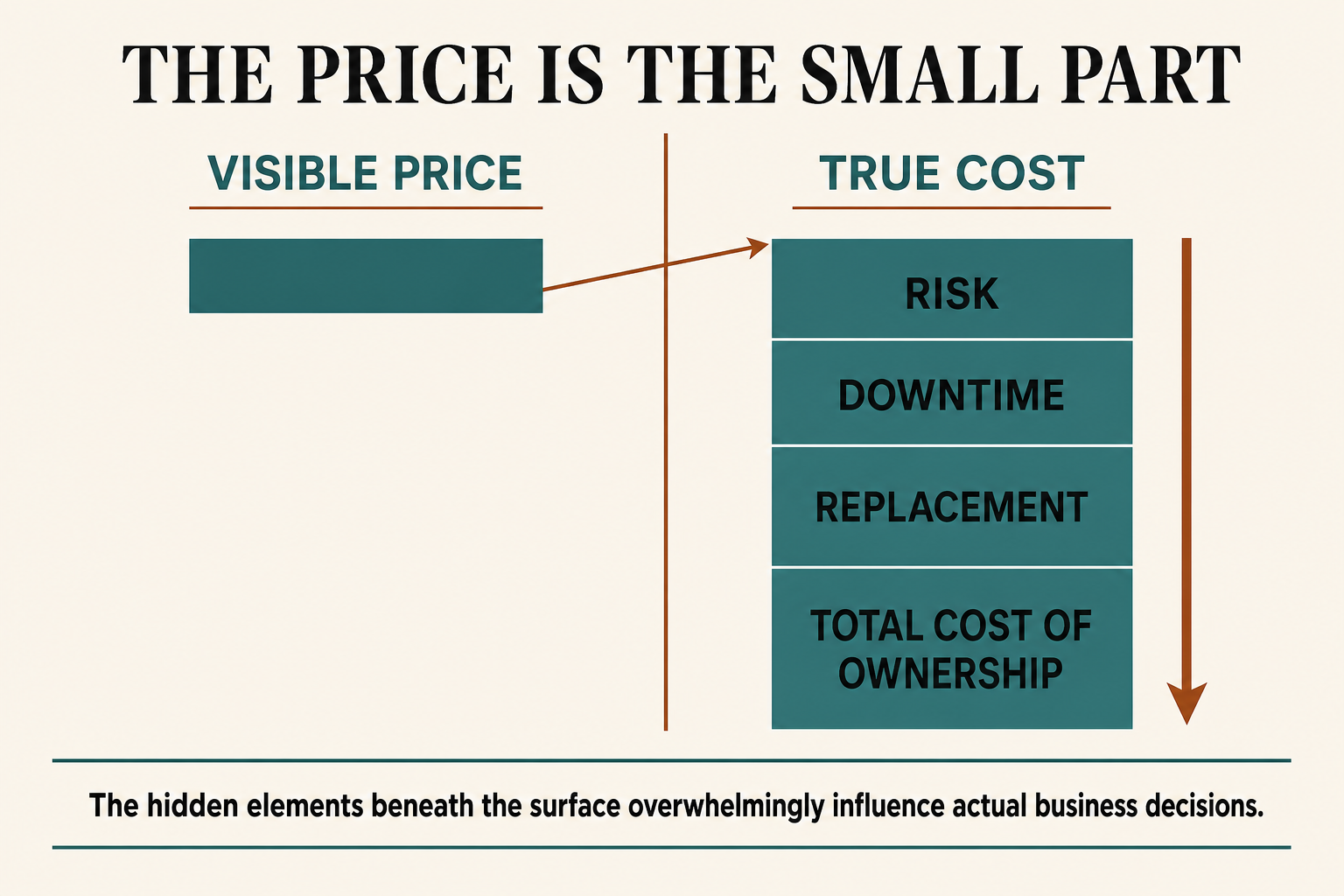
The third is risk cost. The price of being wrong. In a critical-service application this layer dwarfs the other two, because a failure does not cost the part, it costs the shutdown, the cleanup, the safety review, and the buyer's standing in the building.
A serious buyer weighs all three, even if he only names the first. When he says expensive, he is usually flinching at the second or the third. He is asking you, without asking, to make the full cost legible so he can defend the choice.
Discount the price and you answer the only objection the buyer was not actually making.
The seller who lowers the number is solving layer one. The buyer was stuck on layer three. They are now talking past each other, and the lower price reads as a tell. If you could drop it that easily, what was it worth?
The work is not to make your product cheaper. The work is to move the conversation to the layers where your product actually wins, and to do the buyer's arithmetic for him on those layers, in terms he can carry upstairs.
Where The Real Cost Lived
There is a version of this in specialty valves that makes the point exactly.
A Mexican maker of specialty and alloy valves was entering the U.S. market. Not commodity valves. Critical-service components, the kind that sit in a line where failure is expensive and dangerous, which is precisely why nobody installs them casually.
The presentation to a Fortune 500 distributor landed well. They liked the product. Then they said something that sounded like an obstacle and was actually the whole truth: go get this approved by our customers, the end users, before we can buy it.
The distributor was not haggling over price. The distributor could not buy at any price until the risk cost was retired, and retiring it meant the end users running their approval process, which took months for some and years for others. The expense was never the number on the quote. The expense was the time and proof required before the part could enter service at all.
The permission to buy lived downstream, with the people who carried the risk, not with the buyer in the room who liked the product.
Treating that as a price problem, or even a selling problem, would have wasted years. The honest move was to stop selling to preference and start working the approval path, because that was where the real cost sat the whole time.
Where To Look First
When a buyer pushes back on price, slow down before you touch the number. The objection is data, and discounting throws the data away. Ask yourself these before you respond.
- Who actually pays if this goes wrong? Find the person who carries the risk cost, because that is who the buyer is really negotiating on behalf of.
- What does the buyer have to defend, and to whom? If he cannot explain the choice upstairs, your price is not his problem, his exposure is.
- Which of the three costs is he flinching at? Acquisition, ownership, or risk. The discount only touches the first, and it is rarely the first.
- What unstated work does my product create before it earns its keep? Approval, switching, retraining. That cost is real to him even when it never appears on your quote.
- Am I selling to preference when I should be working a process? Liking the product and being permitted to buy it are different events.
- Have I done his arithmetic for him? If you have not made the total cost legible, you have left him to defend a number he cannot explain.
When a buyer says expensive, he is naming the cost you have not made visible yet. Make it visible, and the number stops being the argument.
The price was never the objection. It was the only word he had for everything underneath it.