A Strong Brand Lowers the Cost of Every Sale
Two suppliers quote the same valve. Same specification, same delivery window, prices within a few percent of each other. One quote comes from a name the buyer has bought from for years. The other comes from a name he has heard of, maybe seen at a trade show, but never purchased.
He does not run the comparison he tells himself he runs. He does not weigh both on the merits and pick the better value. He starts from the name he trusts and asks the unknown one to overcome it. That gap is not about the product. It is about everything the buyer does not have to verify.
Most owners think a brand is what people have heard of. They count impressions, followers, show traffic, the number of times the logo crossed someone's screen. They are measuring the wrong thing.
The Awareness Trap
Awareness is cheap to buy and easy to mistake for progress. You can raise it with a bigger booth, a sponsored webinar, a run of ads. The dashboard lights up. The pipeline does not.
Awareness tells you a buyer can name you. It says nothing about whether he will choose you when his own job is on the line. A purchasing manager who can recall your company and still picks the incumbent has given you the worst outcome of all: he knows you exist and does not trust you enough to act.
That is the gap owners miss. They keep spending to be remembered, when the buyer already remembers them. The problem was never recall. The problem was risk.
Awareness tells you a buyer can name you. It says nothing about whether he will choose you when his own job is on the line.
The buyer is not buying your product in isolation. He is buying the consequence of being wrong. In critical-service work, a bad valve is not a return. It is a shutdown, a safety review, a meeting where someone asks why he chose an unproven supplier. Awareness does nothing to lower that fear. A brand does.
What a Brand Actually Buys You
A brand is the buyer's stored answer to a question he would otherwise have to ask again every time. Will it work. Will it ship. Will I look foolish for choosing this. When the answer is already settled in his mind, the sale costs less to make. That is the whole mechanism, and it is worth being precise about it.
Think of every sale as carrying a load of friction the seller has to lift:
- Proof of performance. Will it do what the spec says under real conditions.
- Proof of reliability. Will it arrive, every time, without a chase.
- Proof of recourse. If something goes wrong, will someone stand behind it.
- Cover for the buyer. If he champions you and it fails, is he exposed.
A weak name carries all four on every quote. The seller pays to lift them with samples, references, site visits, trials, longer terms, deeper discounts. Each one is a real cost in time, money, or margin. A strong name has already lifted most of that load before the quote is sent. The buyer has answered the questions privately, and the answers stay answered.
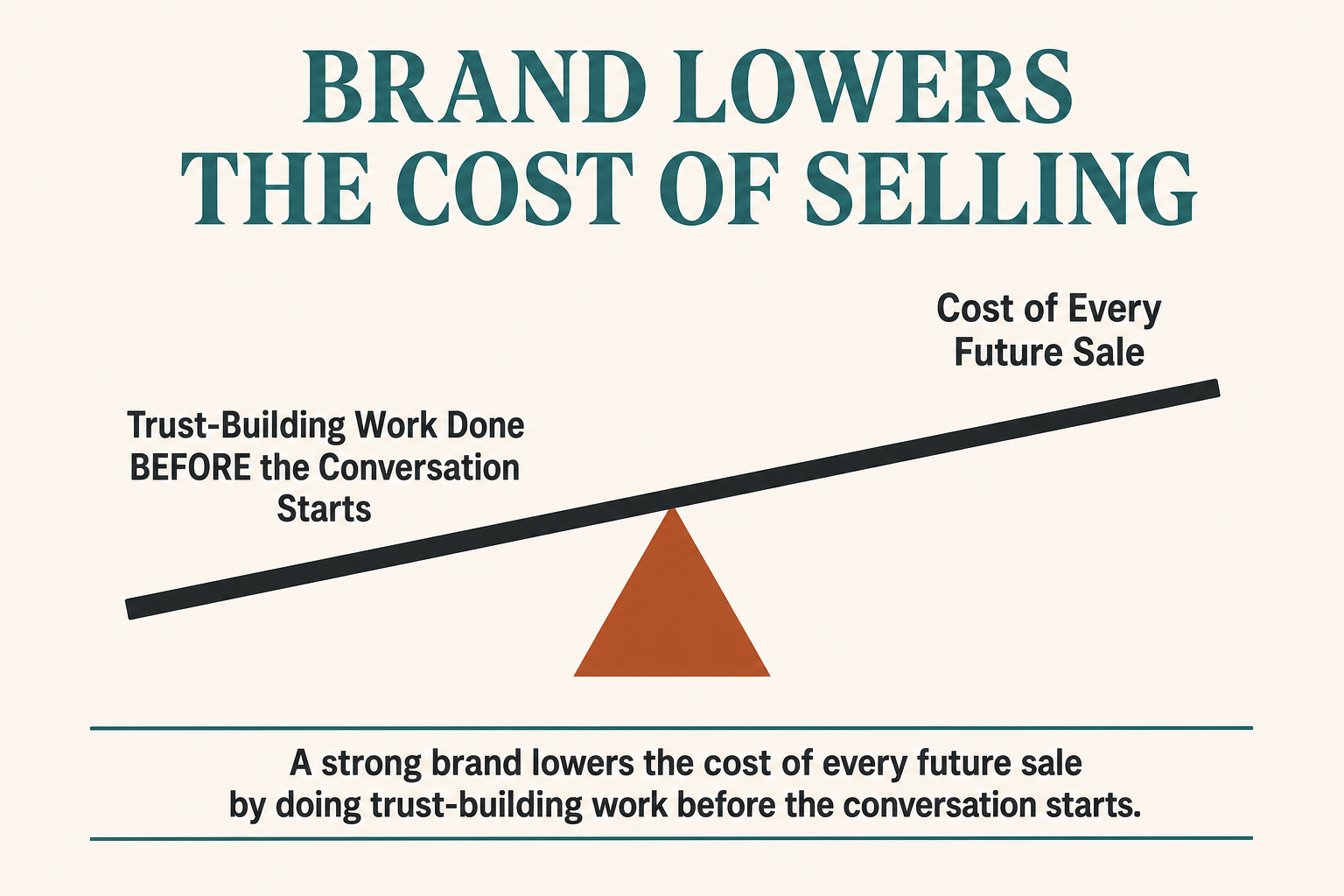
This is why brand is leverage and awareness is not. Leverage compounds. The first satisfied job lowers the cost of winning the second, the second lowers the third, and the trust does not reset between deals. Awareness resets constantly. Stop paying and it fades, because it was rented, not built.
A weak name pays to lift the buyer's risk on every single quote. A strong name lifted it once and kept the receipt.
There is a real caveat, and it cuts the other way. A brand built on the wrong claim is leverage against you. If the name promises premium and the product ships ordinary, every sale gets harder, because now you are fighting a reputation as well as a competitor. Brand only lowers cost when the experience behind it is true. Otherwise you have spent years teaching the market to distrust you efficiently.
The Catalog That Had to Be Built by Hand
In 1996 there was no playbook for selling art supplies online. We built MisterArt.com from nothing: 40,000 to 60,000 SKUs depending on the season, every one digitized, photographed, cataloged, and written from scratch. There was no Shopify, no Stripe. We wrote our own cart and our own code to drive modems to the credit-card processors for authorization. Everything was home grown, in the most literal sense.
A buyer who landed on that catalog had no name to lean on. We were new. So every product had to carry its own proof, because we had no stored trust to spend. The photograph had to show the thing honestly. The copy had to answer the question before it was asked. The cart had to work the first time, because a failed checkout from an unknown store is not a retry. It is a goodbye.
That is what it costs to sell without a brand. You pay, on every transaction, for the trust you have not yet earned. You pay it in detail, in patience, in the constant work of removing doubt one buyer at a time.
Without a name to lean on, every single product had to carry its own proof, because we had no stored trust to spend.
The cost did not disappear as the name grew. It moved. Repeat buyers came back without the same scrutiny. They had answered the questions once, and a good experience kept the answers settled. The brand started doing the work the copy used to do alone.
How to Tell If You Are Buying Awareness or Building Brand
- When you win, do buyers cite trust and track record, or only price and lead time?
- Does a repeat customer scrutinize the second order as hard as the first, or has the friction dropped?
- If you stopped all marketing for a quarter, would demand hold or quietly fade?
- Are your salespeople still lifting the same four risks on every quote, years in?
- Does the experience behind your name match what the name promises, or do you fight your own reputation?
- When a buyer champions you internally, is he exposed if you fail, or covered by your record?
- Are you paying to be remembered by people who already remember you?
Awareness is rented and resets the moment you stop paying; a brand is owned, and it lowers the cost of every sale that comes after the one that earned it.
Spend to be known, and you spend forever. Earn to be trusted, and the cost of selling falls on its own.