Comfort Is Engineered, Not Decorated
A guest walks out to the pool a little after ten at night. She wants the water lit, the string lights on, the fire pit going low. She does not look for a panel. She does not call anyone. She says it out loud, to no one in particular, and it happens.
That moment reads as effortless. It is not. Effortless is the most expensive thing a property can build, because it requires the system to disappear completely while still doing exactly what was asked, every time, with no one standing behind the curtain to catch the failure.
Most owners get the sequence backward. They finish the house, then bolt on smart features because guests expect them now. The result works, mostly, in the way a translated sentence works: technically correct, faintly foreign, and the seams show under pressure.
The Gap Between Smart And Seamless
Plenty of rentals now have some flavor of smart control. An app for the lights. A code for the door. A thermostat you can nudge from your phone before you arrive.
None of that is the same as a guest standing at a fire pit at midnight, saying what she wants, and getting it without friction. Voice control, unified across systems that were never designed to talk to each other, is a different order of problem. It means the pool equipment, the lighting circuits, and the fire feature all have to recognize the same command and respond in concert, invisibly, on a property with no engineer on call.
Most operators solve this by narrowing the ambition. Fewer integrations, simpler asks, an app instead of a voice, because the app is easier to get working and easier to blame when it doesn't.
The easy version of smart is smart enough to demo and not smart enough to trust.
What Guests Actually Notice
Guests do not notice architecture. They notice friction, and they notice its absence, and they remember one far more than the other.
A guest who has to find a binder, locate the right breaker, or text the property manager to ask why the fire pit won't light has just been handed a chore in the middle of a weekend they paid a premium to not think about. That single interruption reframes the whole stay. The property stops feeling like a private world and starts feeling like a rental with extra steps.
The inverse is just as true, and less obvious. A guest who never once has to ask for help does not think "the technology here is impressive." She thinks nothing at all. That is the actual target. Not admiration. Absence of thought.
Why The Invisible Layer Has To Be Built, Not Bought
Off-the-shelf smart home products are built to be good enough for a homeowner managing their own house, with their own patience for the occasional glitch. A rental operating at a premium price point cannot borrow that tolerance. The guest has no relationship with the quirks of the system and no reason to forgive them.
This is where building beats buying, and the distinction matters because it is not about being more advanced for its own sake. It is about matching the tool to the one job that actually threatens the business.
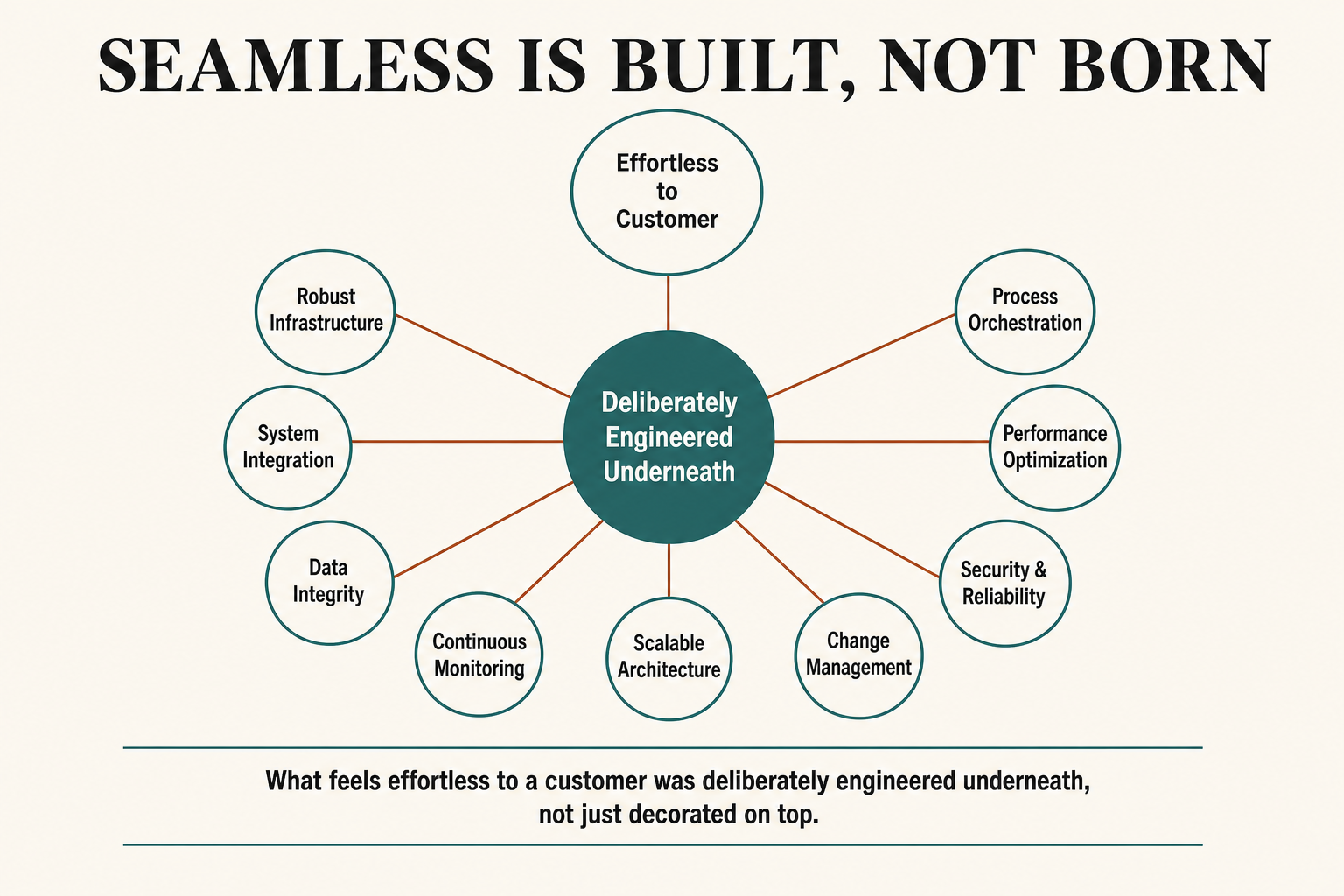
A useful way to sort it: some parts of a technology stack are commodity infrastructure, and some parts are the experience itself. Commodity infrastructure should be bought, configured well, and left alone. Reliable network coverage across a property, properly zoned lighting control, dependable wifi in every structure, these are solved problems. Buying best-in-class off-the-shelf hardware here is not a compromise. It is the correct call, because the value it creates is identical whether you built it or bought it, and building it yourself only adds risk with no offsetting advantage.
But the layer where the guest actually feels the difference between "smart house" and "this place just works" is not a commodity problem. It is specific to how the property is used, which commodity systems are not designed to know. A voice command that has to reach across a pool controller, a lighting system, and a fire feature that were never built to speak to each other requires someone to build the translation layer between them. No vendor sells that, because it is not generic. It is this property, for this pattern of use.
Buy the parts that are the same for everyone. Build the part that is the reason someone chose you.
The integration itself does something else worth naming: it takes the owner and the staff out of the loop for the routine request. Every time a guest can serve themselves, that is one less call at ten at night, one less person who has to physically walk over and flip a switch. The system is not just seamless for the guest. It is quietly reducing how much the operation depends on a person being available and paying attention.
The Test Nobody Runs Until It Fails
The real test of an invisible system is not the demo. It is the edge case, at night, with a stranger involved.
A guest at Element Ranch can control the pool, the lighting, and the fire pits herself, through a voice-driven Home Assistant integration built specifically for how a group actually spends an evening there. That single piece was built custom. The rest of the stack, the lighting hardware itself, the network, the marketing and booking systems, was deliberately bought and configured rather than built, because those pieces are the same problem everyone else has already solved well.
The split is the whole discipline. Build where the experience lives. Buy where it doesn't.
The parts nobody sees are the parts that decide whether the parts everyone sees actually work.
Where To Look First
- Where does a guest currently have to ask for something that should have just happened? That is your build list, not your feature wish list.
- Which parts of your stack are truly generic, solved by someone else already, and safe to buy off the shelf?
- Which single moment, if it fails at 10pm with no one around, does the most damage to how the whole property is perceived?
- Are you building custom technology to look advanced, or because a specific, recurring friction point demands it?
- How many routine requests currently require a person to intervene, and which of those could be engineered out?
- If your best staff member were unreachable for a weekend, what would break for the guest?
Comfort that survives contact with a real guest was never decoration. It was engineered, on purpose, to disappear.
The properties that feel effortless spent real effort making sure no one would ever see it.