Control It Before You Own It, Entitle for the Exit
A buyer signs the purchase agreement, wires the deposit, and only then starts asking what the land can actually become. The zoning, the access easement, the water rights, the setback that quietly eats a third of the buildable area. Each question gets answered after the money is committed, which means each answer can only cost something. There is no upside left to discover. The price was set when the optionality was highest, and the optionality is gone.
This is the normal order of operations in real estate. Find a deal, fall for it, close, then solve. It feels like momentum. It is the most expensive sequence a developer can choose, and almost everyone chooses it.
The Order That Quietly Loses Money
The problem is not that developers fail to plan the exit. Many write a pro forma with a sale price and a hold period on the first page. The problem is that they plan the exit on paper while taking on the asset in fact.
They own the dirt before they control the outcome. They commit capital before they have resolved the things that decide whether the project is worth building at all. Entitlements, utilities, the buyer who will eventually take it off their hands. Those questions get pushed past the close, into a period when the only available move is to absorb whatever the answer turns out to be.
Control and ownership are not the same thing, and treating them as the same is where the money goes. You can control a parcel for very little: an option, a long due-diligence window, a feasibility contingency that lets you walk. Ownership transfers the risk to your balance sheet. Control keeps it on the seller's.
You can control a parcel for very little. Ownership transfers the risk to your balance sheet.
The developer who closes first has bought the right to discover bad news he can no longer escape.
Decide the End Before the Beginning
Start from the buyer who is not in the room yet. Before any entitlement, before any sketch, name who takes this asset at the end and what they will require to pay full price for it. A merchant builder selling to an institutional owner needs clean entitlements, signed leases, and no open questions. A developer selling raw entitled land needs the approvals stamped and the utilities confirmed. The exit buyer's checklist is the actual scope of work. Everything else is decoration.
Then control the parcel without owning it while you go resolve that checklist. Tie it up under option or contingency. Spend the cheap money first: the zoning attorney, the civil engineer, the utility letters, the conversations with the planning department. Find the deal-killers while you can still walk away for the cost of a deposit, not the cost of a building.
The exit buyer's checklist is the actual scope of work. Everything else is decoration.
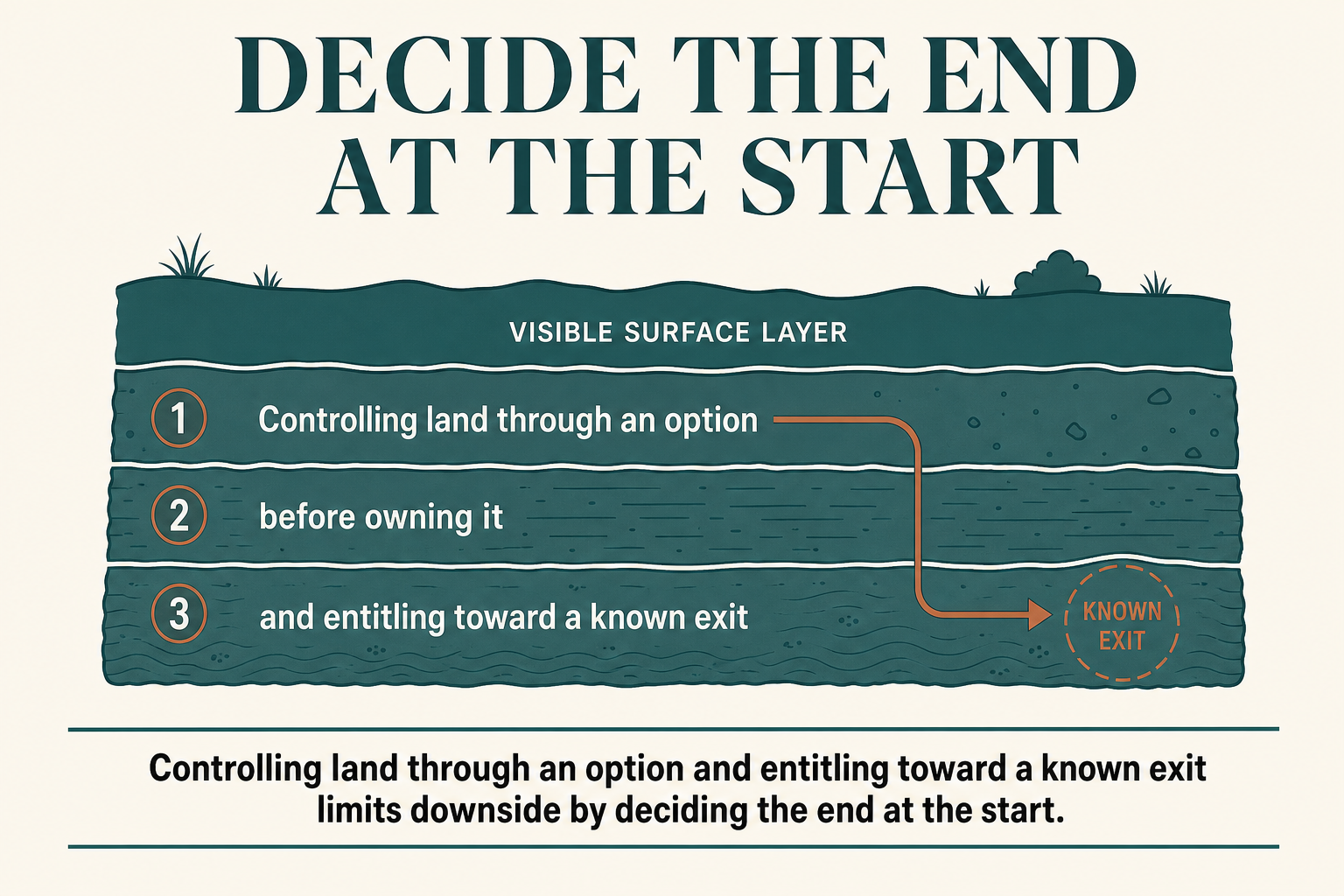
Only close when the answers you cannot change have come back acceptable. Entitle for the exit means you do the approval work, the rezoning, the variance, the platting, while the downside still lives with the seller, and you take title at the moment the asset is worth more than you are paying for it.
This inverts the usual sequence. Most developers buy, then create value, then hope a buyer agrees. This approach defines the buyer, creates the value under option, and only then buys, by which point the value is already proven rather than promised. The risk has been spent down to nearly nothing before the largest check is written.
The cost of this discipline is real. It is slower. It requires legal fees and engineering fees on a deal you might abandon. Sellers resist long control periods, and some will not grant them. But the alternative is to pay for those answers anyway, after closing, when every answer can only subtract.
Why Element Ranch Was Designed Backward
The same logic shaped a property far from any rezoning fight. Element Ranch, near Round Top, was designed around the end before the beginning, but the end there was not a buyer. It was the guest's weekend.
Before a single finish was selected, the question was how a group actually moves through the place over two days. Where they gather when they arrive. Where someone drinks coffee alone in the morning. Where the group lands at sunset. Where the property photographs without anyone staging it. That answer drove the layout, the pool area, the shared spaces, and the scale, in that order. The finishes came last, because finishes are the cheap decision and the structure is the expensive one.
Most rental builds run the opposite way. Count the bedrooms, buy the trendy furniture, hire a good photographer, call it a ranch retreat. That produces a commodity that depends on the photos holding up once guests arrive. The experience was decided after the building was committed, which is the same mistake as closing before you entitle. The expensive things were locked in before anyone asked what they were for.
The finishes are the cheap decision. The structure is the expensive one, and it gets decided first or not at all.
The property commands a rate well above comparable rural houses because guests rent a setting and a level of execution, not a bedroom count. That premium was not added at the end with adjectives. It was decided at the start, when the outcome was named and the building was shaped to deliver it.
Where to Look First
Before you commit capital to a deal, walk it back to front and check whether you are buying optionality or buying obligation.
- The exit buyer: Can you name the specific party who takes this asset at the end, and the exact checklist they will require to pay full price?
- Control versus ownership: Are you tying the parcel up under option or contingency, or are you about to take title and inherit every unanswered question?
- The cheap money first: Have you spent on the attorney, the engineer, and the utility letters before spending on the land?
- The deal-killers: Do you know the answers that cannot be changed, the ones that decide whether this is buildable at all, before you can no longer walk?
- The sequence: Are you creating value under control and buying proven, or buying first and hoping value follows?
- The premium: Is the value built into the structure of the deal, or bolted on at the end with hope and good marketing?
Decide who buys it and what they need before you buy it yourself, and you will never own a problem you could have walked away from.
The deal you control costs a deposit to leave. The deal you own costs everything to fix.