
Demand Is Earned at the End User, Not the Branch
A presentation goes well. The distributor across the table sees the product, asks good questions, and likes what he sees. The fit is real and the interest is genuine. Then he says something that sounds like a yes but is not one. Go get this approved by our customers, and then we can buy it.
That sentence stops most new entrants cold, because it does not match how they thought selling worked. They came to win the room. They won the room. And the order still did not come.
The instinct at that point is to push harder on the person who said it. More follow-up, better pricing, a stronger pitch. That instinct is almost always wrong, and understanding why is the whole game.
The Person Who Likes It Cannot Always Buy It
In a lot of industrial channels, the distributor is not the buyer in any meaningful sense. He is a holder of inventory and a fulfiller of orders. What he stocks and sells is shaped by what his customers, the end users, have already agreed to accept.
For critical-service components this is not a preference. It is a rule. An end user running a refinery or a plant maintains an approved list, and a part that is not on that list does not go into service, no matter who likes it or how good it is.
So the distributor can be enthusiastic and still be structurally unable to act. He is not stalling. He is telling you the truth about where permission lives.
The distributor can advocate. He cannot approve.
This is the gap that sinks new entrants. They read interest as buying authority, and they keep selling to the person who already agrees with them. The agreement was never the obstacle. The obstacle is downstream, with people who were not in the room and have not yet been asked.
Preference and Permission Are Two Different Sales
It helps to separate two things that feel like one. There is the sale to preference, which is winning someone's belief that your product is good. And there is the sale to permission, which is clearing the process that allows the product to be bought at all.
Preference is what most sellers are trained to chase. It is the demo, the relationship, the conversation that lands. It feels like progress because it produces warmth and agreement.
Permission is colder and slower. It is the approval path: the specification, the qualification, the testing, the formal acceptance onto an approved list. It does not care whether anyone likes you. It cares whether you followed the steps.
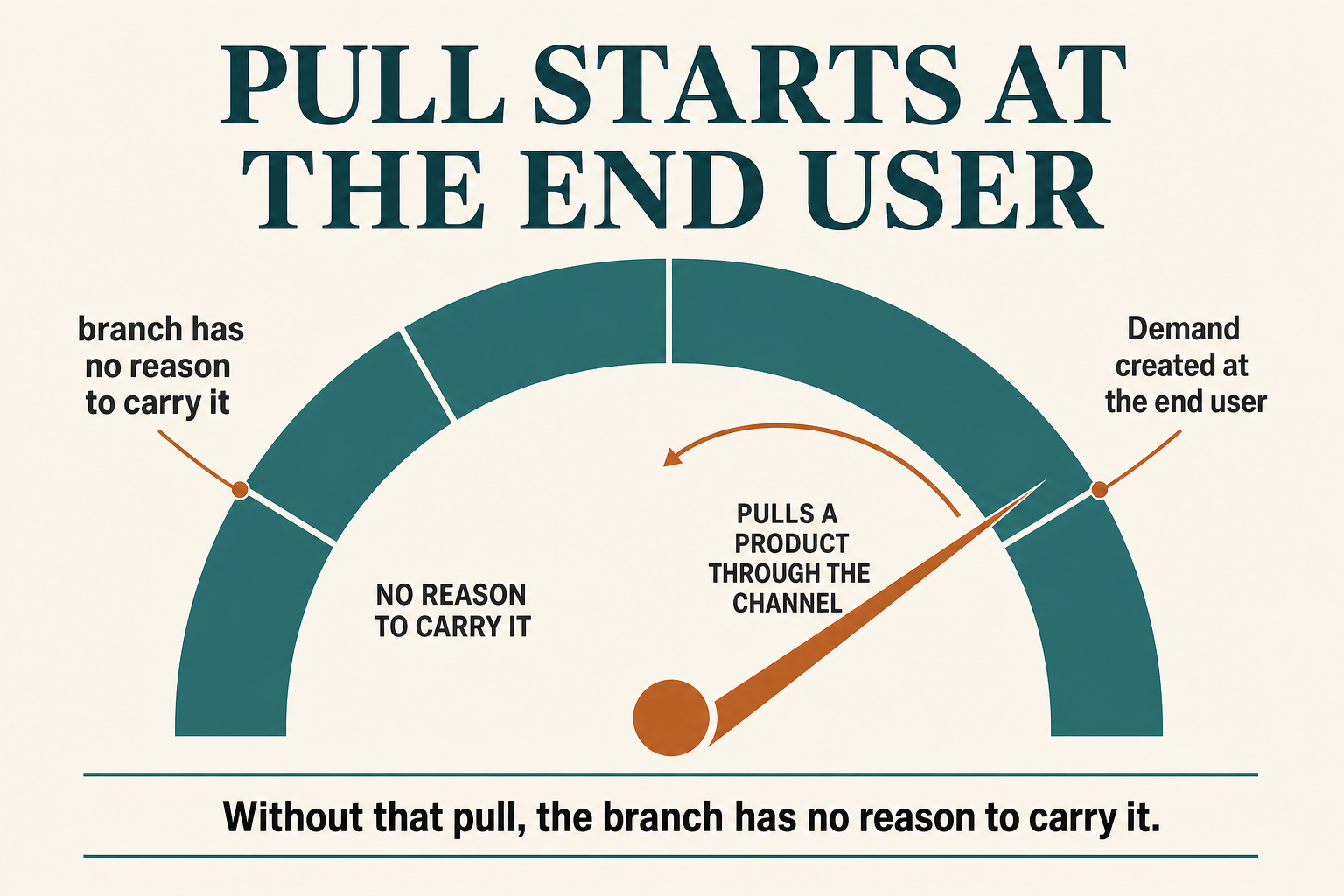
Here is the part that gets missed. Preference and permission do not live in the same place. Preference often lives at the branch, with the salesperson or the distributor who handles the transaction. Permission lives at the end user, sometimes several layers back, with an engineer or a reliability team who will never take your call cold.
When you sell only to preference, you accumulate goodwill that cannot convert. You have a channel full of people who want to help and cannot. The order is gated somewhere they do not control.
Goodwill at the branch is not the same as permission at the plant.
The work, then, is not to sell harder at the branch. It is to find where permission actually lives and to go earn it on its own terms. That means learning the approval process before spending a dollar on persuasion, mapping who specifies, who qualifies, and what acceptance requires. It is unglamorous and it is slow, and it is the only thing that turns interest into orders.
Once permission exists, the channel works for you. The distributor who could not buy can now stock with confidence, because his customer has already said yes. You have created pull-through: demand that pulls the product through the channel rather than being pushed against it. The branch stops being a wall and becomes a conduit.
A Valve That Won the Room and Lost the Order
Consider a manufacturer of specialty and alloy valves entering the United States. Not commodity valves. Critical-service components, the kind that go into demanding applications where failure is expensive and an end user will not allow an unapproved part into service.
The presentation to a large national distributor went well. They were genuinely interested. Then came the sentence that defines this whole problem: go get this approved by our customers, the end users, so that we can buy it.
The distributor liked the valve. He still could not purchase it. The permission to buy lived downstream, with end users who had not yet evaluated it, and their approval ran from months to years.
The early effort had gone the wrong way, treated as a matter of knocking on doors and winning preference. The fix was to stop selling to preference entirely and to first understand the approval process, then follow it. Not faster. Correctly.
The product had not lost. It had simply never been allowed to compete.
That is the trap. A good product can win every conversation and still sit outside the buying system, because no one mapped where the yes actually had to come from.
How to Tell If You Are Selling to the Wrong Yes
Before you spend another quarter pushing on a channel that likes you and will not buy, work through these.
- Who actually holds the yes? Name the specific person or function that authorizes purchase. If it is not the person you have been selling to, you have been selling to preference.
- Is there an approval list? For critical-service or specified products, find out whether an approved-vendor or approved-part list governs what can be bought. If one exists, nothing matters until you are on it.
- Have you mapped the process, or just the relationship? A warm contact is not a path. Can you write down the steps from interest to formal acceptance?
- How long is the real timeline? Approval can take months to years. If your forecast assumes preference converts to orders this quarter, your forecast is fiction.
- Are you pushing or pulling? Are you pushing product at a channel, or has an end user created demand that pulls it through? Only one of those scales.
- What would the branch need to buy freely? Ask the distributor directly what has to be true for him to stock you without friction. His answer is your real task list.
The channel will carry you only after the end user has said yes; until then you are pushing weight uphill and calling it a sales process.
Win the room if you can. Then go find the room where the actual decision gets made, and earn permission there.