Difference You Cannot Copy Is the Only Kind That Holds
Two rural rental listings sit side by side online. Both sleep twenty. Both have a pool, a long view, a kitchen built for a crowd, and a name with the word "ranch" in it. The photos are good. The furniture is current. On the screen they are nearly indistinguishable, and that is the point a developer should sit with.
If two assets read the same in photographs, the only thing left to compete on is price. The guest cannot feel the difference until they arrive, and by then the booking decision is already made on the cheaper one. So the more expensive build loses the comparison it was supposed to win.
That is the trap. You spend more, you look the same, you compete on rate anyway.
The Comparison Set Is a Cage
Every asset is sorted into a comparison set the moment it enters the market. A buyer or a guest does not evaluate your property in isolation. They line it up against the others that look like it and pick.
The comparison set is defined by what is easy to see and easy to copy. Square footage. Bedroom count. Pool. View. Trendy finishes that photograph well. These are the features competitors can match in a season, because they are visible in the listing and absent from the experience.
Here is the quiet problem. Most of what makes a place expensive to build is invisible in a photograph. Better sightlines, real material weight, the way spaces flow into each other, the scale of the shared rooms. You pay for all of it upstream. The listing photo captures almost none of it.
So the developer who built carefully and the developer who built cheaply land in the same cage, judged by the same visible features, separated only by price.
If two assets read the same in a photograph, the only thing left to compete on is price.
Protect the Recipe, Not the Dish
There is a difference between the dish and the recipe. The dish is the finished thing anyone can see and photograph. The recipe is the set of decisions that produced it, most of them made before a single finish was chosen.
Copyable difference lives in the dish. The furniture, the paint, the staging, the listing copy. A competitor sees it, likes it, and reproduces it. Within a year your edge is everyone's baseline.
Durable difference lives in the recipe. It is the upstream choice about how the space actually works, the structural decisions that cost more and cannot be retrofitted. A competitor can see the result and still not copy it, because copying it would mean tearing down what they already built.
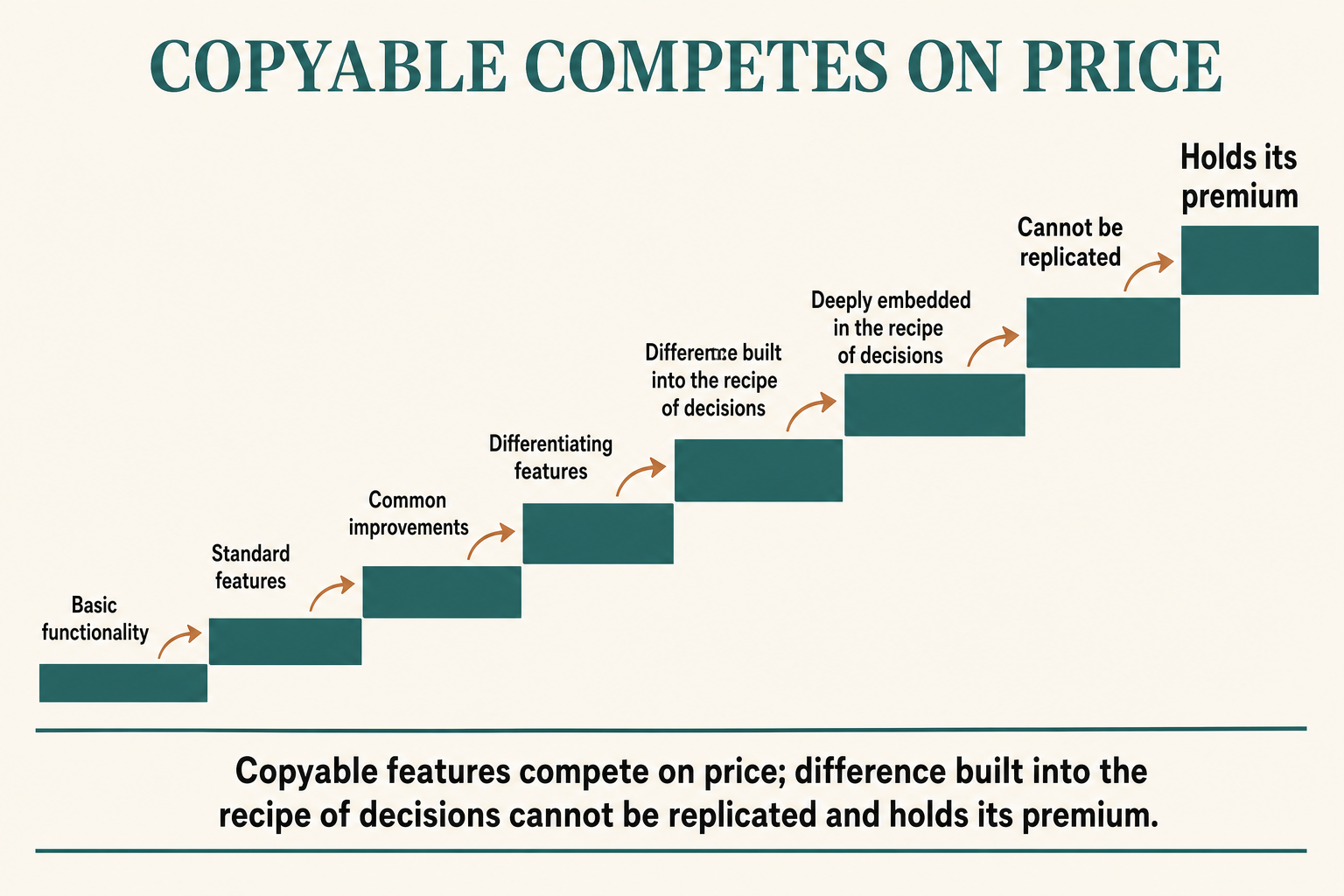
This is the test for whether a difference will hold. Ask whether a well-funded competitor could match it in a season. If the answer is yes, it is a feature, and features get matched. If matching it would require them to start over, you have built something that holds.
The upstream decisions are the ones that hold. Where people gather and where they break off into smaller groups. Where someone has coffee in the morning and where the group lands at sunset. The flow between inside and outside. The scale of the rooms relative to how a group actually moves through a weekend. These are decided before finishes, and they are nearly impossible to fix afterward.
Copyable difference lives in the dish. Durable difference lives in the recipe.
The cruel part is that the recipe costs more and shows less. Large common spaces, better sightlines, and real outdoor areas are not the cheapest way to build, and none of them photograph as a distinct line item. So they are exactly the things value engineering cuts first. The cut saves money on the build and costs you the only difference that would have held.
What a Group Actually Feels
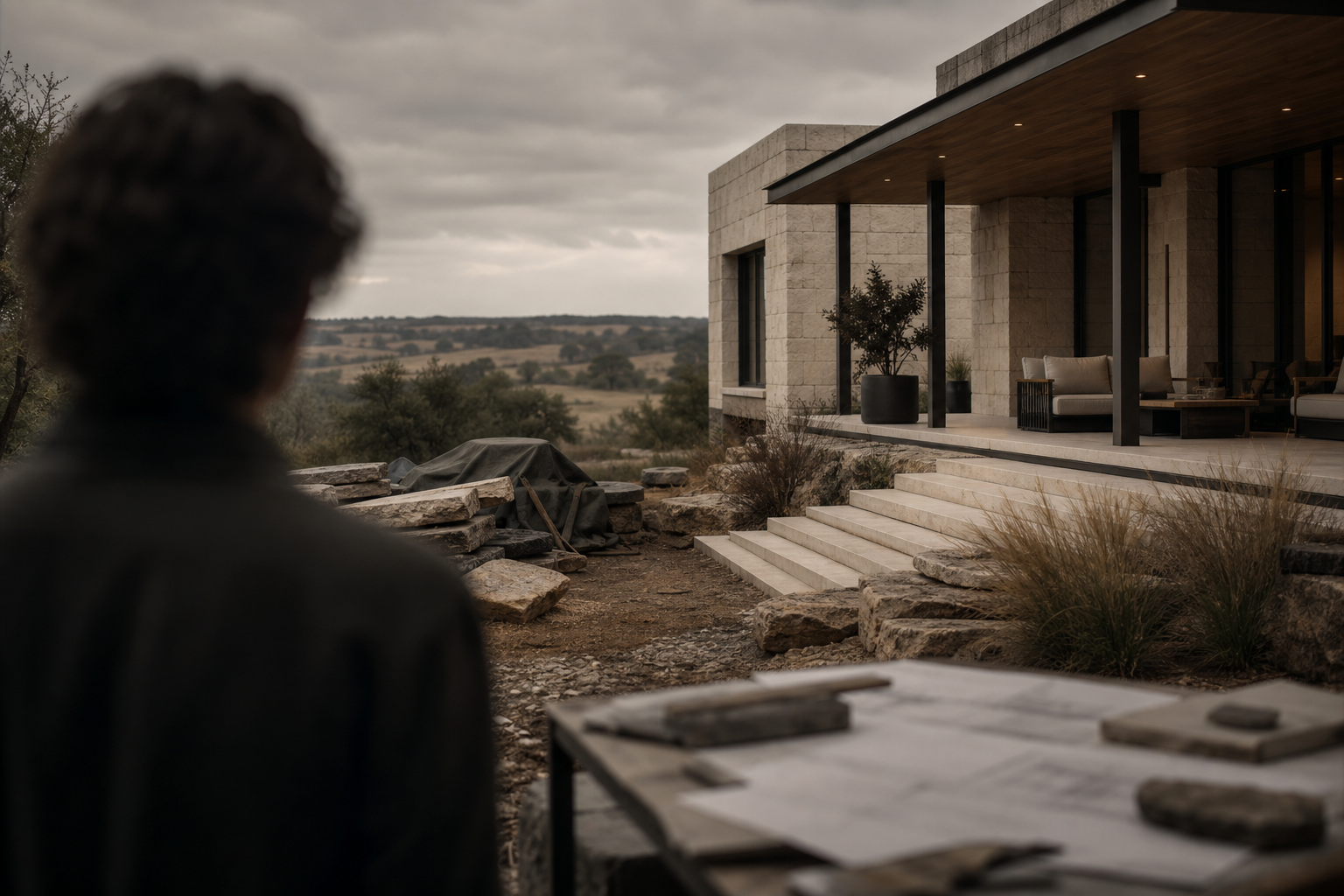
There is a property near Round Top, about forty acres, built around a single decision made before any finish was selected. Not how many bedrooms can we fit. How does a group actually use this place over a weekend.
That question drove everything. The layout, the pool area, the shared spaces, the scale. Where the group gathers, where the conversation splits into twos and threes, where the light moves through the living spaces toward the pool and the land at sunset. The materials were chosen to feel substantial where it mattered, so the place reads as permanent rather than themed. A guest may not know why a room feels right. They feel the weight and the intention.
The easy version was available the whole time. Big house, trendy furniture, call it a ranch retreat, lean on good photography. That version is a commodity. It depends on the photo because the experience does not hold up once people walk in.
The built version holds up at the moment that matters most, which is evening arrival. The property opens off the road, the house has a quiet presence, and the light moves through the place toward the land. Guests call it special, peaceful, different. It commands a rate well above comparable rural properties, because people are not renting bedrooms. They are renting a setting and a level of execution they cannot find in the comparison set.
People are not renting bedrooms. They are renting a setting they cannot find in the comparison set.
How to Tell If You Built a Dish or a Recipe
Before you break ground, and certainly before you let value engineering near the plan, work through these honestly.
- The season test. Could a well-funded competitor match your difference in one season? If yes, you built a feature, and you will compete on price.
- The photo test. Does your difference show up in the listing photos, or only on arrival? If it only shows in photos, it is copyable. If it only shows on arrival, protect it.
- The first-cut test. When the budget tightens, what gets value engineered first? If it is the sightlines, the shared spaces, and the outdoor areas, you are cutting the recipe to save the dish.
- The bedroom test. Did you design around how a group uses the place, or around how many beds you could fit? One produces a setting. The other produces a "sleeps twenty."
- The retrofit test. Of the things that make your asset special, how many could be added later? The ones that cannot are the ones that hold.
- The arrival test. Does the experience exceed the photo when guests walk in, or fall short of it? Falling short is the signature of a commodity dressed as a premium.
Spend upstream on the decisions a competitor cannot copy without starting over, and let the photo be the smallest part of what you sell.
The features get matched. The recipe is what keeps you out of the cage, and the cage is where price wins.