
Differentiation Has to Be Built Into the Asset
Two rural rental properties sit twenty minutes apart. Both have the big house, the pool, the long view, the trendy furniture. Both photograph beautifully. Both describe themselves as a luxury ranch retreat with the same five adjectives. One commands a rate well above the other and books the gatherings that matter, the retreats and the milestone weekends. The other competes on price and calendar gaps.
Walk the two and the difference is not in the listing. It is in where you end up standing at sunset, whether the group naturally breaks into smaller conversations or piles into one room, whether the place feels permanent or assembled. The first one was designed around how a group actually lives there over a weekend. The second was designed around how many beds it could fit and how well it would shoot.
Same adjectives. Different buildings.
The Adjective Trap
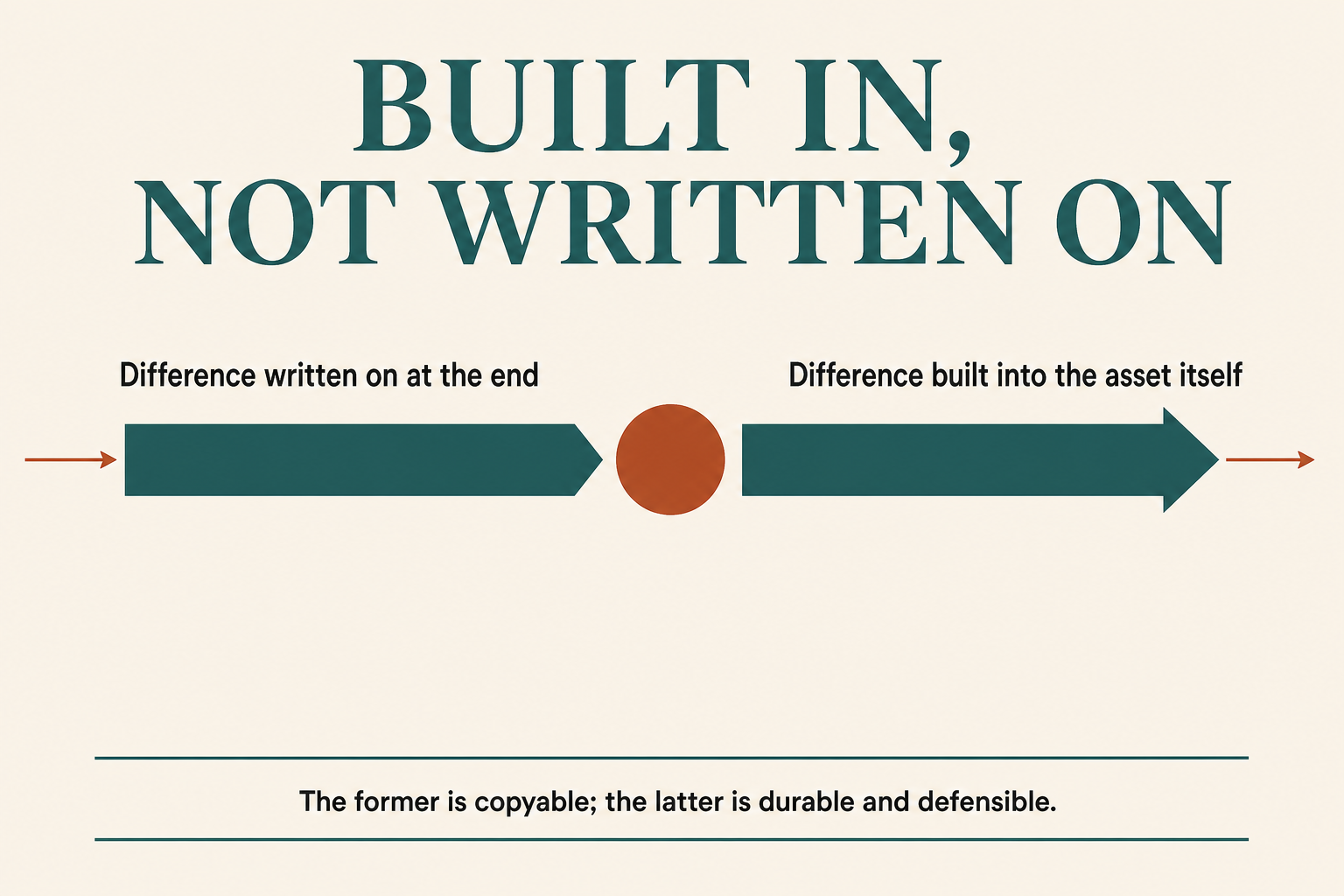
Most "differentiation" in a competitive market is written, not built. It lives in the copy, the brand language, the photography. It is the word luxury applied to a structure that was value-engineered toward the cheapest version of itself.
This is the say-do gap that runs through whole categories. Owners say they are different. What they actually built is the same thing everyone else built, finished a little nicer, described a lot better. The difference exists in the marketing layer, which is the one layer a competitor can copy by lunchtime.
A trendy sofa can be ordered. A good photographer can be hired. A tagline can be rewritten over a weekend. None of that is hard to match, which is exactly why none of it holds.
The trouble shows up after the guest arrives. The photos promised one thing; the experience delivers a slightly worse version of the same generic thing the competitor down the road also delivers. The owner is now defending a premium with adjectives the building cannot back up.
Difference that lives in the description is difference your competitor can copy by lunchtime.
Where Difference Actually Lives
Real differentiation lives in upstream decisions that are expensive to make and nearly impossible to reverse. It is built into the bones of the asset, before the finishes, before the photography, before the copy.
Start with the decision that sets everything else. You can design around the spec sheet, how many bedrooms, how many baths, the square footage that the comp set rewards. Or you can design around how a group actually uses the place: where they gather, where someone has coffee alone in the morning, where the group lands at sunset, where the space photographs without anyone staging it. The spec sheet is the cheap path and the copyable one. The use-pattern path costs more, because large shared spaces and clean sightlines and real outdoor areas are not the efficient way to put up a building.
The second decision is material. Real, substantial materials where they matter make a place feel permanent rather than themed. A guest cannot always name why a room feels better, but they register weight, texture, and intention. That is the part a competitor cannot reproduce by changing a vendor or restaging a shoot, because it was poured into the structure, not laid on top of it.
The third decision is the refusal. There is always an easy commodity version available: the big house, the trendy furniture, the good photography, call it done. It is cheaper, faster, and it tests fine in the listing. Refusing it means spending money on things that do not show up in a thumbnail and only reveal themselves once people are standing inside.
Notice what these three have in common. They are all made before anything visible exists. They are all costly. And they all become part of the asset rather than the message about the asset.
You cannot value-engineer the differentiation back in later; you can only build it in early or live without it.
What the Building Decides
Element Ranch, roughly forty acres near Round Top, was designed in exactly that order. Before a single finish was selected, the question was how a group lives there across a weekend. Where do twelve people gather, and where do three of them peel off to talk. Where does the morning coffee happen. Where does everyone end up when the light goes long.
That sequence drove the layout, the pool area, the scale, the indoor-outdoor connection. The large shared spaces and the sightlines and the strong outdoor areas cost more than the efficient floor plan would have. Those are also the exact things a guest feels without being told to feel them.
The sensory proof is the evening arrival. The property opens off the road, the house carries a quiet presence, and around sunset the light moves through the main living spaces out toward the pool and the land. Calm, private, elevated, not stiff. No staging required, because the building was arranged for that moment on purpose.
Guests respond emotionally. They call it special, peaceful, different. That reaction is not the photography working. It is the upstream decision being felt.
Guests rent a setting and a level of execution, not a count of bedrooms.
How to Tell If This Is You
The test is simple and uncomfortable. Strip away the copy, the brand, and the photography, and ask what is left that a competitor cannot reproduce in a quarter.
- Is your difference written into the asset, or written into the listing about the asset?
- If a competitor copied your photos and your tagline exactly, what would still separate you on arrival?
- Were your most expensive decisions made upstream, before finishes, or downstream in the visible layer?
- Does the experience hold up after the guest walks in, or does it quietly underdeliver against the photos?
- Which line items did you value-engineer out, and did you cut the differentiation with them?
- Can you name the specific moment your asset is built to deliver, the way sunset moves through a room?
- Are you charging a premium for decisions, or for adjectives?
If the honest answers point to the listing rather than the building, the premium is borrowed and someone will take it.
Anything you can describe, a competitor can copy; only what you built into the asset is yours to keep.
Difference written in later is decoration. Difference built in early is structure, and structure is the only kind that survives the comparison.