
Every Purchase Is a Career-Risk Decision
A purchasing manager at a refinery holds the sample valve and turns it over in his hands. The body is alloy, not cast iron. The machining is clean. He knows the product is better than what he runs today, and he knows the price is fair.
He sets it down on the desk and does not buy it.
Not because he doubts it. Because the line it would go into runs a corrosive, high-pressure service, and if that valve fails in the field, the question that follows will not be about the valve. It will be about him. Why did he put an unapproved part into critical service. Who told him he could.
The product was never the problem. The career was.
The Sale You Think You Won
Most sellers read interest as progress. The buyer leans in, asks good questions, takes the sample, and says he likes it. The room feels warm. Everyone walks out believing the deal is moving.
What the seller missed is that liking the product and being allowed to buy it are two different things, governed by two different systems.
One system is preference. It lives in the room, in the conversation, in the quality of the thing on the table. Sellers are good at preference, because preference is what a good presentation creates.
The other system is permission. It lives somewhere else entirely, usually downstream, usually invisible from the room where the selling happens. Permission is not about whether the buyer wants your product. It is about whether the buyer can absorb the consequence of being wrong.
In critical service, the consequence is not a return. It is an incident, a shutdown, an investigation with the buyer's name on the approval line.
Liking the product and being allowed to buy it are two different systems, and sellers are only good at one of them.
What the Buyer Is Actually Buying
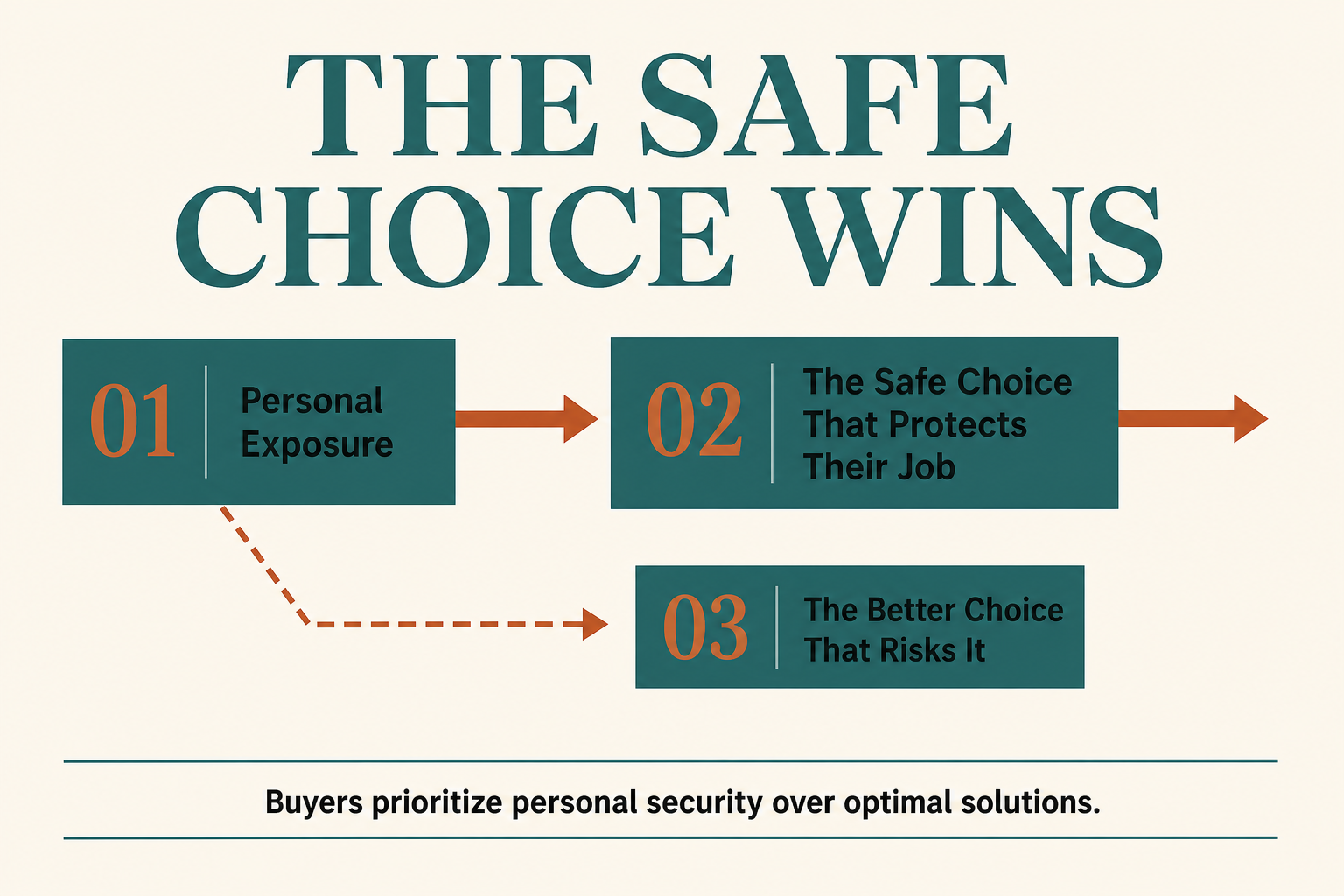
Step back from the transaction and look at what changes hands. The seller thinks he is selling a valve. The buyer is buying something else: a way to not be blamed later.
This is the part that does not show up on the spec sheet. Every purchase in a serious environment carries a second price tag, paid not in dollars but in exposure. The bigger the consequence of failure, the higher that second price, and the more the buyer needs cover before he can say yes.
Cover comes from process. An approved-vendor list, a qualification test, a sign-off from the end user, a paper trail that lets the buyer point and say the part met the standard and someone with authority agreed. Process is not bureaucracy for its own sake. Process is how a buyer transfers risk off his own shoulders.
So the structure under the sale looks like this:
- Preference decides whether the buyer wants you. This is real, but it is the easy half.
- Permission decides whether the buyer is allowed to act on wanting you. This is where deals stall.
- The gate is whoever owns the consequence of failure, and that party is rarely the person in the room.
Find the gate and you find the real sales motion. The mistake is to keep selling harder to the person who already agrees with you. He is not the obstacle. He is your ally, trapped behind the same fence you are.
The work is not more persuasion. The work is mapping the approval path and walking it, in order, before you count a single deal as live.
The buyer is not buying your product. He is buying a way to not be blamed when something goes wrong.
The Distributor Who Could Not Buy
I lived the cleanest version of this with a Mexican maker of specialty and alloy valves entering the U.S. These were not commodity valves. They were critical-service components, the kind an end user will not let into a line without prior approval.
We presented to a Fortune 500 distributor. The presentation landed. They were genuinely interested. The product was good and they could see it.
Then they told us to go get the valve approved by their customers, the end users, so that they could buy it.
Read that carefully. The distributor liked the product. The distributor still could not purchase it. The permission to buy did not live in that room. It lived downstream, with end users who gate critical parts because they own the consequence if the part fails in their plant.
The original instinct had been to treat market entry as door-knocking. Sell harder, see more buyers, push preference. But preference was never the constraint. The valve had won the room and the room could not act.
The real work was different and slower. Understand each end user's approval process. Follow it. Earn the spot on the list. Some of those approvals run months. Some run years.
The distributor liked it and still could not buy it, because the permission to buy lived downstream.
How to Tell If This Is You
Before you celebrate the next warm meeting, run the situation through these.
- The gate: Do you know who actually owns the consequence if your product fails, and is that person in the room when you sell?
- Preference versus permission: Have you confused the buyer wanting you with the buyer being allowed to buy you?
- The approval path: Can you name, in order, the steps between interest and a purchase order, or are you guessing?
- The timeline: Are you forecasting on sales-cycle math when the real clock is an approval cycle measured in months or years?
- The advocate's limit: Is your champion someone who can advocate but cannot approve, and do you know the difference?
- The wrong effort: Are you selling harder to someone who already agrees, instead of mapping the permission you still lack?
- The second price tag: Have you given the buyer the cover he needs to say yes, or only the reasons he already accepts?
No serious buyer will trade his own exposure for your margin, so sell to the system that grants permission, not just the person who grants preference.
The product winning the room is not the deal. The deal is the buyer being safe enough to sign.