
First to Answer Wins, Even With an Imperfect Number
A purchasing manager has three quotes on his desk for the same valve. Two arrived this morning. One arrived four days ago.
He does not compare them line by line. He glances at the old one, confirms it is in the ballpark, and picks up the phone to issue the PO.
The other two quotes were probably fine. Maybe one was even a little cheaper. It does not matter now. The desk is clear, the order is placed, and nobody upstream is asking him why the valve order is still open.
This is not a story about a lazy buyer. It is a story about what "fast" is actually worth, and why most companies price it at zero.
The Gap Between Quoted and Won
Ask a sales team what wins a deal and they will say price, spec fit, relationship. Ask them how long a quote takes to produce and they will shrug: a day, two days, depends on the manufacturer.
Nobody on the sales side thinks of turnaround time as a competitive variable. It is treated as overhead, the boring administrative lag between "customer asked" and "customer decided." The real competition, in their minds, happens in the number itself: the discount, the terms, the relationship.
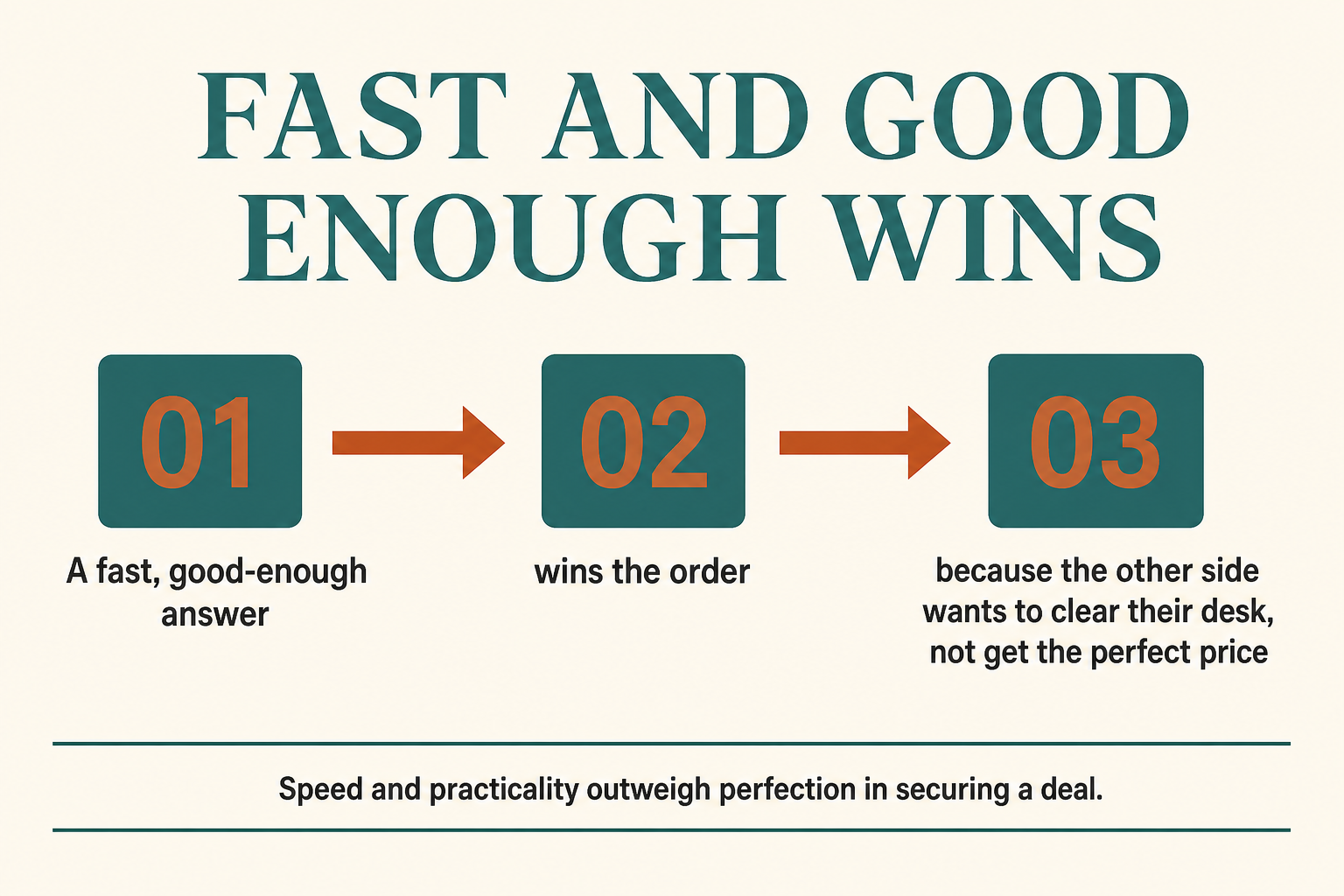
But the purchasing manager is not running a competition. He is clearing a queue. He has forty open requisitions and a boss asking why the valve order is still pending. The moment a credible quote lands, the incentive to keep shopping evaporates, because the cost of continuing to compare is higher than the cost of a slightly worse number.
The buyer is not optimizing for the best quote. He is optimizing for the last decision he has to make today.
Sales teams keep competing on the number. The number was never the constraint. The wait was.
Why Waiting Was Ever the Default
In specialty and alloy valves, every SKU is close to unique: a spec, a metallurgy, an application that shifts the price. That is exactly why quoting felt like it had to be slow. Somebody had to check with the manufacturer, confirm the spec cleared, wait for pricing to come back. Days, sometimes longer. The delay felt like diligence. It was actually just an unexamined default, inherited from a process nobody had gone back to question, because "checking with the manufacturer" sounded like the responsible thing to do every single time.
It is not the responsible thing to do every time. Most quotes are not novel. A given SKU, for a given customer type, has been priced before, at a price that held. The manufacturer confirmation was often a formality being executed as if it were a discovery.
The fix was not to negotiate a faster turnaround from the manufacturer. It was to stop asking the question when the answer was already known.
Answer From What You Already Know
A historical-pricing database, tracking actual quoted and won prices for every unique SKU, changes what "waiting for the manufacturer" means. If a SKU has cleared spec and pricing before, under similar terms, the company does not need permission to quote it again. It needs a record.
That record lets a quote go out in minutes instead of days. Not a guess. Not a placeholder. A real number, built off real history, sent while the buyer's desk is still open and the requisition is still active.
This only works with a deliberate posture: quote off the history, and clear it with the manufacturer after, not before. Ask forgiveness, not permission. The manufacturer confirmation still happens. It happens in parallel, as a backstop, instead of as a gate the customer has to wait behind.
The manufacturer's approval became a safety net instead of a gate.
That reordering is the whole insight. Nothing about the underlying process changed, the spec still gets checked, the price still gets confirmed. What changed is the sequence. The customer sees the answer first and the verification second, instead of the other way around.
When a Faster Wrong Answer Beats a Slower Right One
The instant-quote system was not built because the historical price was guaranteed correct. It was built because a historical price, delivered today, beats a perfect price delivered next week, in a market where the purchaser wants the first credible number more than the best possible one.
Occasionally the instant quote needed a correction after manufacturer confirmation came back. That cost was real, but small, a follow-up call, an adjusted invoice. It was never close to the cost of losing the deal to whoever answered first.
Speed was not a shortcut around the manufacturer's authority. It was a bet that most quotes do not need it in real time.
That bet paid off because of who was on the other end of the phone. Not a procurement department running a formal bid comparison, but one purchasing manager with too many open requisitions, whose real objective was never "find the optimal valve." It was "get this valve ordered so I can move to the next thing." First to answer, with a number he trusted enough to act on, won more often than slowest to answer with a marginally better one.
The system did not eliminate the manufacturer's role, or the salesperson's judgment on unusual specs. It removed the artificial wait on the ordinary ones, which was most of them, and let the company be first on the desk when it mattered most.
Where to Look First
Before deciding whether your business needs a faster answer or a better one, check the following:
- Where does your quote or proposal actually go after you send it, onto a desk that gets cleared fast, or into a genuine multi-bid comparison? These require different weapons.
- How much of your turnaround time is real diligence, versus inherited habit, a step nobody has re-examined since the process was first built?
- Do you have a record of what has already been decided, priced, approved, spec-cleared, that you are re-deriving from scratch every time instead of reusing?
- What is the actual cost of being wrong fast, a correction, a follow-up, versus the cost of being right slow, the deal going to whoever answered first?
- Is your approval step protecting against real risk, or just protecting the person who owns the step?
- Would your customer rather wait for your best number, or take a good number now and move on with their day?
The business that answers first, with a defensible number, usually beats the business that answers best, with a perfect one.
Perfect is a virtue when someone is comparing. It is a cost when someone just wants to be done.