
Fix It Before the Busy Season Finds It
Every warehouse has a version of the same document: a pick list, printed on paper, that tells someone which shelf to walk to next. In November, with a few hundred orders a day, the order of that list barely matters. A picker walks a slightly inefficient route, loses a few minutes, and nobody notices.
In December, the same list stops being a minor inefficiency and becomes the whole problem. The order was never designed for volume. It was designed for whenever someone happened to build it, back when volume was low enough that the design didn't matter.
Nothing about the list changed. The season changed, and the list could not survive contact with it.
The Warning Nobody Reads
Most operating problems do not appear out of nowhere in December. They exist in October, running quietly at low volume, disguised as tolerable friction. A slightly wrong pick order. A slightly slow authorization step. A slightly manual reconciliation at the end of the day.
At low volume, all of this is survivable. Staff absorb it. Nobody escalates it. It looks like the normal texture of running a business, not like a warning.
The instinct, understandably, is to wait. Fix things when they actually break. Don't spend time or money solving a problem that hasn't cost anything yet.
That instinct is exactly backwards, and it's worth being precise about why.
A problem that only shows itself under pressure will always show itself at the worst possible time.
Reading the System Before It Fails
The businesses that get hurt by seasonal spikes are rarely running a system that's fundamentally broken. They're running a system that was fine at last year's volume and was never re-tested against this year's.
That's a different diagnosis, and it points to a different fix. The question isn't "what's wrong with our operation." The question is "what's currently working only because volume hasn't stressed it yet."
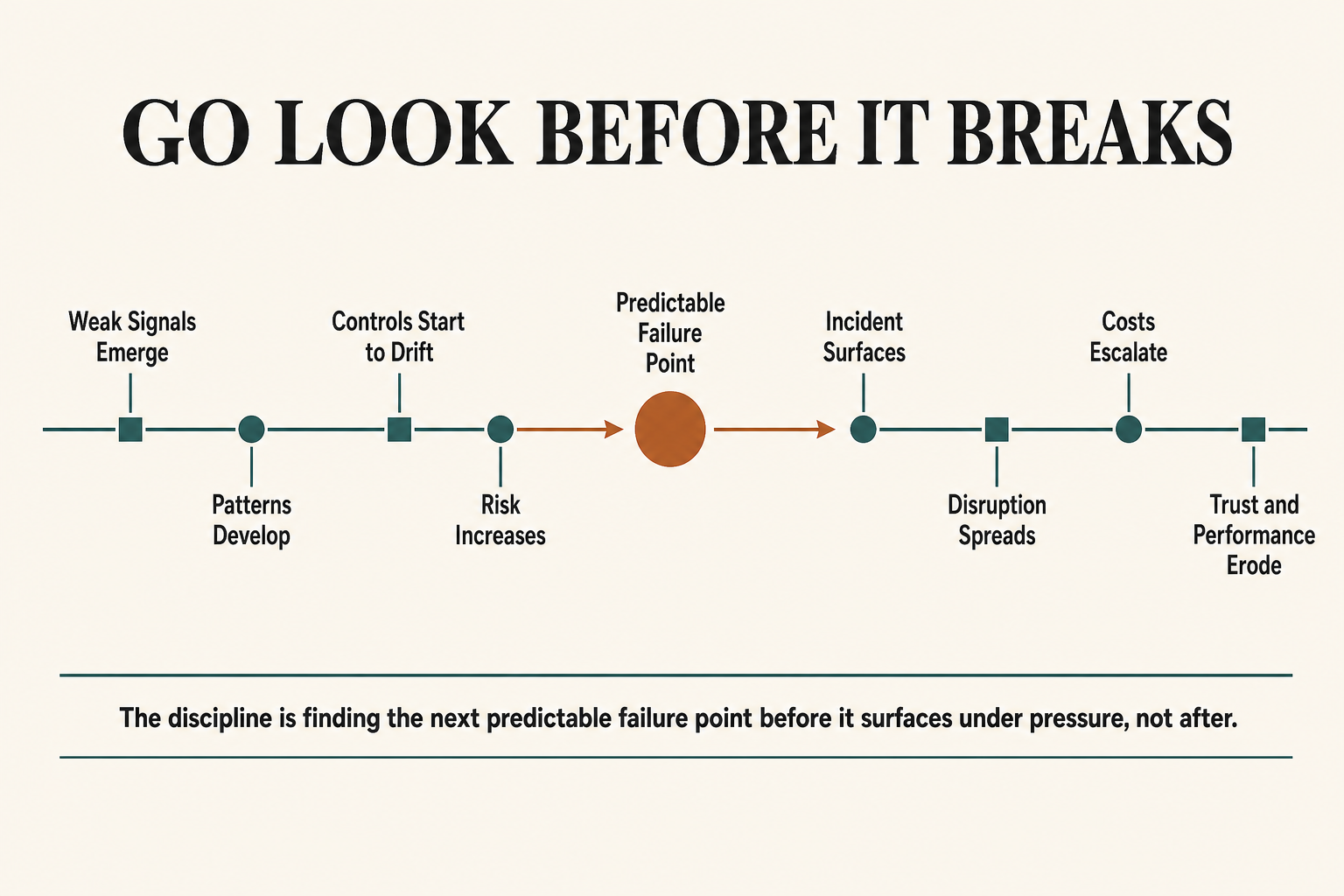
This requires a specific kind of attention, one most owners don't naturally practice. It means walking the floor, or the process, not looking for what's broken today, but asking where the next order of magnitude of volume would find the seam. Where does a process depend on a person remembering something. Where does accuracy depend on nobody being rushed. Where is there a single point that everything routes through.
Paper pick lists are a clean example of this kind of seam. A list on paper works because a person reads it, interprets it, and self-corrects when something looks off. That self-correction is invisible labor. It doesn't show up anywhere as a line item. It only becomes visible when the person doing it is moving too fast to do it anymore.
The system was never validating anything. A tired person was validating it, and nobody had priced that in.
Fixing this before the spike, rather than during it, requires believing that the spike is coming and specific enough to plan around, not just possible in the abstract. It also requires accepting that the fix has to be in place and working before volume arrives, which means the research, the decision, and the implementation all have to happen on the slow side of the calendar. There is no version of this where you diagnose the seam in the middle of the surge and fix it that same week. By the time the surge reveals it clearly enough to be undeniable, there isn't enough runway left to solve it properly.
The owners who do this well aren't smarter than the ones who don't. They've just made it a habit to go looking for the next predictable failure rather than waiting for one to introduce itself.
Finding the Fix Before the Order Volume Did
At MisterArt.com, running tens of thousands of SKUs through a warehouse built and run from scratch, the paper pick list was one of those seams. It worked fine most of the year. Pickers walked the floor, read the sheet, pulled what it said, and the error rate was low enough that nobody was worried about it.
The Christmas spike didn't introduce a new problem. It just multiplied the existing one until it was impossible to ignore. Order volume went up, pick lists came out in an order that made sense on paper but not on the floor, and pickers were moving fast enough that the informal self-correction that normally caught mistakes started missing them.
The fix wasn't exotic. It was first-generation Symbol scanners, the kind that could route a picker in an efficient sequence and then validate each pick by scanning the shelf label and then the item's UPC, so an error surfaced at the shelf instead of at the customer's door. It required research, a decision, and integration work, none of which happens instantly.
The detail that matters isn't the scanner. It's the timing. The fix went in before the next spike hit, not after the current one had already done the damage. That only happens if someone is treating the current strain as information about the next one, rather than as a one-time headache to survive and forget.
The scanner didn't make the system smarter. It moved the correction earlier, to where a mistake was cheap instead of where it was expensive.
That's the actual shift. Not smarter, not more advanced. Earlier. A shelf-then-UPC scan catches an error at the moment of the pick, for pennies. A pick list catches nothing; the customer catches it, at full cost, in a call to support during your busiest week.
Where to Look First
Before the next predictable spike, whatever form it takes for a given business, it's worth walking the operation with one question in mind: what's currently working because volume hasn't tested it yet.
- Where does the process rely on a person noticing something, rather than the system catching it?
- What currently runs through one person, one document, or one manual step with no backup?
- Where did last year's version of this season expose a seam that got patched with effort instead of design?
- What would break first if volume tripled overnight, and would anyone know before a customer told them?
- Is the fix for that seam something that can be researched and built now, on the slow side of the calendar?
- Who on the floor already knows where the friction is, and has anyone actually asked them?
The discipline isn't fixing what's broken. It's finding what's about to be.
Busy season doesn't create your weakest point. It just finds it, on schedule, every time. The only real choice is whether you find it first.