
Growth Exposes Whatever You Already Are
A warehouse in December tells the truth about a business in a way no quarterly review ever will.
Orders arrive faster than the floor can move. The pickers who looked competent in October now wander between aisles, paper lists in hand, hunting for a SKU that is three rows from where the list implies. Mistakes climb. Shipments slip. The phones light up with customers asking where their package is, and the answer is somewhere in a pile that nobody can see through.
Nothing about the people changed. Nothing about the product changed. The only thing that changed was the number of orders, and that number walked through the door and pulled the cover off everything underneath it.
This is what growth does. It does not introduce new problems. It enlarges the ones already there.
The Comfort Of Low Volume
Most businesses run for years on slack they never name. A process that wastes ten minutes per order does not hurt when there are twelve orders a day. A founder who personally fixes every exception is a feature when there are five exceptions a week. A handoff that depends on one person's memory works fine while that person is in the building.
These are not strengths. They are shortcuts that have not yet been tested at scale.
The owner reads the smooth months as proof the operation is sound. It is not proof of anything except low volume. The slack is absorbing the flaws, quietly, the way a half-empty road hides a bad merge lane.
Then demand arrives. The same flaws are still there, but now there is no slack to absorb them, and each one gets multiplied by the new volume. The ten wasted minutes per order, harmless at twelve orders, becomes a wall at four hundred.
Growth does not test whether you can sell more. It tests whether you built anything underneath the selling.
A System Has A Breaking Point Before It Has A Symptom
Here is the mechanism owners miss. Every operation has a point at which its current design stops working, and that point exists long before anyone feels it.
The system is not fine until the spike. The system was always going to fail at that volume. The spike simply arrived and found the number.
So the right question is never "are we handling the current load." Of course you are; you would not still be open otherwise. The right question is "at what volume does this specific design fall apart, and how far is that from where we are now."
Think of three layers in any operating business.
- The promise layer. What the front of the business tells the customer: we have it, we will ship it, it will be right.
- The capture layer. The machinery that turns a promise into a fulfilled order: the picking, the packing, the authorizing, the routing.
- The slack layer. The invisible buffer of human effort and low volume that covers the gap between the first two.
In quiet times the slack layer hides any weakness in the capture layer. The promise gets kept because someone runs across the warehouse, because the founder catches the error, because there is time. Growth does one thing with brutal consistency. It burns the slack layer to zero, and then the promise layer and the capture layer meet face to face with nothing between them.
The buffer that made you look ready is the first thing growth destroys.
If the capture layer cannot keep the promise on its own, the customer finds out at exactly the moment you have the most customers watching.
What The Christmas Spike Exposed
In 1996 we were running an online art-supply business with somewhere between forty and sixty thousand SKUs, every one digitized, photographed, and written up by hand. There was no Shopify, no Stripe, no playbook to copy. We had built the cart ourselves and written the code that drove the modems to reach the credit-card processors for authorization. Everything was home grown, in the literal sense of the word.
The selling worked. People came, people bought. And then Christmas arrived and the orders stacked up, and the part of the operation nobody had stress-tested came into full view.
We were printing paper pick lists. Worse, the lists were not even in an efficient pick order, so the pickers wandered the shelves chasing items in whatever sequence the system happened to spit out. At low volume this was invisible. At Christmas volume it was the whole problem.
The fix was not to push people harder. It was to change the machinery. We brought in first-generation Symbol barcode scanners, programmed to route the picker, tell them where to go and what to pull, and to validate each pick by scanning the shelf location and then the UPC. The wandering stopped. The errors stopped. The next spike met a system built to take it.
The demand was never the problem. The demand was the audit.
How To Tell If This Is You
You will not learn your breaking point from a good month. You learn it by looking, on purpose, before the volume does the looking for you.
- The slack audit. List every part of your operation that currently works because one person catches things, runs faster, or remembers. Each one is a flaw your volume is hiding.
- The 3x test. Picture three times your current order volume next quarter. Name the first thing that breaks. If you cannot name it quickly, you have not looked.
- The handoff check. Walk one order from sale to delivery and mark every step that depends on memory rather than design. Those are your wandering pickers.
- The promise gap. Write down what the front of your business promises customers. Then ask whether the back of your business can keep that promise with no extra effort. The gap is where growth will hurt.
- The tool question. Where are you spending human effort to paper over a process problem? That effort is the symptom. The process is the disease.
- The proof question. What evidence do you actually have that you are ready, beyond the fact that you have not failed yet at this size?
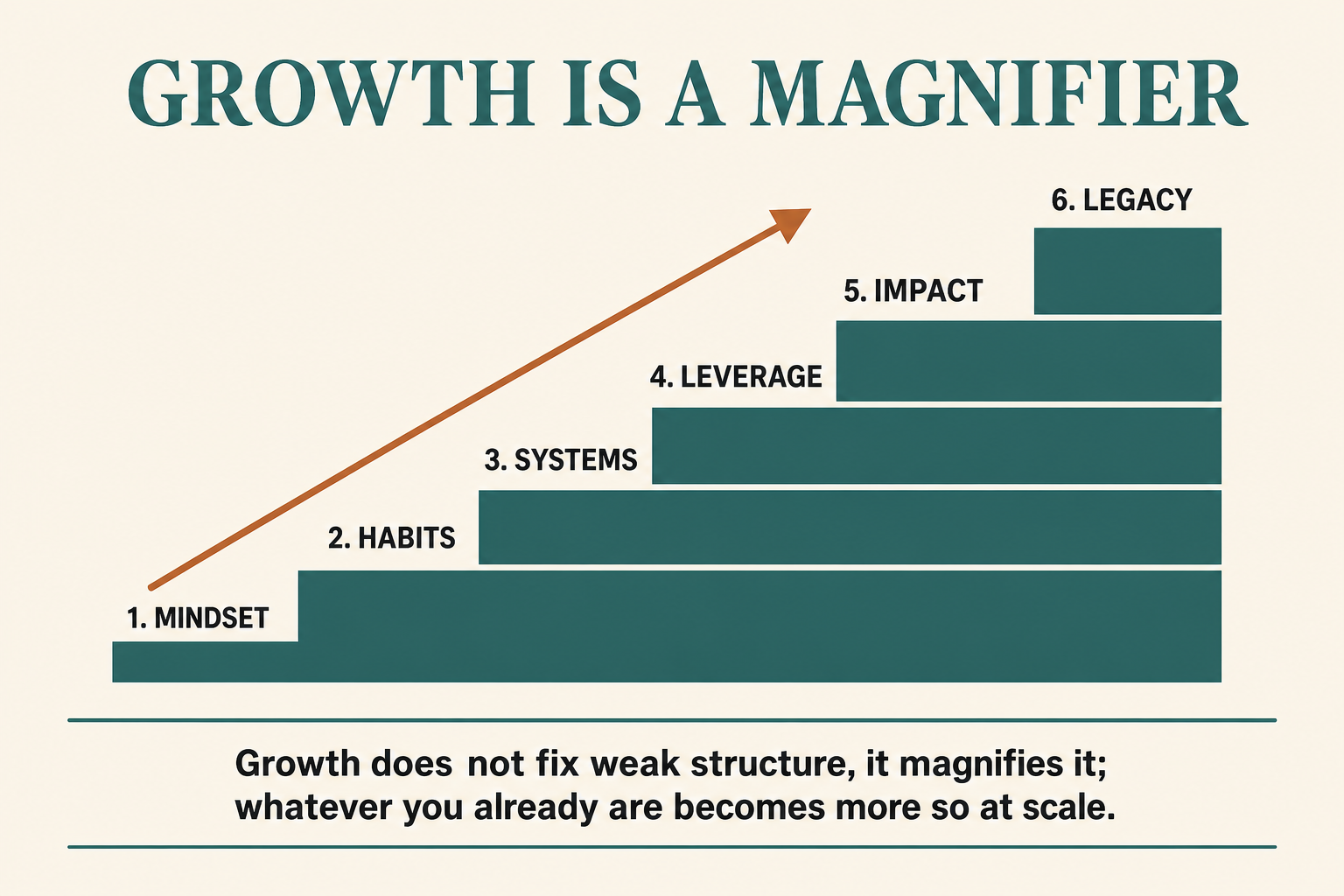
Growth is not a strategy. It is a magnifier, and it enlarges whatever you already are.
Build the system before the demand arrives, because demand does not wait for you to be ready, and it shows no mercy to the parts you never tested.