
Leverage Before Labor
The order volume tripled in three weeks. The instinct, sitting in that chair, is to hire. More orders means more hands, and more hands means the work gets done. It feels obvious. It feels responsible.
So the floor fills with temporary pickers, and the orders still go out late. Now there are more people, more confusion, and more payroll, and the bottleneck has not moved an inch. The owner looks at the chaos and concludes he needs even more help.
He has misread the problem entirely. The work was never short of hands. It was short of structure. What looked like a capacity problem was a design problem wearing a capacity costume, and throwing labor at it made the design problem more expensive without making it any smaller.
The Reflex That Hides The Real Issue
When output falls behind demand, the first explanation an owner reaches for is people. Not enough of them, or not good enough. It is the explanation that requires the least thought and the most money.
It is also the one that lets everyone off the hook. If the problem is headcount, then nobody designed anything badly. You just grew faster than you staffed. That is a comfortable story, and comfortable stories are the ones worth distrusting.
The trouble is that a broken process does not improve when you add people to it. It scales. Every inefficiency you had with five workers, you now have with fifteen, and you are paying three times as much to reproduce the same waste. The mess does not get solved. It gets multiplied.
A broken process does not improve when you add people to it. It scales.
The honest test is uncomfortable. Before you hire, you have to ask whether your current people, doing the work as it is currently designed, are actually being used well. Most of the time they are not. They are wandering, waiting, redoing, and walking. And no amount of new hires fixes walking.
What Leverage Actually Means
There are two ways to get more output from a process. You can add input, which means more people, more hours, more money. Or you can increase leverage, which means each person and each hour produces more without working harder.
Leverage is the better answer almost every time, and owners reach for it almost last. It is less visible than a hire. You cannot point to it on the floor. But it compounds in a way that headcount never does, because once the process is fixed, every future person you add inherits the improvement instead of inheriting the mess.
Here is the distinction that matters.
- Labor is linear. Double the people, roughly double the output, double the cost. The ratio stays flat.
- Leverage is structural. Fix the routing, the validation, the sequence, and the same people produce more at the same cost. The ratio shifts permanently.
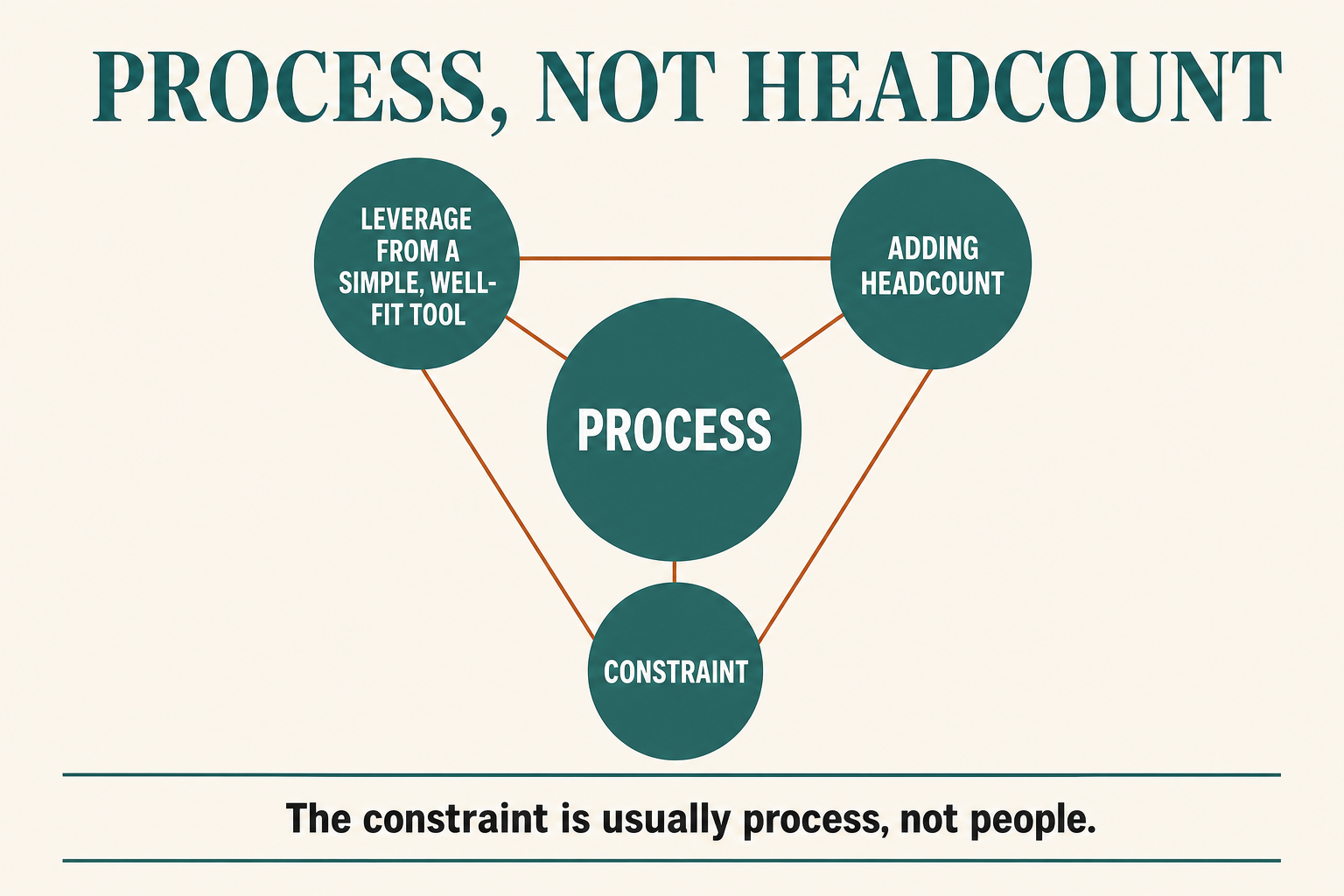
The reason owners default to labor is that labor is fast to deploy and easy to understand. You post the job, you fill the seat, you feel like you acted. Leverage requires you to stop, study the actual mechanics of the work, and find the specific point where effort leaks out. That is slower and it feels less like progress. It is the higher-return move anyway.
Once the process is fixed, every future person you add inherits the improvement instead of inheriting the mess.
The question to sit with is not "how many more people do I need." It is "where is the work being wasted right now, and would another person waste it too." If the answer is yes, hiring is the wrong tool. You are about to pay to scale your worst habit.
The Christmas That Exposed The Machine
In 1996 I was running an online art-supply business with somewhere between forty and sixty thousand items in the catalog, every one of them digitized, photographed, and written up from nothing. There was no Shopify, no Stripe, no template to follow. We had built the cart ourselves and written code to drive modems out to the credit-card processors for authorizations. Everything was home grown.
Then Christmas came, and the demand spike pulled the cover off the fulfillment floor. We were printing paper pick lists, and the lists were not even in an efficient pick order. So the pickers wandered. They crossed the warehouse, doubled back, hunted for locations, and burned most of their hour walking instead of picking.
The easy read was that we needed more pickers. We did not. We needed the pickers we had to stop walking in circles.
The fix was first-generation Symbol barcode scanners, programmed to route each picker, telling them where to go and what to pull, and to validate every pick by scanning the shelf location and then the item's code. The walking collapsed. The errors collapsed. The same people, doing the same job, cleared far more orders the next time the spike hit.
We did not need more pickers. We needed the pickers we had to stop walking in circles.
We had not bought labor. We had bought leverage, and it paid forward into every season after.
How To Tell If This Is You
Before you open a job posting in response to a backlog, run through these. They separate a real capacity shortfall from a process problem hiding behind one.
- Watch the actual work. Spend an hour on the floor and count the minutes your people spend producing versus walking, waiting, searching, or redoing. If most of the hour is the second kind, you have a design problem.
- Ask where the rework comes from. Errors that get caught and fixed downstream are leverage leaking out. More people will produce more errors, not fewer.
- Check whether the sequence is designed or accidental. Did someone lay out the order of operations on purpose, or did it just accrete? Accreted processes are almost always inefficient.
- Test the tool question. Is there a tool, a layout change, or a validation step that would let the current team do more without working harder? If yes, try it before you hire.
- Find the bottleneck before you feed it. Adding people upstream of a bottleneck just grows the pile in front of it. Locate the real constraint first.
- Ask what each new hire inherits. If you hired tomorrow, would they step into a clean process or a broken one? You are about to replicate whatever they inherit.
Fix the process first, because labor scales whatever you point it at, and you do not want to point it at a mess.
The hire may still come. But it should come after the structure is sound, when each new person inherits leverage instead of chaos. That order is the whole difference.