
Motion Is Not Progress
Walk a warehouse during a demand spike and you will see effort everywhere. Pickers moving fast. Phones ringing. A manager with a clipboard calling out numbers. The floor looks alive, and everyone in it feels productive, because they are tired and they are moving.
Then you look at the orders that shipped on time, and the number is lower than last week. Not because anyone slacked. Because the motion and the result had quietly come apart, and nobody noticed, because being busy felt like the same thing as getting it done.
It almost never is. Activity is the easiest thing in a business to generate and the easiest thing to mistake for traction. It produces sweat, noise, and the comforting sense that the team is fighting hard. None of that is the same as moving the number you actually care about.
When Busy Hides the Bottleneck
Here is the trap. When volume rises, the first instinct is to push harder on the system you already have. More hours, more people on the floor, more urgency in the morning meeting.
That works right up until the system itself is the problem. Then every extra hour goes into a process that was never built to carry the load, and the harder you push the more motion you generate per unit of actual output. The team works longer and ships less per hour, and the gap between effort and result widens precisely when you are trying hardest to close it.
The reason owners miss this is that effort is visible and structure is not. You can see a person walking fast. You cannot see that the path they are walking is twice as long as it needs to be.
So the diagnosis goes wrong. The owner looks at flat output during a period of obvious hard work and concludes the team needs to want it more, or needs more bodies. Both add motion. Neither touches the thing that is actually capping the result.
Effort is visible and structure is not, so the owner blames the people and leaves the bottleneck untouched.
Separate the Number From the Noise
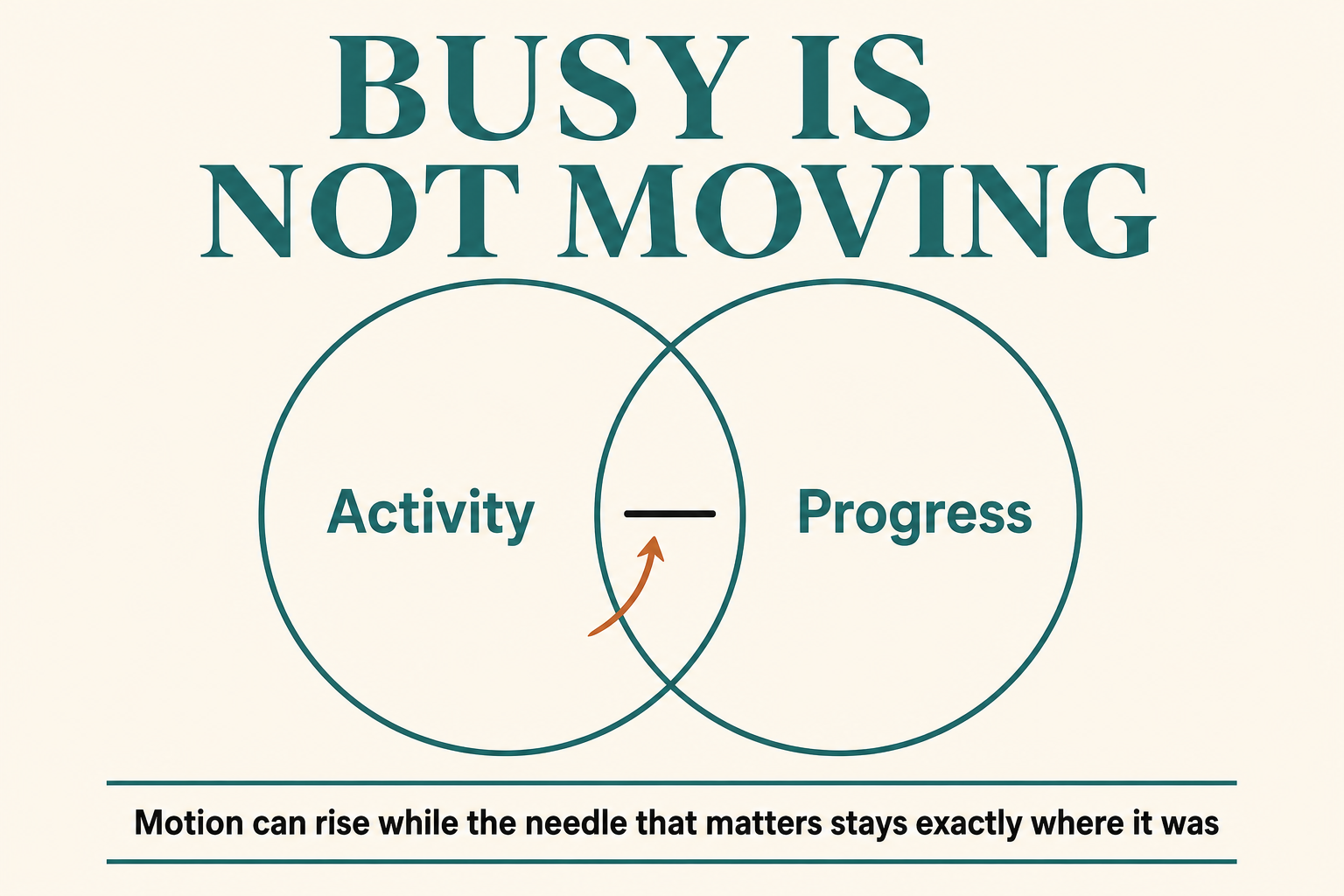
The fix starts by refusing to read activity as progress at all. Treat them as two completely different measurements, because they are.
Activity is what the team does. Progress is what the customer receives. Between those two sits the machinery of your business, and that machinery either converts motion into output efficiently or it bleeds most of the motion away as wasted steps. The job of an owner is to look straight at the conversion, not at the motion feeding into it.
Three questions pull the real picture apart from the noise.
First, what is the unit of progress here? Not "we were slammed all day." Orders shipped accurate and on time. Approved drawings returned. Whatever the customer is actually waiting on. Name it precisely or you will measure the wrong thing.
Second, where does the motion go to die? Find the step where work piles up and waits. The constraint is rarely where the noise is loudest. It is usually upstream of it, quiet, and being fed by people working hard in front of it.
Third, is more effort or a better path the answer? If the same number of people, routed better, would clear the work, then adding bodies just adds expensive motion. The tool or the sequence is the leverage, not the labor.
Activity is what the team does. Progress is what the customer receives. The two are not the same measurement.
This is uncomfortable, because it means the hardest-working day can be the least productive one, and the team that looks heroic might be heroically compensating for a structure you never fixed. The heroism is real. It is also a signal you have been reading the wrong number.
The Christmas Floor in 1996
I lived the cleanest version of this running an art-supply catalog online in 1996, back when there was no Shopify, no Stripe, no playbook. We had built everything ourselves, down to the code that drove the modems to reach the credit-card processors for authorizations. Forty to sixty thousand SKUs, every one digitized, photographed, and copywritten from nothing.
Then Christmas hit, and the front of the business worked beautifully. Orders poured in. The machinery behind them did not.
We were printing paper pick lists, and the lists were not even in an efficient pick order. So the pickers wandered. They walked the building, backtracked, hunted for a shelf, walked again. Everyone was moving constantly and the floor looked like a full-tilt operation under pressure.
But the motion was the problem. Every wandering step was effort that produced no shipped order. Adding more pickers would only have put more people walking the same bad path, more bodies generating more motion against the same wall.
The answer was not more effort. It was a better path. We brought in first-generation Symbol scanners, programmed to route the picker, tell them where to go and what to pull, and to validate each pick by scanning the shelf location and then the UPC. The work stopped being a hunt and became a sequence.
We did not need people to walk faster. We needed them to stop walking the wrong way.
How to Tell If This Is You
Before you add hours, bodies, or pressure to a system under strain, check whether you are funding progress or just funding motion.
- Can you name the one unit of progress that matters this week, separate from how busy everyone felt?
- When output went flat, did you add effort before you found the bottleneck?
- Is the loudest, most visible scramble actually where work piles up and waits, or just where the noise is?
- If you froze headcount and only fixed the path, how much of the current effort would survive as waste?
- Are your best people being heroic because the structure forces them to be?
- When was the last time you measured shipped result per hour worked, not just hours worked?
- Does the tool exist that would route the work, and are you avoiding it because the team is "managing"?
Before you spend on more motion, find out where the motion you already have goes to die.
A busy floor is not a verdict. The number the customer receives is the only one that counts, and it does not care how hard the day felt.