
Not Every Bottleneck Deserves a System
Every owner has felt the same itch. Something is slow, or manual, or annoying enough that someone says out loud, "we should build a tool for this." Sometimes that instinct is correct, and the tool becomes the reason the business wins. Sometimes it is just an expensive way to avoid a small, boring inconvenience that was never actually costing anything.
The two situations feel identical from the inside. Both show up as friction. Both generate the same complaint in the same tone of voice. The difference between them has nothing to do with how annoying the friction feels, and everything to do with what happens downstream of it.
Two Frictions, One Instinct
A specialty valve quote sits in someone's inbox. A salesperson is waiting on the manufacturer to clear a spec and confirm a price on a unique SKU. The purchaser on the other end has three other vendors circling the same job.
That purchaser is not going to wait. Purchasers are lazy in the specific, professional sense: given a workable quote now, most will issue the PO and move on rather than hold out for a marginally better number next week. The vendor who answers first often wins, not because the price was lowest, but because the desk got cleared.
A guest at a rental property wants the pool heated before dinner. A different kind of friction. Nobody loses the booking over it. Nobody down the hall is racing to heat a competing pool faster.
Both are bottlenecks. Only one of them is a competitive weapon.
A bottleneck that costs you the deal is not the same problem as a bottleneck that costs you a few minutes of goodwill.
What Actually Justifies The Build
The instinct to build software is almost never wrong about the existence of friction. It is frequently wrong about the value of removing it. Before a system gets built, three questions do the real work, and they have nothing to do with how much anyone hates the current process.
The first question is whether the delay changes the outcome. Not whether it's annoying. Whether, if the delay shrinks from days to minutes, someone wins something they would otherwise have lost. In a market where the first workable quote tends to close the deal, shaving days off a quote turnaround is not an efficiency gain. It is a different win rate.
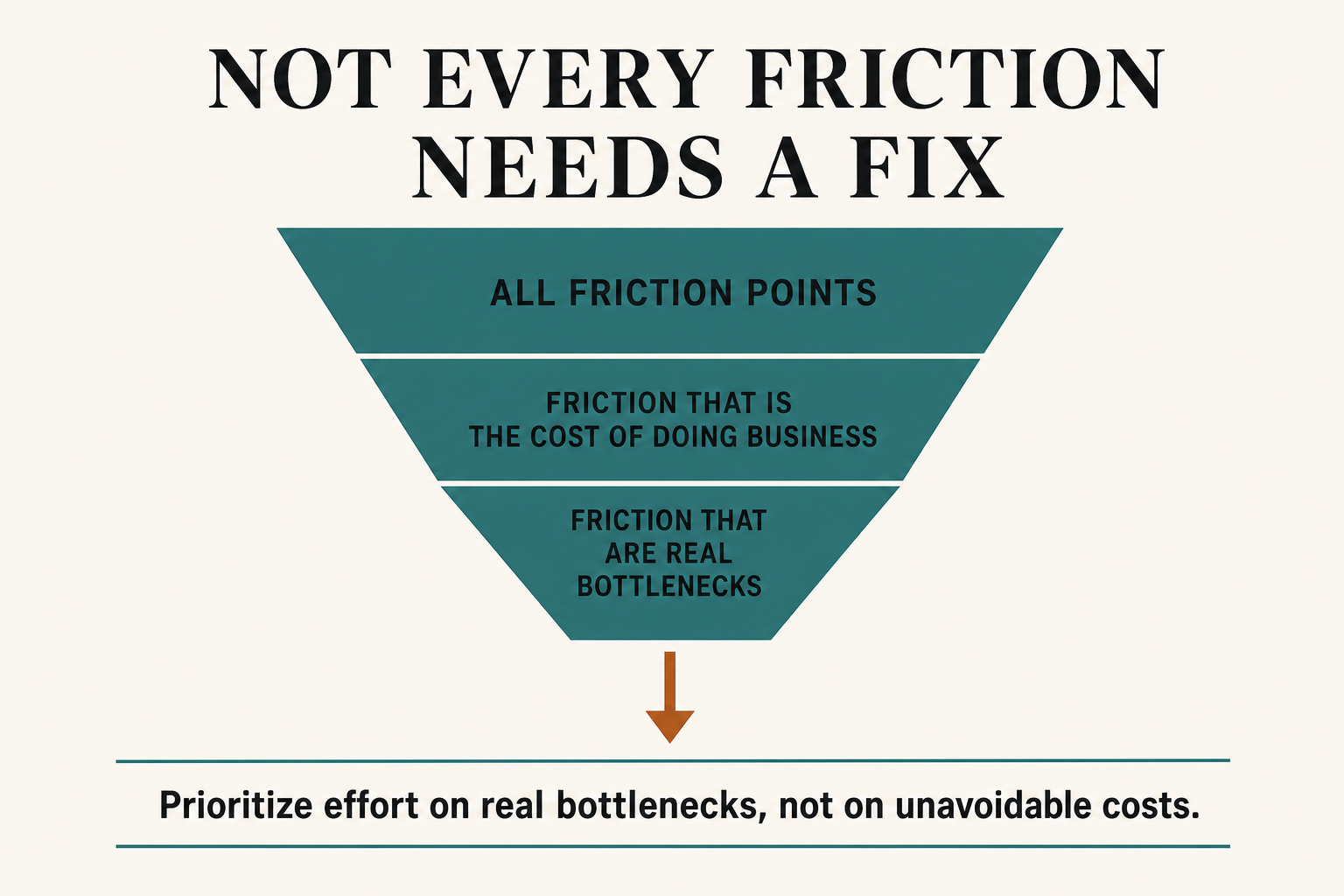
The second question is whether the bottleneck happens often enough, and consistently enough, to be worth encoding. A rare, tolerable annoyance does not justify a system built to remove it. A frequent, structural one does. The valve quoting problem was not occasional; it hit every salesperson, on every unique SKU, on every deal, all day. That is the volume that pays back an investment in software. A once-a-week pool request from a guest does not carry the same math, no matter how satisfying it would feel to solve it with an app.
The third question is who is actually blocked, and by what. At the valve company, the block was structural: nobody, no matter how capable, could quote instantly without historical pricing at hand, because the information genuinely did not exist anywhere accessible. That is a system problem. When the block is really about attention or habit, a checklist or a better calendar fixes it. Software built to solve a discipline problem usually just becomes an expensive way to store the discipline problem.
If the delay doesn't change who wins, you're not looking at a bottleneck worth engineering around.
Put those three questions together and a rule falls out that is easy to state and hard to actually follow, because it cuts against the satisfaction of building: build where speed compounds into an outcome that matters, buy or configure where the friction is real but bounded, and leave alone where the friction is just the ordinary cost of running a business that deals with humans.
Where The Line Actually Sat
The valve quoting system got built because the case was airtight on all three questions. A historical-pricing database, tied to a custom CRM, let the company issue an instant quote off known pricing instead of waiting on the manufacturer to respond, sometimes days later, to confirm a number on a SKU that had already sold at that price before. The system enforced business rules and sent reminders so nothing stalled in someone's inbox. It operated on the belief that it is better to ask forgiveness than permission, because the alternative, waiting for the manufacturer's blessing on every quote, guaranteed losing the deals that mattered most: the ones where the purchaser wanted to move today.
Contrast that against a working rental property's back office. Guest inquiries need routing. Marketing needs automation. A CRM needs to track who stayed, when, and what they liked. All of that friction is real. None of it is unique enough to justify custom software. GoHighLevel handles marketing, automation, and CRM at the property, configured carefully rather than built from nothing, because the problem it solves is common across thousands of businesses that are not valve distributors racing a purchaser's attention span.
The valve quote had to be fast because someone else was also being fast. The pool schedule just had to work.
The property did build one thing custom: a Home Assistant integration that let guests control the pool, lighting, and fire pits themselves. That was worth building, not because it removed a painful bottleneck, but because it replaced staff intervention with something that felt more seamless to the guest and set the property apart. Different justification, same discipline: ask what the build actually buys before reaching for the tool.
Where To Look First
The temptation to build almost never announces itself as a mistake. It shows up dressed as diligence, as "we should just fix this properly." The businesses that avoid wasting money on the wrong system are the ones that interrogate that instinct before funding it.
- Does the delay change who wins, or does it just change how satisfied someone feels about the process?
- How often does this friction actually occur, measured honestly, not by how loudly the last complaint was made?
- Is the block structural, meaning nobody could solve it faster with better information, or is it really about attention and habit?
- Would a well-configured off-the-shelf tool solve 90 percent of this for a fraction of the cost and none of the maintenance?
- Does removing this friction let the business win a deal, a guest, or a margin it would otherwise lose?
- If a competitor never solves this, would they actually be at a disadvantage, or just mildly less polished?
The discipline is not knowing how to build. It is knowing when the friction is actually costing you the thing you can't get back.
Most bottlenecks are just the weather. A few are the business. Tell the difference before you write a line of code.