
Positioning Is a Decision You Are Already Making
A buyer in your category has already placed you. Before you sent the deck, before you tuned the website, before you argued about your tagline in a conference room, they sorted you into a box: cheap and reliable, expensive and worth it, the safe default, the one nobody got fired for picking, the one you call when the real supplier is out of stock.
You did not approve that placement. You may not even know what it is. But it is doing work right now, in conversations you are not part of, shaping what people are willing to pay you and how hard they push back on price.
Most owners think positioning is something you do later, after the product is built and the doors are open. They treat it as a marketing layer. It is not a layer. It is the consequence of every choice already made.
The Gap Between Strategy And Default
Ask an owner what their positioning is and you usually get an adjective. Premium. Trusted. High quality. Customer focused.
Those are not positions. They are hopes.
A real position is where you actually sit in the buyer's mind relative to the alternatives, and the buyer decides that, not you. They decide it from evidence: your price, your lead time, how you answer the phone, what your delivery looks like when it arrives, whether the thing holds up after they install it.
Here is the trap. An owner can decide nothing, choose the cheapest version of every input, ship the most generic possible offer, and still end up positioned. The market will not leave the slot empty. It fills it for you, and it almost always fills it at the bottom, because the bottom is the default for anything that did not earn a higher place.
The market never leaves your slot empty; it fills it for you, usually at the bottom.
That is the say-do gap most owners never see. They say they are premium. Every decision they made was the cheap one. The buyer trusts the decisions, not the adjective.
Positioning Lives In The Build, Not The Brochure
Start with the mechanism. Where does a position actually come from?
It comes from accumulated decisions a buyer can feel. Not what you claim, but what you chose when each choice had a cost. Cheaper material or the one that holds weight. A layout that fits the most units or one built around how the thing is actually used. A response that goes to a queue or a person who answers.
Every one of those is a small vote. The buyer adds them up without being asked to. By the time they form an opinion of you, you have already cast every vote that matters.
This is why positioning cannot be bolted on afterward. The expensive decisions that create a defensible position are upstream decisions, made before the brochure exists, often before the product exists. They are also the decisions that look easiest to cut.
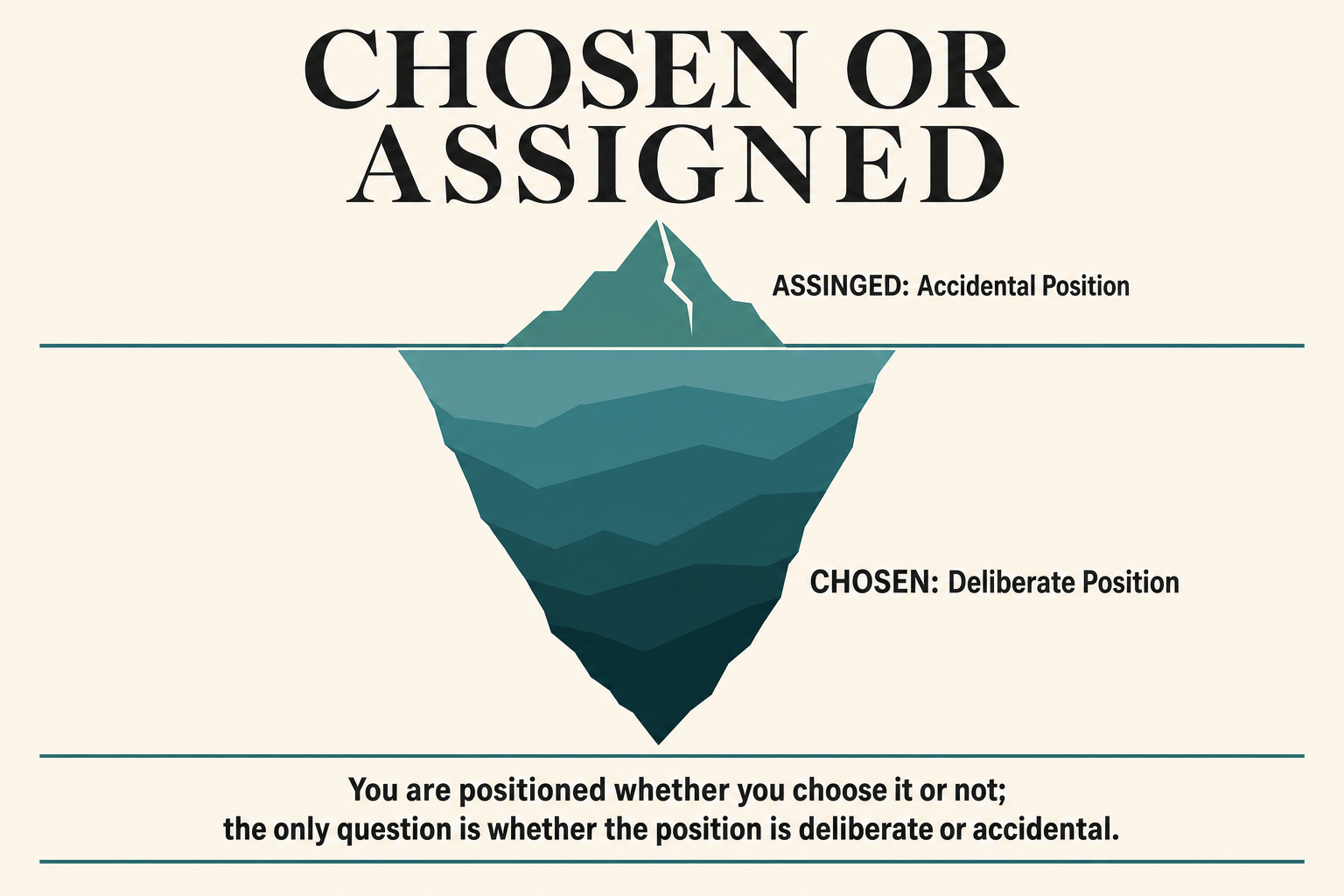
Think of it as two layers. The visible layer is what you say about yourself: the words, the photos, the claims. The structural layer is what you actually built: the materials, the design choices, the operating standard, the things that cost more and do not photograph. The visible layer can borrow a position for one transaction. The structural layer is the only thing that holds it once the buyer has the product in hand.
The danger is that the two layers can disagree for a while. Good photography and a confident claim can sell a commodity as a premium good, once. Then the buyer arrives, or installs, or uses it, and the structural layer speaks louder than the brochure ever could.
You can borrow a position for one transaction; you can only own the one you built.
So the real question for an owner is not "how do we describe ourselves." It is "what have we already decided, and where do those decisions place us." If the honest answer is that you took the cheap path at every fork, no amount of language moves you. You are positioned where your decisions put you. The work is to decide the position first, then make every downstream choice serve it, and refuse the value-engineering cut that quietly drags you back to the default.
What A Group Feels At Sunset
Consider a property built as a luxury retreat near Round Top, Texas. The easy version was obvious: a big house, trendy furniture, call it a ranch retreat, hire a good photographer, list it. That version is a commodity. It depends entirely on the photos, and it falls apart the moment a group walks through the door and senses that the place is thinner than the listing promised.
The harder path started upstream, before any finish was chosen. The design began with how a group actually uses a place over a weekend. Where they gather. Where someone has coffee alone in the morning. Where the whole group lands at sunset. That drove the layout, the shared spaces, the pool area, the scale.
Then the refusal that cost money. Real, substantial materials where they mattered, so the place felt permanent instead of themed. Guests cannot name why a room feels better. They feel weight, texture, intention. That is hard to fake after the fact and impossible to add in editing.
The position was decided in those choices, not in the listing copy. Guests arrive in the evening, the property opens off the road, and the light moves through the living spaces out toward the pool and the land. They call it special, peaceful, different. It commands a rate well above comparable rural properties.
They are not renting bedrooms; they are renting a decision made long before they arrived.
How To Tell Where You Actually Sit
Run these against your own business before you touch your messaging.
- The adjective test: when you describe your position, do you have an adjective or a list of decisions a buyer could verify? If it is an adjective, you do not have a position yet.
- The borrowed-versus-built test: does your position survive the buyer actually using your product, or does it live only in the brochure and the first conversation?
- The fork test: at the last five decisions where the cheaper option was available, which one did you take, and what do those five choices say about you?
- The default test: if you decided nothing today, where would the market place you? That is your real starting position, and it is probably lower than you think.
- The cut test: what upstream cost are you about to value-engineer away, and is it the exact thing your position depends on?
- The evidence test: would a buyer reach your claimed position from the evidence alone, without you explaining it?
You do not get to choose whether you are positioned. You only get to choose whether you did it on purpose.
The owners who win the premium slot decided it upstream and paid for it in choices nobody sees. Everyone else inherited a slot, and it was the cheap one.