
Preference Is Not Permission
A purchasing manager at a refinery holds a specialty valve and turns it over in his hands. He likes the casting. He likes the alloy. He likes the price against what he is paying now. He would buy it tomorrow if the decision were his to make.
It is not his to make.
Somewhere upstream of him is a list, an approved vendor list, and the valve is not on it. Getting on it is not a sales conversation. It is a process with steps and gatekeepers and a clock that runs in months, sometimes years. Until that process finishes, his preference is worth nothing in the only sense that matters. He cannot issue the order. The want is real and the want is stuck.
Most sellers never see this wall, because the people who like the product are rarely the people who clear it.
The Trap Of The Warm Room
A good presentation produces a warm room. People lean in, ask sharper questions, start picturing the product in their own operation. The seller reads the warmth correctly. The product is wanted.
Then the seller draws the wrong conclusion from it. He assumes that wanting leads to buying, that enthusiasm in the room converts to an order on the desk. In a lot of markets it does. In critical-service industrial markets it often does not, and the seller does not find out for months.
The gap hides because everyone in the room is sincere. The buyer genuinely wants it. The buyer genuinely cannot purchase it. Both are true at once, and the seller, hearing only the first, walks out believing he has nearly closed.
He has not nearly closed. He has nearly nothing, because he has confused two things that look identical from across the table.
The buyer genuinely wants it. The buyer genuinely cannot purchase it. Both are true at once.
Preference Lives Here, Permission Lives There
Here is the structure underneath the noise.
Preference is the judgment that the product is good. It can sit anywhere. It can sit with the buyer in front of you, with an engineer, with a plant manager, with the person writing the check.
Permission is the right to actually buy. In a critical-service market, permission almost never sits where preference sits. It lives downstream, with the end user who has to put the part into service and live with the consequences if it fails.
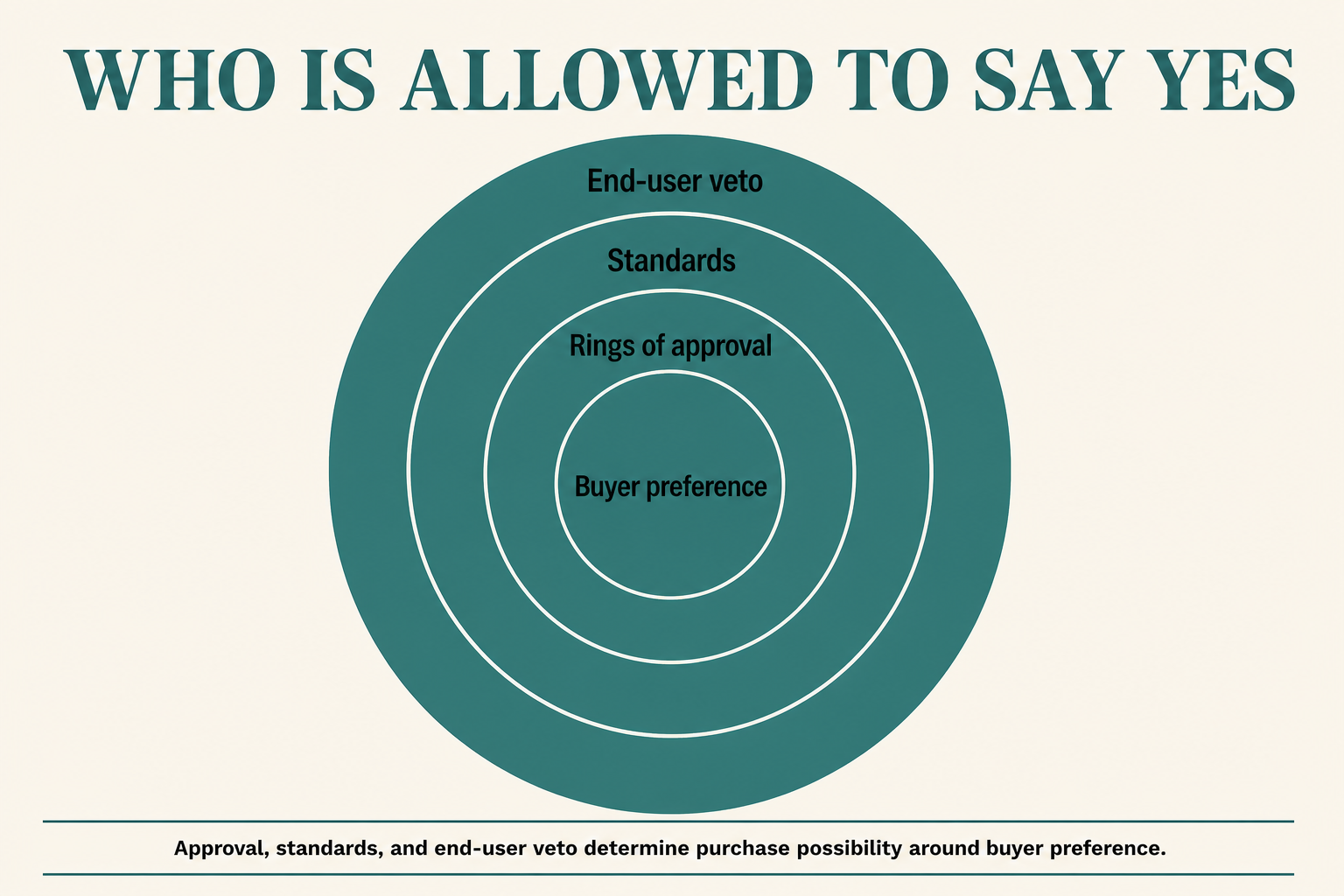
The two get separated for a reason that has nothing to do with whether the product is good. A valve in critical service can shut a line down, hurt someone, or fail in a way that costs far more than the part. So the end user builds a wall in front of his own buying. Nothing enters service without prior approval. The approved vendor list is that wall, written down. The wall protects him, and it is indifferent to how much anyone likes your casting.
So the real map of a deal has two layers. One layer is who likes it. The other is who is allowed to buy it. When those two layers are the same people, selling to preference works fine. When they are different people sitting in different places, selling to preference is selling to a room that cannot transact.
The work, then, is not to generate more preference. It is to find where permission lives and learn the process that grants it.
The work is not to generate more preference. It is to find where permission lives.
That process is rarely a conversation. It is qualification, documentation, sometimes a trial in a non-critical spot, sometimes a sample held by an engineer for a quarter while nothing visible happens. It is slow because it is supposed to be slow. The slowness is the safety.
A seller who understands this stops mistaking silence for rejection. The deal is not dead. It is in the part of the process he cannot see, moving at the speed the end user requires. His job is to be correctly placed in that process, not to keep warming a room that was already warm.
The Valve The Distributor Could Not Buy
A Mexican manufacturer of specialty and alloy valves wanted into the U.S. market. These are not commodity valves. They are critical-service components, the kind an end user will not allow into service without prior approval.
The presentation went to a Fortune 500 distributor. It landed. They were genuinely interested in the product. Then they said the thing that explains the whole market: go get this approved by our customers, the end users, so that we can buy it.
The distributor liked the valve and could not purchase it. Not would not. Could not. The permission to buy lived downstream, with the end users, not with the distributor in the room who was nodding along.
Before that, the effort had gone the wrong way, treating market entry as a matter of knocking on more doors and producing more warm rooms. More preference. The structure said preference was not the constraint. Permission was, and permission had a process, and the process took months for some end users and years for others.
The distributor liked it and still could not buy it. The permission lived somewhere else.
The correct move was to stop selling to preference and start working the approval path. Understand it first, then follow it. Slower on paper. Faster in reality, because it was the only motion that ended in an order.
What To Check Before You Push Harder
Before you read a warm room as a near-close, find out whether the people who like it are the people who can buy it.
- Who signs, and who approves. Map the person who can issue the order against the person who must clear the product first. If they are different, you have a permission problem, not a preference problem.
- Where the approved vendor list lives. Ask who owns it, what gets a product onto it, and how long that has taken for the last new entrant.
- What "yes" in the room actually authorizes. A buyer's enthusiasm may authorize nothing more than passing your sample downstream. Know exactly what the warmth buys you.
- Whether you are selling project or MRO motion. A one-time project spec and an ongoing approved supply are different doors with different keys. Confusing them wastes a year.
- What the clock really is. If approval runs months to years, your pipeline math, your cash plan, and your patience all need to match that clock, not your sales optimism.
- Where the deal sits when it goes quiet. Silence after a good meeting is usually the process working, not the deal dying. Know which one you are looking at.
A buyer who loves your product and cannot purchase it has told you exactly one thing: the decision lives somewhere you have not been yet.
Go find that place. Learn its process. Sell to permission, and let preference do what it was always going to do anyway.