
Pressure Makes You Solve the Wrong Problem
A manufacturer with a strong product and a thinning cash runway will almost always do the same thing. It pushes harder on the part it already knows how to do.
It hires another salesperson. It cuts the price. It books more meetings, prints better brochures, flies someone north to knock on more doors. The activity feels like progress because it is visible, it is familiar, and it answers the question the owner is asking himself at two in the morning, which is "are we doing enough."
That question is the trap. Effort is not the variable that was ever in doubt. The team was always willing to work. What no one stopped to ask, because stopping felt like losing time, was whether the work was pointed at the thing actually blocking the sale.
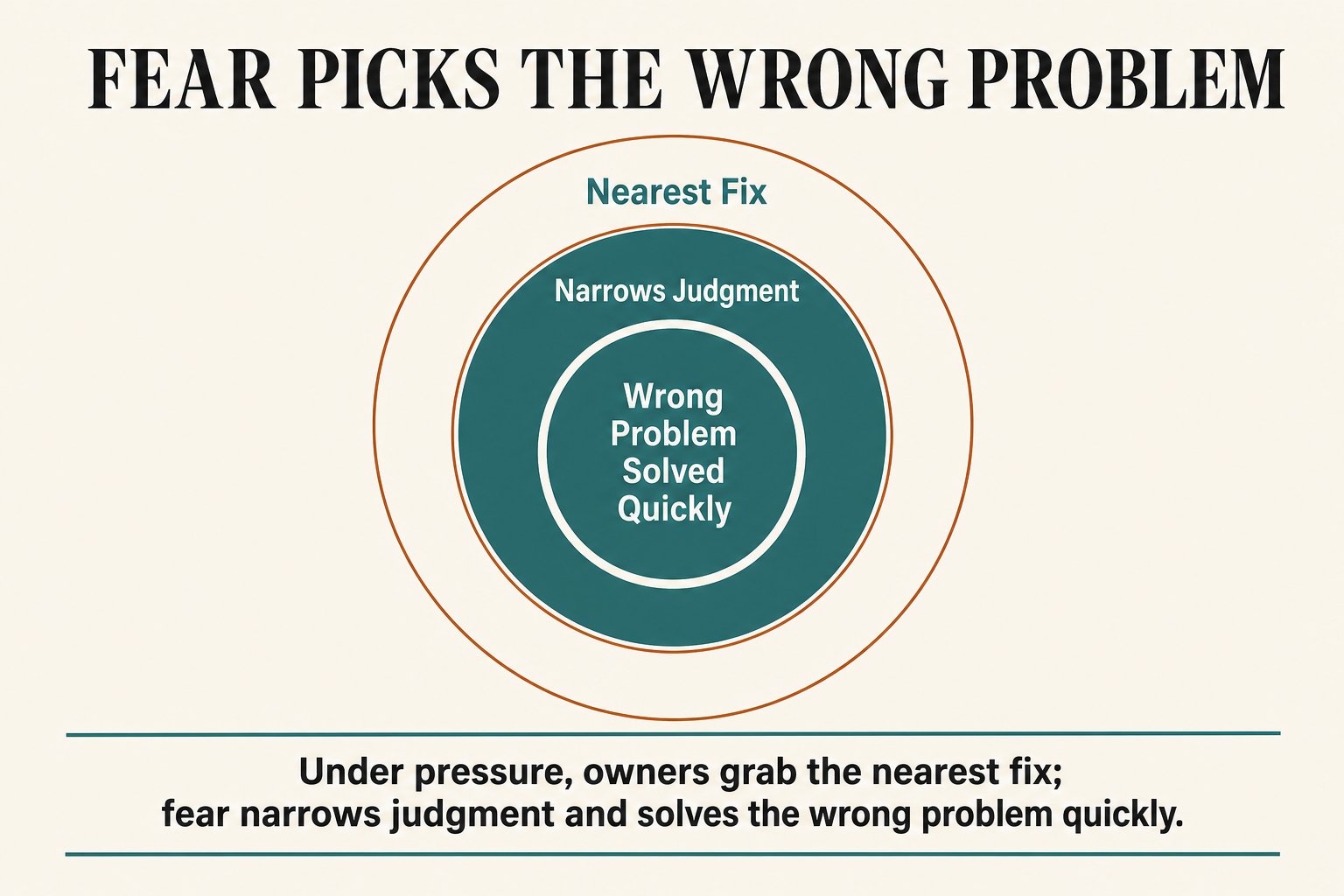
Pressure does not make people lazy. It makes them fast. And fast, applied to the wrong problem, just gets you to the wrong place sooner.
The Loud Problem Drowns the Real One
Every stuck business has two problems running at once. There is the loud one, the one generating the anxiety, usually phrased as "we are not selling enough." And there is the real one, the structural reason the selling is not converting, which is quiet because nobody has named it yet.
Under calm conditions an owner can hold both in view. He can sell while he investigates. Under pressure the loud problem eats all the attention, because the loud problem is the one attached to fear. Fear is a terrible diagnostician. It points at the symptom with total confidence and never once examines the cause.
So the response gets bigger and the target stays wrong. More dials, more demos, more discounting, all aimed at a door that was never the door.
Fear points at the symptom with total confidence and never once examines the cause.
Reading the Situation Is the Owner's Real Job
Here is the part that gets skipped. Before you decide what to do, you have to decide what is actually true about how the buyer buys.
Most markets do not run on preference. They run on permission. The two feel identical in a good meeting and they are not the same thing at all. Preference is whether the person in the room likes your product. Permission is whether that person is structurally allowed to bring it in. A buyer can have all the preference in the world and zero permission, and a sales push answers only the first.
That distinction is the whole job. The owner's primary work, the part that cannot be delegated to the sales team, is reading where the permission actually lives.
Permission tends to sit in one of a few places, and you have to know which before you spend a dollar selling:
- With the person in the room. Rare, clean, and the only case where harder selling is the right answer. If they can say yes and mean it, sell.
- Downstream with the end user. The buyer wants it but cannot use it until someone they serve approves it for service. The work is qualification, not persuasion.
- Inside a process. A spec, an approved-vendor list, a code, a procurement gate. The work is getting onto the list, which a demo does not touch.
- Across a committee. No single yes exists; the work is mapping who must not say no.
When the runway is short, the temptation is to treat all four cases as the first one. Just sell harder. But three of those four are immune to selling harder. You can run your best people flat out against a permission problem and move nothing, because the obstacle was never that the buyer was unconvinced.
The discipline is unglamorous. Slow down at the exact moment every instinct says speed up, long enough to name which problem you have. That pause is not lost time. It is the only thing that keeps the next ninety days from being lost time.
You can run your best people flat out against a permission problem and move nothing.
A Valve That Could Not Be Bought
A Mexican maker of specialty and alloy valves wanted into the U.S. market. Not commodity valves, the critical-service kind, the ones that hold under conditions where failure is expensive. The early effort was exactly what pressure produces. Knock on doors. Find buyers. Sell.
Then came the meeting that should have changed everything. A presentation to a Fortune 500 distributor landed well. They liked the product. They were genuinely interested. And then they said the thing that reveals the entire structure: go get this approved by our customers, the end users, so that we can buy it.
Read that slowly. The distributor in the room wanted the valve and still could not purchase it. The permission did not live with them. It lived downstream, with the end users who would not allow a critical-service valve into service without prior approval, on timelines that ran from months to years.
The distributor liked it. The distributor could not buy it. The permission lived somewhere else.
Every additional sales call on distributors would have been effort aimed at the loud problem. The real work was to stop selling to preference and start working the approval process, deliberately, end user by end user. That is slower and it is correct. The valve was never the issue. The path to permission was, and no amount of pushing on the wrong door opens it.
How to Tell If This Is You
When the pressure is on and the obvious move is to do more of what you already do, run these before you commit the spend.
- Name both problems. What is the loud problem you are reacting to, and what is the quiet structural reason it is not converting? If you can only name one, you have not looked yet.
- Locate the permission. Who is actually allowed to say yes, and is that person the one you have been selling to?
- Separate preference from permission. Do your prospects like the product but lack the authority to buy it? A warm meeting that goes nowhere is the tell.
- Test the obstacle. Would selling twice as hard move this, or is the blocker something selling cannot touch?
- Check what the pace is hiding. What did you stop investigating the moment things got urgent?
- Price the pause. Is two weeks of diagnosis more expensive than ninety days aimed at the wrong target?
The hardest discipline under pressure is to stop and read the situation before you decide what to do about it.
Speed is not the problem. Speed pointed at the wrong problem is. The owner's job is to find the right target first, and then nobody has to work harder than they already were.