
Reading the Soft No
A salesperson comes back from a meeting and reports that it went well. The buyer liked the product. The conversation was warm. There was talk of next steps, a follow-up scheduled, business cards exchanged. Everyone in the room was nodding.
Then nothing happens. The follow-up gets rescheduled, then rescheduled again. The buyer is still friendly. He still says good things about the product. And the order never comes.
Most owners read this as momentum that stalled. They send more material, lower the price, add a feature. They treat the silence as a gap to be filled with more selling.
The silence was not a gap. It was the answer.
The Politeness Problem
Buyers are rarely cruel. A professional buyer who has decided not to proceed almost never says so plainly, because saying so creates friction he has no reason to absorb. It is easier to stay warm. It is easier to keep the door open in case something changes. It costs him nothing to be kind and everything to be blunt.
So he praises the product. He asks about lead times he will never use. He says he will circulate it internally. None of this is dishonest. It is simply the path of least resistance, and the path of least resistance for a buyer who cannot or will not buy looks almost identical to genuine interest.
This is the trap. The warmer the room, the more an eager seller reads encouragement into what is actually a polite exit. The seller hears the words and misses the structure underneath them.
The path of least resistance for a buyer who cannot buy looks almost identical to genuine interest.
The real signal is never in what the buyer says about the product. It is in what he does, and more precisely, in what he is structurally able to do.
Preference Is Not Permission
Here is the distinction that decides the outcome, and most sellers never make it.
A buyer can have a preference. He can genuinely want your product, prefer it to what he uses now, and speak well of it to everyone he meets. Preference lives in the room you are sitting in.
Permission is something else. Permission is the structural right to actually place the order, and it does not always live with the person who likes the product. In many industrial channels it lives somewhere else entirely, downstream or upstream, with a party who was never in your meeting.
When preference and permission sit in the same person, a warm meeting means a coming order. When they are split, a warm meeting means nothing at all. The buyer's enthusiasm is real and also irrelevant, because the thing he controls is not the thing that has to move.
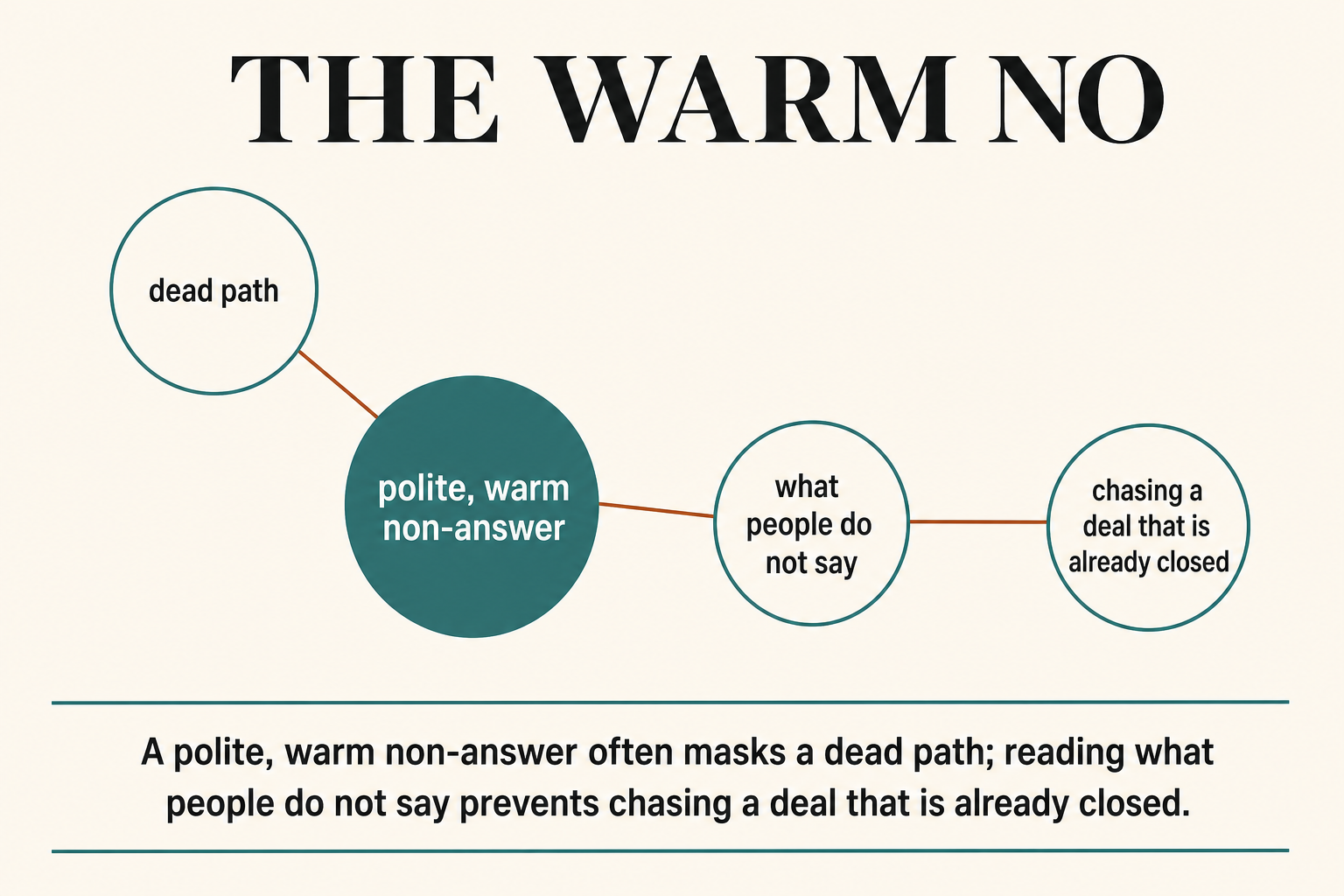
This is why the soft no is so easy to misread. The seller assumes the warm person is the deciding person. He pours more effort into deepening a preference that was already strong, when the actual obstacle is a permission that sits a layer away and was never addressed.
A buyer's enthusiasm is real and also irrelevant when the thing he controls is not the thing that has to move.
The work, then, is not to sell harder. The work is to find where permission lives before you spend a year selling to someone who can only ever say nice things. You ask who has to sign off. You ask what gates the purchase. You ask the question that feels rude and is actually the only honest one: if you wanted to buy this tomorrow, what would stop you?
A buyer who likes you will usually answer that question truthfully. His answer is the map. The rest of the meeting was scenery.
What the Distributor Could Not Say
Consider a specialty valve maker entering the U.S. market. Not commodity valves, alloy and specialty valves, the kind that go into critical service where a failure is not a nuisance but an event.
The presentation went to a Fortune 500 distributor. It landed. They were genuinely interested, the product was strong, the room was warm. Then they said the thing that revealed everything: go get this approved by our customers, the end users, so that we can buy it.
The product had not lost. The relationship had not cooled. The distributor still wanted it.
He simply could not buy it. Permission to put a critical-service valve into a refinery does not live with the distributor. It lives with the end user, who will not allow an unapproved component into service, and whose approval process runs months in the easy cases and years in the hard ones. The distributor could advocate. He could not approve.
He could advocate. He could not approve.
The mistake that came before was treating market entry as door-knocking, as a matter of finding enough people who liked the valve. But liking was never the constraint. The constraint was a downstream approval process that no amount of warmth in the distributor's office could shortcut. The real work was to understand that process and follow it, in that order, before spending another month selling preference to someone who had already told you, politely, exactly where the permission lived.
How to Tell If This Is You
The soft no is recoverable, but only if you read it early. Run your stalled opportunities through these.
- The warmth test. Is your read on this deal built on what they said about the product, or on something they actually did? Words are cheap. A scheduled audit, a sample request with a spec, a name passed to procurement, those cost something.
- The permission question. Do you know, by name or by role, who has the structural right to place this order? If you cannot name them, you are selling to preference, not to permission.
- The gate. Is there an approval, qualification, or sign-off between this buyer and a purchase order? If yes, when did you last touch it?
- The honest ask. Have you asked them directly what would stop them from buying tomorrow? If not, you are guessing at the obstacle.
- The effort mismatch. Are you adding features and cutting price to win a buyer who already prefers you? If so, you are solving a problem that was already solved and ignoring the one that is not.
- The clock. How long has this been warm and still? Genuine momentum has a pulse. A soft no stays exactly as warm as the day you got it.
A polite buyer will tell you everything except the one thing you most want to hear, so stop listening to the praise and start reading the structure.
The order does not come from the person who likes you. It comes from the person who is allowed to place it. Find that person first, and the warm meetings start to mean something.