The Budget Is Decided in Design
A developer sits in a conference room three months into construction, staring at a change order. The number is large. The ceiling detail that looked clean on the drawing turns out to require structural steel nobody priced. Now the choice is to pay for it, or cut it and watch the room lose the thing that made it worth building.
He thinks he is making a budget decision today. He is not. He is paying for a decision someone made in a design meeting a year ago, a decision nobody flagged as a money decision at the time.
This happens on almost every project. The owner watches the budget during construction, where the numbers are loud and the invoices arrive weekly. But the budget was already set somewhere quieter, earlier, when the lines were still cheap to move.
Where The Money Actually Gets Spent
The instinct is to control cost where you can see it. Bids, allowances, change orders, the running tally your contractor sends. That is where attention goes, because that is where dollars visibly leave the account.
It is the wrong place to look.
By the time a contractor is pricing the work, the expensive choices are already locked. The span of the room, the height of the ceiling, the relationship between inside and outside, the structure that holds it all up. Those were decided on paper. Construction does not set those costs. It pays them.
What looks like a construction overrun is usually a design commitment cashing in. The window wall that frames the view costs what it costs because someone drew a window wall. You can argue with the glazing contractor about price per square foot. You cannot argue your way out of the square footage of glass the design requires.
Construction does not set the cost. It pays the bill design already wrote.
The Two Buckets Most Owners Confuse
There are two kinds of cost in a building, and treating them the same is where owners get hurt.
The first is structural cost. This is geometry and physics. Spans, heights, loads, the basic shape of the space and how it stays up. These are decided in design and they are nearly impossible to change later without tearing into work already done. A wider room is a wider room. You commit to it once, on paper, and you pay for it for the life of the project.
The second is finish cost. This is the visible layer. Stone, tile, fixtures, cabinetry, the things people point at on a tour. These feel expensive because you see the price tags, but they are flexible deep into the project. You can trade a finish almost up to the day it gets installed.
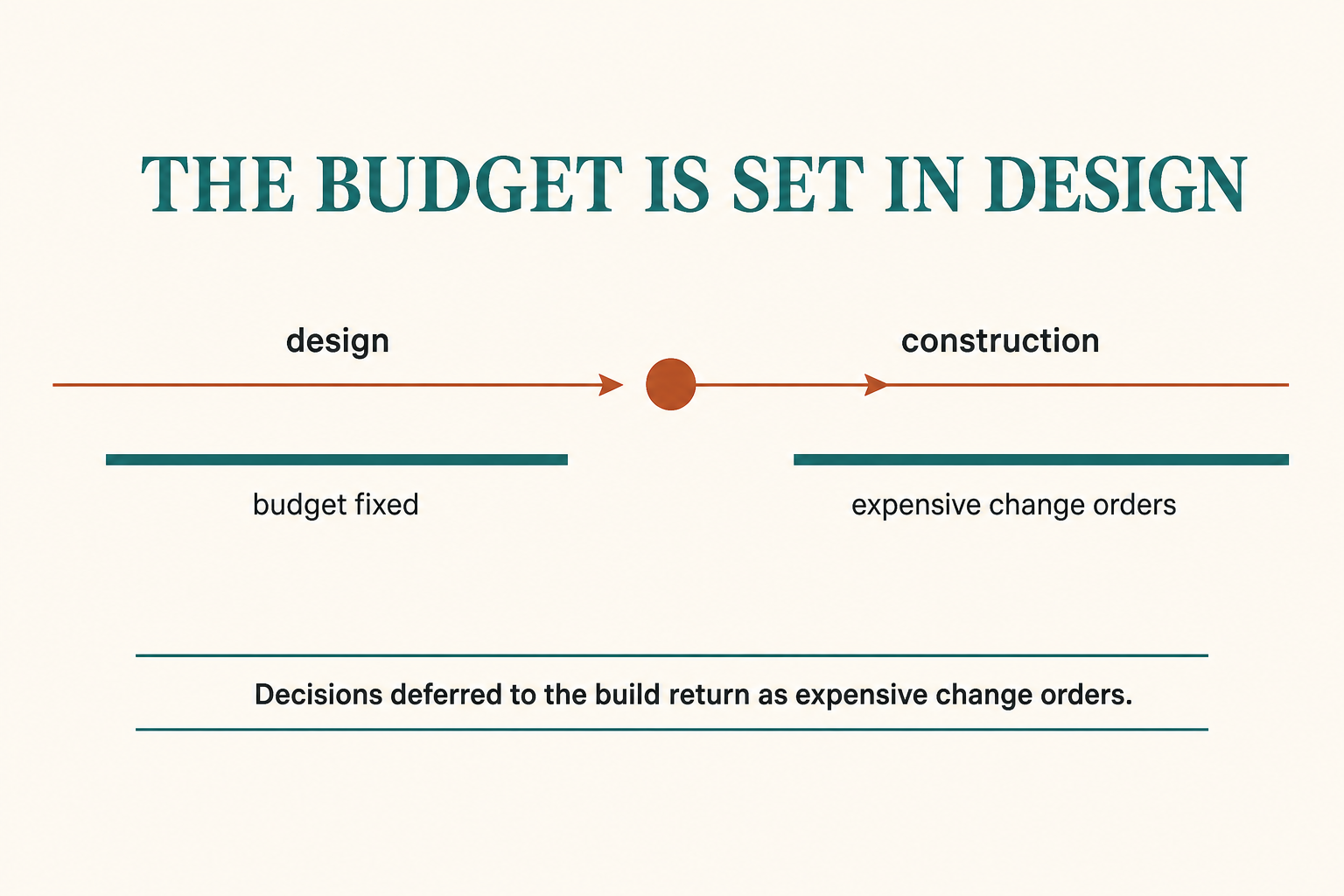
Here is the trap. When the budget gets tight, owners cut the bucket they can still reach. They value-engineer the finishes, because that is what is left to cut. The structure is poured, so it stays. The story-carrying decisions are already spent, so they are protected by default, whether or not they were the right decisions.
That means the cuts land on the things guests touch and feel, while the things that drive the largest line items are untouchable, because cutting them means demolition.
When the budget tightens, owners cut what they can still reach, not what they should.
The owners who control cost do it in reverse. They spend their hardest scrutiny on the structural bucket, in design, when those lines are still free to move. They decide deliberately where the geometry earns its money and where it does not. Then they protect the finish budget instead of raiding it, because finishes are where the guest actually meets the building.
A wide span over a great room might be worth every dollar. A wide span over a hallway is a budget hole with no payoff. Both cost real money. Only one of them gets felt. That distinction has to be made in design, because in construction it is already too late to make it.
What Element Ranch Decided On Paper
The Villa was designed around how a group actually moves through a weekend before a single finish was chosen. Not how many bedrooms fit. Where people gather, where someone takes coffee in the morning, where the group lands at sunset, how the light moves through the living spaces out toward the pool.
Those are structural decisions. Large shared spaces, high ceilings, strong sightlines, real indoor-outdoor connection. None of them are the cheap way to build. They cost more in design and they cost more to construct, and they were chosen on purpose, before anyone picked a faucet.
That sequence is the whole point. The expensive geometry was decided when it was a decision, not absorbed later as a surprise. And because the structural money was placed where guests would actually feel it, the finish budget was never the thing being defended against a panic cut.
Guests do not rent bedrooms. They rent the decisions made before the finishes.
The easy version was available the whole time. A big house, trendy furniture, good photography, call it a ranch retreat. That path makes a commodity that depends on the photos holding up better than the place does. The harder path put the money into weight, scale, and sightlines that hold up once people arrive. Guests respond emotionally, and the property commands a rate well above comparable rural houses, because they are renting a setting and a level of execution. That premium was authored in design. Construction just built what the drawings already committed to.
What To Settle Before You Break Ground
By the time the dirt moves, your budget is mostly written. These are the questions to ask while the lines are still cheap to move.
- Which costs are geometry and which are finishes? Sort every major line into structural or surface. The first is locked in design. The second is flexible for months.
- Where does the expensive geometry actually get felt? A tall ceiling over the room people live in earns its cost. The same ceiling over a corridor does not.
- What will you cut first if the number comes in high? If the honest answer is finishes, you are planning to wound the guest experience to protect decisions you never pressure-tested.
- Did you design around use, or around a unit count? Bedroom math builds a commodity. Use math builds a place.
- What looks cheap on the drawing and bills expensive later? Find the details that need hidden structure before a change order finds them for you.
- Are you protecting the finish budget, or raiding it? The finishes are where the building meets the guest. Defend that line.
The cheapest place to cut a cost is the drawing, and the most expensive place to discover it is the invoice.
Decide the budget when the lines are still free to move. After that, you are not deciding. You are paying.