The Cheapest Bid Is the Most Expensive Builder
Three bids land on the desk. They cover the same drawings, the same square footage, the same scope on paper. One comes in noticeably under the other two, and the gap is large enough to feel like found money.
The owner does the obvious thing. He circles the low number.
What he does not do, in that moment, is ask why one builder thinks the same job costs that much less. The answer is almost never that the cheap builder is smarter or leaner. The answer is that the three bids are not actually describing the same building. They are describing the same drawings, which is a different thing. The drawings leave out a thousand decisions, and the low bid has quietly made all of them the cheap way.
What a Low Number Is Actually Pricing
A construction bid is not a measurement. It is a forecast, built on a stack of assumptions about everything the drawings do not pin down. Which grade of material. How much labor a tricky detail really takes. How much margin to carry for the things nobody can see yet.
Two builders looking at the same plans will price the same room differently, and both can be honest. One assumes the owner wants the detail held tight and budgets the hours to do it. The other assumes the owner wants the number low and budgets to hit the number.
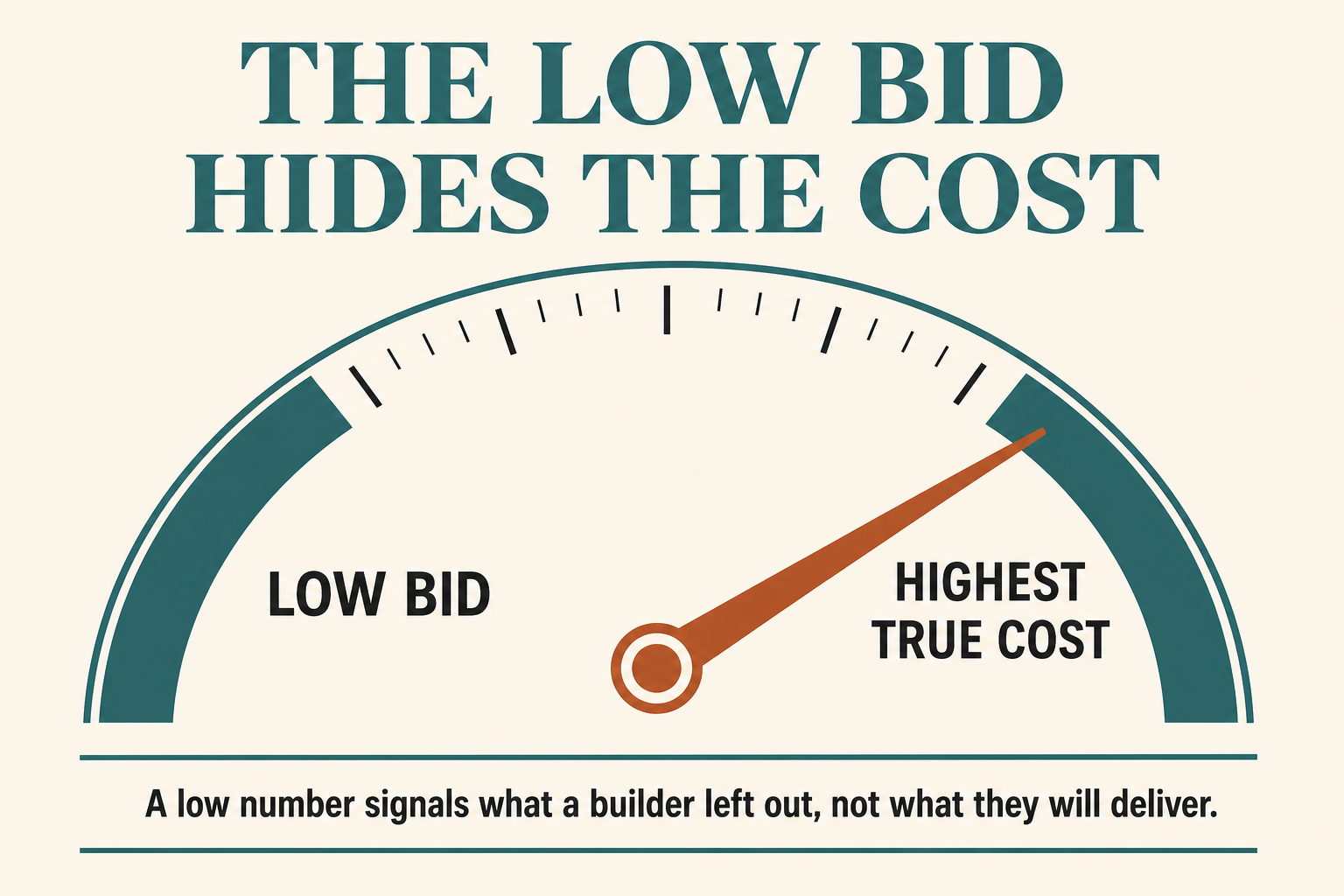
The gap between those two bids is not waste. It is a forecast of behavior. The low bid is telling you, in advance, how this builder intends to make money on your job, and it is not by being more efficient.
He makes it back on the change orders, on the substitutions, on the corners you will not notice until you are standing in the finished room.
The low bid is a forecast of behavior, and it is telling you how the builder intends to make money on your job.
The Incentive Underneath the Number
Here is the structure most owners never look at. The cheapest bid wins the work by being optimistic, and then has to survive the job on a margin it priced away to win.
That builder now has one path to a decent outcome. He has to claw the margin back during construction. Every ambiguity in the drawings becomes a change order. Every spec that says "or equal" becomes a cheaper equal. Every detail that costs hours he did not budget becomes a negotiation, and he is negotiating from the position of a man who is already losing money.
You did not hire a builder. You hired an adversary, and you paid a deposit to start the fight.
The honest higher bid is doing the opposite. It priced the job to be profitable while building it correctly, which means the builder has no reason to fight you over the things you actually care about. His margin is in the contract, not hidden in the corners he plans to cut. His incentive and your outcome point the same direction.
This is the part that costs people real money. They treat the bid as a price for a finished building, when it is really a price for a relationship that runs for twelve or eighteen months. A relationship where the two parties either want the same thing or do not.
You did not hire a builder. You hired an adversary, and you paid a deposit to start the fight.
So the question to ask the low bid is not "can you do it cheaper." It is "what did you assume so you could be this low," and then "what happens when that assumption is wrong." A builder who cannot answer the second question clearly is not a bargain. He is a series of future invoices you have not seen yet, and the building you imagined will quietly erode into the building he can afford to deliver on what he bid.
What This Cost on the Ground
When we built the Villa at Element Ranch, the expensive decisions came before any finish was chosen. We designed the place around how a group actually moves through a weekend. Where they gather. Where someone has coffee alone in the morning. Where everyone lands at sunset.
That drove large shared spaces, long sightlines, strong indoor-outdoor connection, and a pool area scaled to the group. None of that is the cheap way to build. A value-engineered version of the same square footage would have given us more bedrooms, smaller common rooms, and a number a contractor could brag about.
It also would have given us a commodity. A big house with trendy furniture that depends on good photography and collapses the moment a guest walks in and feels the difference between weight and veneer.
The materials were the same calculation. Real, substantial materials where they mattered, so the place reads as permanent rather than themed. A guest cannot tell you why a room feels right. He can tell you it does, and he pays for the feeling.
Guests rent a setting and a level of execution. They do not rent the number the builder hit.
The property commands a rate well above comparable rural places for exactly that reason. The savings from the cheap path would have shown up once, on the build. The cost would have shown up every weekend after, forever.
What to Check Before You Sign
The number on the page is the easiest thing to compare and the least useful. Before you award the work, interrogate the assumptions underneath it.
- Read the gap, not the bottom line. When one bid is well under the others on identical drawings, find out exactly which assumptions create the difference. The gap is information.
- Make the cheap bid show its math. Ask what allowances, grades, and quantities the low number is built on. Vague answers mean the cheapness lives in places you will discover later.
- Count the "or equal" lines. Every substitution clause is a door the builder can walk through. Decide now which ones you will hold tight, and price those tight.
- Ask how he makes his margin. A builder who expects to profit on change orders will tell you, indirectly, by how he talks about the drawings being incomplete.
- Separate the decisions from the finishes. Layout, sightlines, and structure are expensive to fix later and free to get right now. Protect those from the value-engineering knife first.
- Price the relationship, not the building. You are buying twelve to eighteen months of a builder either fighting you or building with you. Bid that.
The cheapest bid wins the job by pricing away its own margin, and then spends the next year taking that margin out of your building.
Pay for the bid where the builder's incentive and your outcome point the same way. That alignment is the only thing a low number can never buy.