The Cost of Building It Yourself Is Not the Build
A guest at a rural property taps a tile on a wall-mounted tablet, and the pool lights shift from white to a low amber. The fire pits come up. The pendant lights over the long table dim to where a group naturally settles in for the evening. None of it required a call to the host. None of it required staff walking the grounds at dusk flipping switches. The technology did its job by disappearing.
That tablet sits on top of a custom build. The integration behind it took real work to make seamless. And the day someone asks what it cost, the honest answer has almost nothing to do with the hours it took to write.
What the Build Number Hides
When an owner weighs building custom technology against buying something off the shelf, the comparison is almost always framed as a one-time cost. Development hours against a license fee. A few weeks of effort against a monthly subscription.
That framing is where the mistake lives.
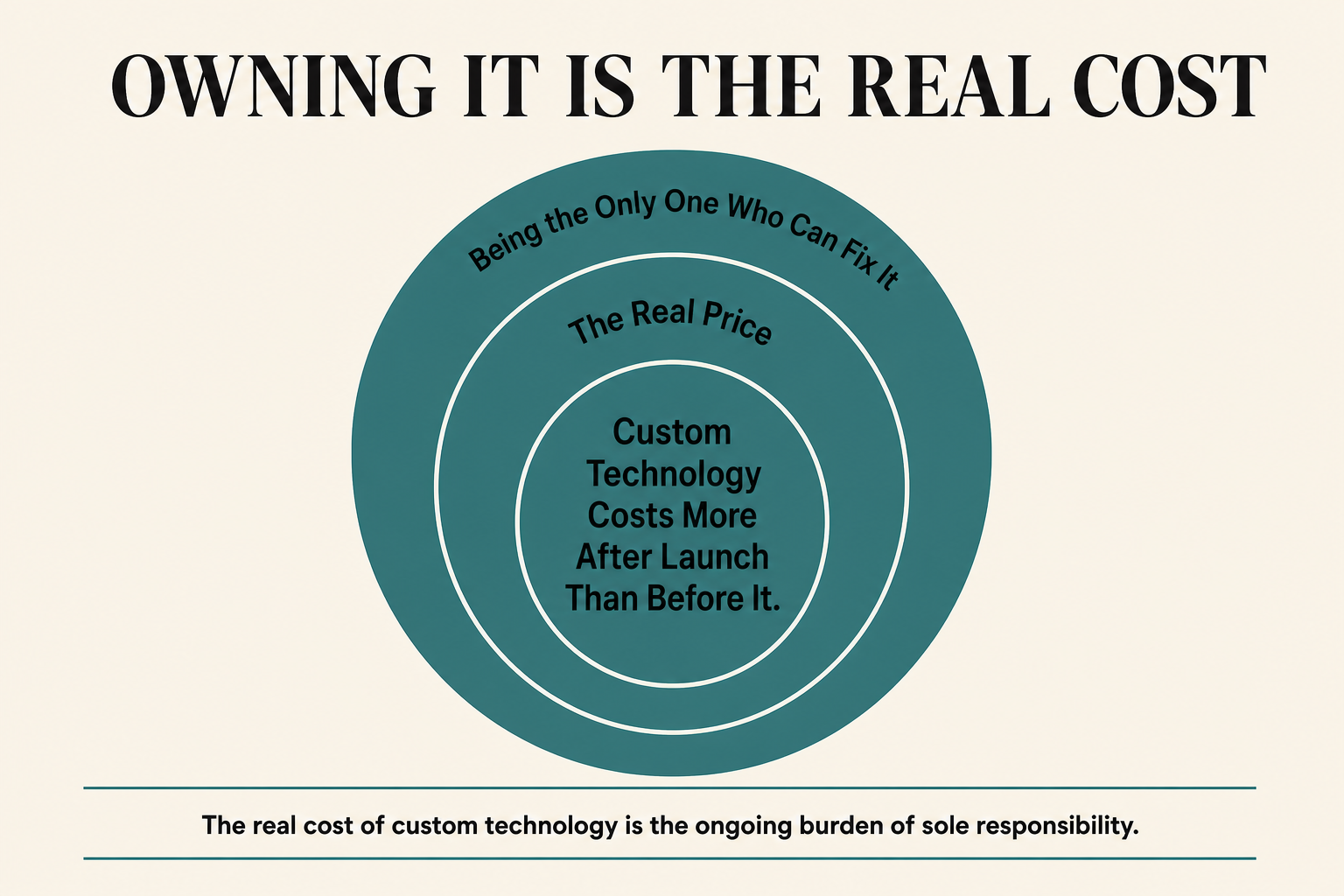
The build is the cheap part. It happens once, you can scope it, and you can see it finish. The expensive part starts the day after it works, and it never finishes. Someone has to own the thing. When the pool controller stops talking to the lighting at nine on a Saturday with guests on site, there is no vendor to call. There is the person who built it, or no one.
This is the cost that does not show up in the estimate. It is not labor. It is the permanent obligation of being the only entity on earth that understands the system well enough to fix it.
The build happens once. The ownership never ends.
Build Where It Earns Its Keep
The discipline is not "build less" or "buy more." The discipline is knowing which parts of a business actually justify carrying that permanent obligation, and which parts do not.
At Element Ranch the line was drawn deliberately. The guest controlling the pool, the lighting, and the fire pits from one place, with no host in the loop, was the difference. It made the property feel like a level of execution guests could not get elsewhere. It reduced staff and owner intervention. It set the place apart. That is worth owning, because owning it is the whole point.
Everything else was bought and configured, not built. Lutron RadioRA 3 ran the lighting hardware. UniFi ran the network and the wifi. GoHighLevel handled marketing, CRM, and automation. None of that was a compromise. All of it was deliberate. There is no competitive advantage in a hand-rolled lighting protocol or a homemade network stack. There is only a maintenance burden with your name on it.
So the real test is not "can we build this." Almost anything can be built. The test is whether the thing you would build creates a difference worth defending, and whether you are prepared to be the one who keeps it alive for as long as it runs.
If the answer to the difference is yes, build it, and accept the obligation with open eyes. If the answer is no, buy the best-configured version of it and move on. The failure is building something that gives you no edge and then discovering you have signed up to maintain it forever.
You are not buying a feature. You are adopting a dependent.
When the Build Is the Whole Point
There is a case where you build precisely because the ownership burden is the moat.
At Specialty Valve Group, salespeople could not keep track of inquiries or the back-and-forth with the manufacturer on spec clearance and pricing. A standard CRM would have logged the activity. It would not have done the thing that mattered. So the system was built custom, and its centerpiece was a historical-pricing database for every unique SKU.
That let the company issue a quote instantly off historical prices instead of waiting days for the manufacturer to answer. In that industry, first to quote has a real edge, because purchasers are lazy. They would rather issue the PO and clear their desk than wait for several quotes to accumulate and compare.
No off-the-shelf CRM did that, because no off-the-shelf CRM knew the pricing history of one company's exact SKUs. The advantage lived in the thing only that company could build. That is when you accept the obligation gladly.
Build the part nobody else can hand you. Buy the rest.
But notice what came with it. Once that pricing database existed, someone had to maintain it, trust it, and answer for it when a historical price was wrong on a live quote. The edge was real. The obligation was permanent. That is the trade you make on purpose when the build is the whole point, and the trade you should refuse when it is not.
How to Tell If This Is You
Before you commission a custom build, walk through these. They are the questions that separate an edge worth owning from a liability dressed as a feature.
- The difference test: Does this create something a competitor genuinely cannot buy or copy quickly? If a configured off-the-shelf product gets you ninety percent of the way, the build is rarely worth the other ten.
- The Saturday-night test: When it breaks with customers watching, who fixes it, how fast, and what happens to the business in the gap?
- The single-point test: Is there exactly one person who understands this system? If that person leaves, walks, or burns out, does the capability leave with them?
- The boredom test: Is this part of the business core enough that you will keep investing attention in it for years, or will it quietly rot the moment something more interesting comes along?
- The honest-cost test: Have you priced the next five years of ownership, not just the weeks of the build?
- The reversibility test: If the build fails, how hard is it to fall back to a bought solution, and have you kept that door open?
Run these before the work starts, not after.
Build the thing that is your difference, and buy everything else, because the bill for custom technology is not the hours to write it, it is the years to keep it alive.
The owners who get this right are not the ones who build the most. They are the ones who know exactly which systems are worth being unable to put down.