
The Decision Was Made Upstream of Where You Are Looking
A guest writes a polite review. The house was beautiful, but the weekend felt scattered. People kept drifting to their rooms. Nobody quite landed anywhere.
The owner reads it and reaches for the nearest lever. Better welcome basket. A printed guide to the property. Maybe softer lighting in the great room, maybe a different furniture layout. He treats the review as a fix-it list, and he works through it item by item, the way you would clear a punch list before a closing.
None of it moves the number. The reviews stay warm and slightly disappointed. The rate refuses to climb.
What the owner is staring at is a symptom. The thing that produced it happened long before any guest arrived, before the furniture, before the photos, in a decision nobody is looking at anymore.
The Symptom Is Loud, the Cause Is Quiet
The trouble with symptoms is that they announce themselves at the worst possible distance from their cause.
A weekend that does not gel, a space people pass through instead of settling into, a rate that stalls just below where you want it. These are loud. They show up in reviews, in repeat-booking rates, in the quiet math of a property that performs fine and never breaks out. So that is where the attention goes. You fix what you can see.
But the gathering pattern of a house, where people naturally end up and how the day moves through the place, was set when someone drew the floor plan. The sightlines were set by where the windows went. Whether the group lands somewhere at sunset was decided before the slab was poured.
By the time a guest feels it, the decision is years cold and several layers down.
You can decorate a bad floor plan forever and never fix what the floor plan decided.
This is the gap that catches good operators. They are diligent. They respond to every signal. And they spend that diligence at the layer where the problem appears, not the layer where it was made.
Decisions Cascade, and the Ones That Cascade Hardest Are Made First
Think of a business as a stack of decisions, each one resting on the ones beneath it.
At the bottom sit the structural choices. What is this thing for. Who is it really for. How will it actually be used. These get made early, often quickly, sometimes without anyone realizing a decision was being made at all. Above them sit the design choices, then the operating choices, then the daily adjustments. The daily adjustments are where you spend almost all your time.
Here is the part that matters. The earlier a decision sits in the stack, the more it constrains everything above it, and the harder it is to reverse. A daily adjustment is cheap and reversible. A structural choice is neither.
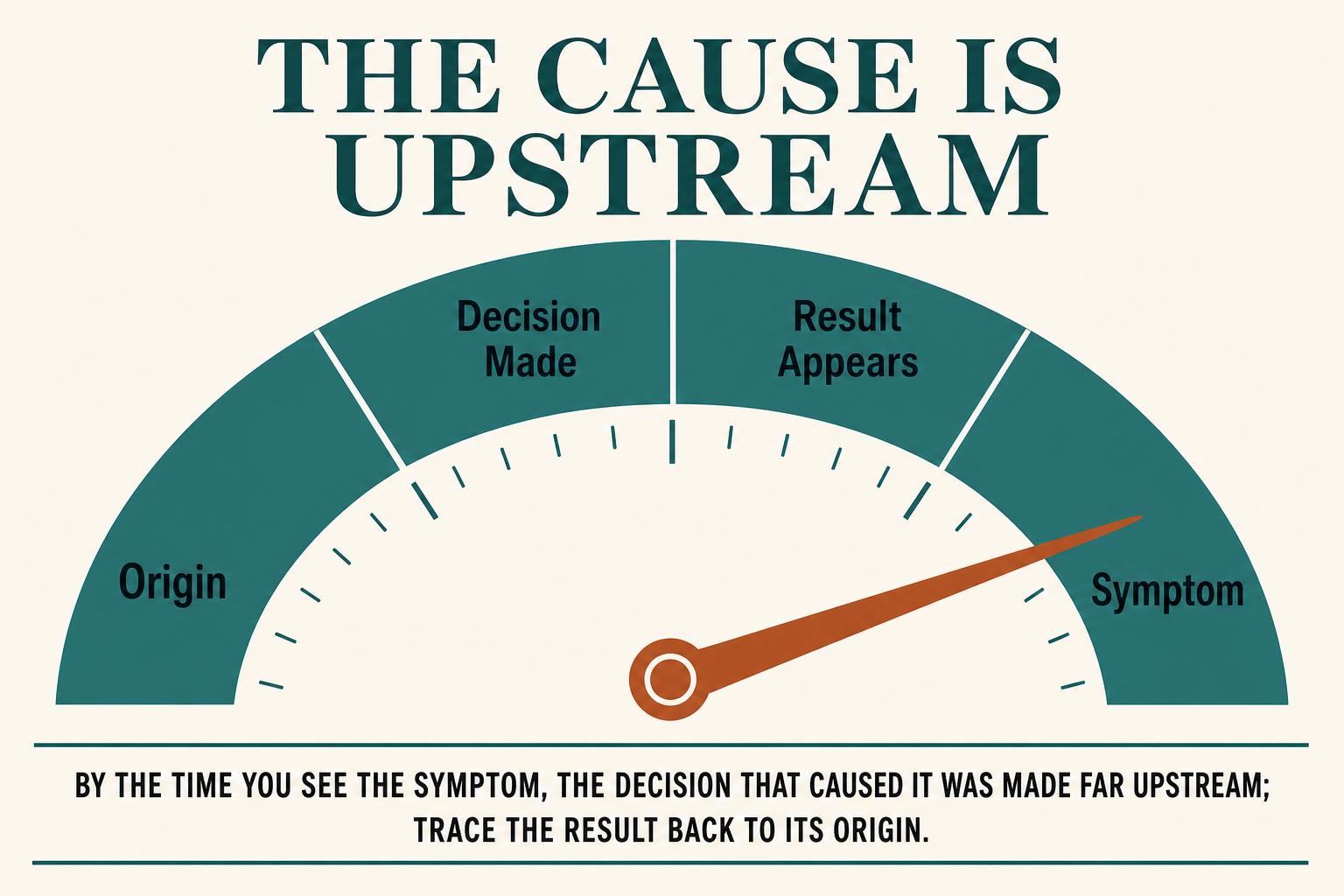
So when something goes wrong at the top of the stack, you have two moves. You can adjust at the level where you noticed it, which is fast and usually does nothing. Or you can trace it down to the decision that actually set it, which is slow and often expensive, and which is the only thing that works.
Most owners pick the first move because it feels like progress. You did something. The basket is nicer. But the constraint that produced the symptom is still sitting there, untouched, generating the same symptom in a new form next month.
The cheap fixes are available at the wrong layer, and the expensive truth lives at the right one.
The discipline is not in being clever at the symptom level. It is in refusing to fix things there until you have followed the cause down to where it actually lives. Diagnosis before action. The action is almost never where the looking starts.
What the Floor Plan Decided Before Anyone Arrived
When we built the Villa at Element Ranch, the temptation was the obvious one. Fit the bedroom count, pick trendy finishes, photograph it well, call it a luxury ranch retreat. That path is cheap, fast, and produces a commodity that lives or dies on its photos.
We started one layer down instead. Before a single finish was chosen, we mapped how a group actually moves through a weekend. Where they gather when they arrive. Where someone has coffee alone in the morning. Where the small side conversations happen. Where the whole group ends up at sunset.
That mapping drove everything above it. The scale of the shared spaces, the sightlines, the indoor-outdoor connection, the way the light moves through the main living areas toward the pool and the land in the evening. We spent more, because large common spaces and strong outdoor areas are not the cheap way to build.
Guests cannot name any of this. They do not see the floor plan. They feel it as the weekend landing somewhere, the group cohering, the place feeling calm and private and alive at the same time.
Guests rent a setting and a level of execution, not a bedroom count, and they pay for the decision they never see.
That is why the property commands a rate well above comparable rural houses. Not because of the finishes. Because of a decision made upstream of where any guest, or any competitor copying the photos, would ever think to look.
How to Tell If This Is You
When a problem keeps coming back no matter what you do at the surface, the cause is upstream. Trace it before you treat it.
- The recurring symptom: Has this same complaint shown up in three different forms? If you keep fixing it and it keeps returning, you are working a level too high.
- The cheap fix that did nothing: Did your last three improvements move the number, or just make you feel responsive? Responsiveness at the wrong layer is expensive motion.
- The decision nobody remembers making: What structural choice got made early, fast, maybe by default? That is your first suspect.
- The constraint you stopped seeing: What about your asset or model do you now treat as fixed and unquestionable? Fixed is exactly where the cause hides.
- The value-engineering cut: Where did you take the cheaper path early to save money, and is that the seam the problem keeps opening along?
- The layer of your attention: Are you spending your time where the symptom appears, or where it was created? They are rarely the same place.
Before you fix what you can see, find the decision that made it inevitable.
The symptom is honest about that something is wrong. It lies about where. Follow it down, and treat the cause where it actually lives, not where it happened to surface.