
The Gaps Between Trades Are the Real Risk
Pull the line items on almost any build and the materials are not where the project went wrong. The lumber package came in close. The tile, the fixtures, the appliances, all roughly where the estimate said they would be. Owners review these numbers, find them reasonable, and conclude the project was managed well.
Then they look at the timeline and the change orders and cannot reconcile the two. The parts were affordable. The whole cost far more than the parts.
What happened lives in the spaces the estimate does not have a line for. The week the framer finished and the electrician had not been scheduled. The plumber who roughed in before the structural detail was final, then came back to redo it. The handoff that nobody owned because it belonged to no single trade.
The Seams Nobody Prices
Every estimate is built around trades. Framing, electrical, plumbing, HVAC, drywall, finish carpentry, tile, paint. Each line has a number, a crew, and a scope. The owner reads down the list and sees the building.
What the list does not show is the order, the timing, and the handoffs between those lines. That is the actual work of building, and it is the part no one quotes.
A trade does its scope well and still leaves a problem for the next trade. The framing is square but the blocking the cabinet installer needed was never called out. The electrician runs clean but the can lights land where a beam has to go. Each crew did its job. The seam between them failed.
Each crew did its job. The seam between them failed.
This is why the budget can be right and the project still go sideways. Materials are visible, so they get priced and watched. Coordination is invisible until it breaks, and by then the cost is already spent.
Sequence Is the Real Plan
A build is not a pile of trades. It is an order of operations, and the order is the plan.
The cheapest version of any project ignores this. It treats the schedule as a list of who needs to show up, not a chain of dependencies where each step constrains the next. When that chain is loose, every trade optimizes for its own crew, finishes fast, and moves to the next job. The gaps they leave become someone else's emergency.
Three failures show up over and over, and none of them are about price.
- Premature work. A trade roughs in before an upstream decision is final, so the work has to be opened and redone. The redo is rarely a line item. It is absorbed as "labor" and disappears.
- Idle dependency. A finished trade waits on a decision or a crew that was not scheduled to be ready. The waiting is invisible, but the calendar moves and the carrying cost runs.
- Orphaned detail. A connection point belongs to no single scope, so no one owns it. The blocking, the transition, the waterproofing lap. It gets discovered late, when fixing it is expensive.
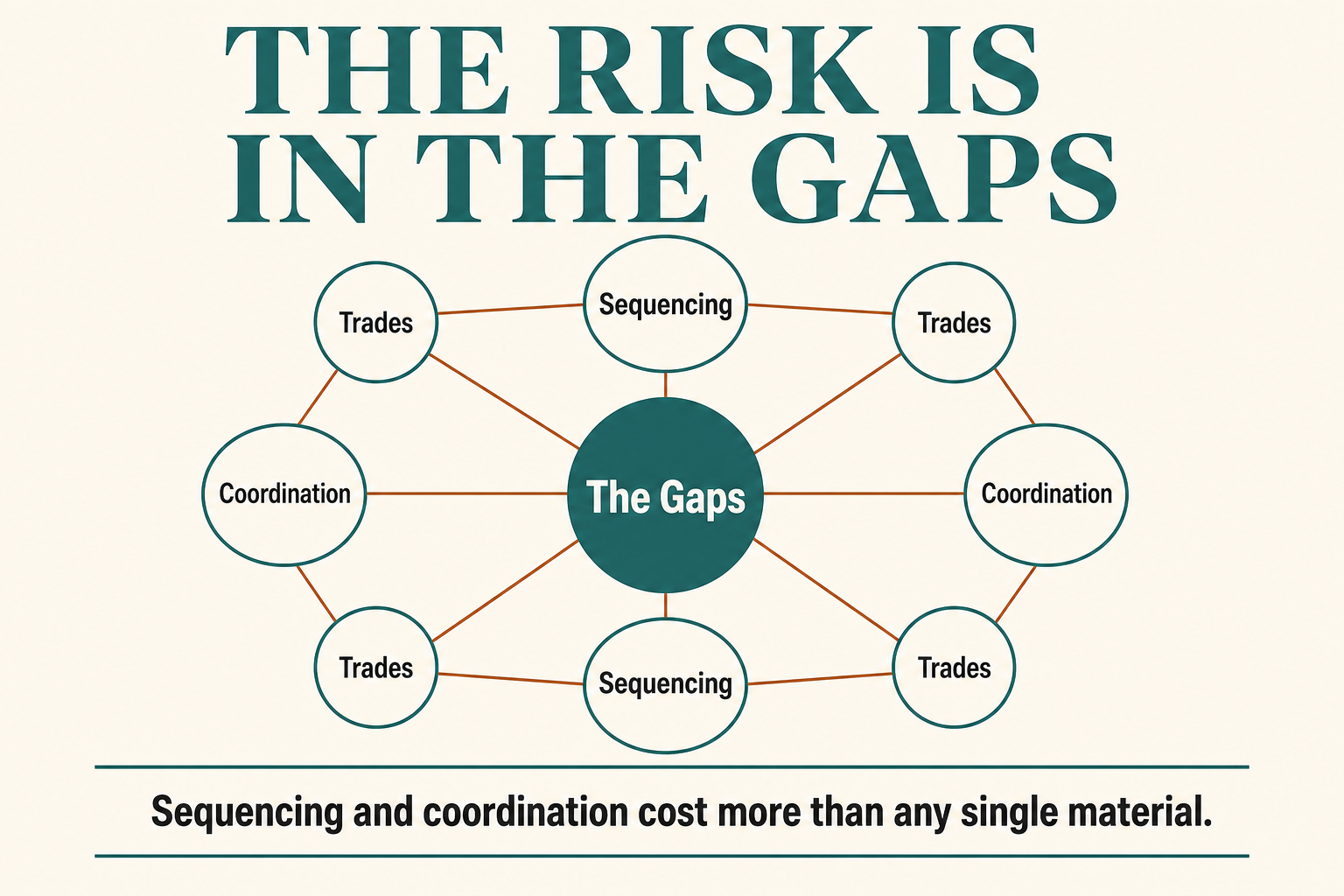
The fix is not a better price on any one trade. It is someone holding the whole sequence in their head and protecting the handoffs before they break. That person decides what has to be final before the next crew arrives, and refuses to let a trade start early just because it showed up.
Coordination is not a soft skill on a build. It is the structure that the budget sits on top of.
This is the cost owners systematically underweight. They negotiate hard on the visible numbers, the materials and the trade bids, because those are easy to compare. Then they leave the expensive thing, the orchestration, to chance or to whoever is least busy. The savings on the bid get eaten by the gaps between the bids, often several times over.
What the Calm Property Actually Cost
When a property is designed around how it will actually be used, the coordination cost is paid on purpose, early, where it is cheapest.
A premium short-term rental near Round Top was built around how a group moves through a weekend before a single finish was picked. Where people gather, where someone has morning coffee, where the group lands at sunset. That decision drove the layout, the sightlines, the pool, the scale.
None of that is a material. It is sequence. The large shared spaces and the strong indoor-outdoor connection only work if the structure, the openings, the lighting, and the mechanicals were coordinated to serve them from the start. You cannot value-engineer a sightline back in after framing. You cannot add weight and intention with a finish package.
The temptation on a project like that is always the easy cut. Shrink the common space, move the window, simplify the transition, save the money now. Each cut looks small on its own line. Together they would have produced a generic house that depends on good photography and falls apart when the guest arrives.
You cannot value-engineer a sightline back in after framing.
The property commands a rate well above comparable rural houses because guests feel the result and cannot name it. What they are feeling is the coordination that was protected when it would have been cheap to give it away.
What to Check Before You Cut
Before you accept a low number or approve a value-engineering pass, look at the seams, not the line items.
- Who owns the sequence, not just the schedule? Name the person who decides what must be final before the next trade starts.
- For each handoff, is the connecting detail assigned to a scope, or does it fall in the gap between two?
- Where are trades being allowed to start early because they are available, rather than because the work ahead of them is ready?
- Which "savings" in the value-engineering pass are actually deferred costs that reappear as change orders?
- What has to be decided now, before framing, that cannot be added back later without tearing something out?
- Is anyone tracking idle time and rework, or are both being absorbed invisibly into labor?
The materials are what you buy. The sequence is what you are actually paying for.
Price the trades all you want. The money is made or lost in the spaces between them, and that is the part no estimate will ever show you.