The Guest Should Never See the System, Only the Result
A woman walks out to the pool at nine at night with a glass of wine in one hand and her phone in the other. She taps a screen once. The pool lights shift from white to a low amber, the fire pit ticks on, and somewhere behind the property line a pump adjusts itself to hold temperature against the dropping air. She doesn't ask who did that. She doesn't wonder how. She sits down.
That moment is the entire point of the system, and also the reason almost no one will ever mention it in a five-star review. Guests don't write "the automation was excellent." They write "it felt like the place was made for us." Those are the same sentence, translated by someone who never saw the wiring.
The Part Owners Get Backwards
Most owners building a premium property think about technology as a feature to announce. A smart panel by the door. A tablet on the counter with icons for everything. Something that photographs well and gives the property manager a talking point during the walkthrough.
That instinct is understandable and it is wrong.
The guest at a high-end rental is not shopping for a gadget. She is trying to disappear into a weekend. She wants to control the fire pit the way she controls the temperature in her own living room, without thinking about the fact that she is controlling anything at all. The moment she has to find a manual, ask a host, or hunt for the right switch on an unfamiliar panel, the illusion breaks. She is no longer a guest at a private property. She is an operator of someone else's equipment.
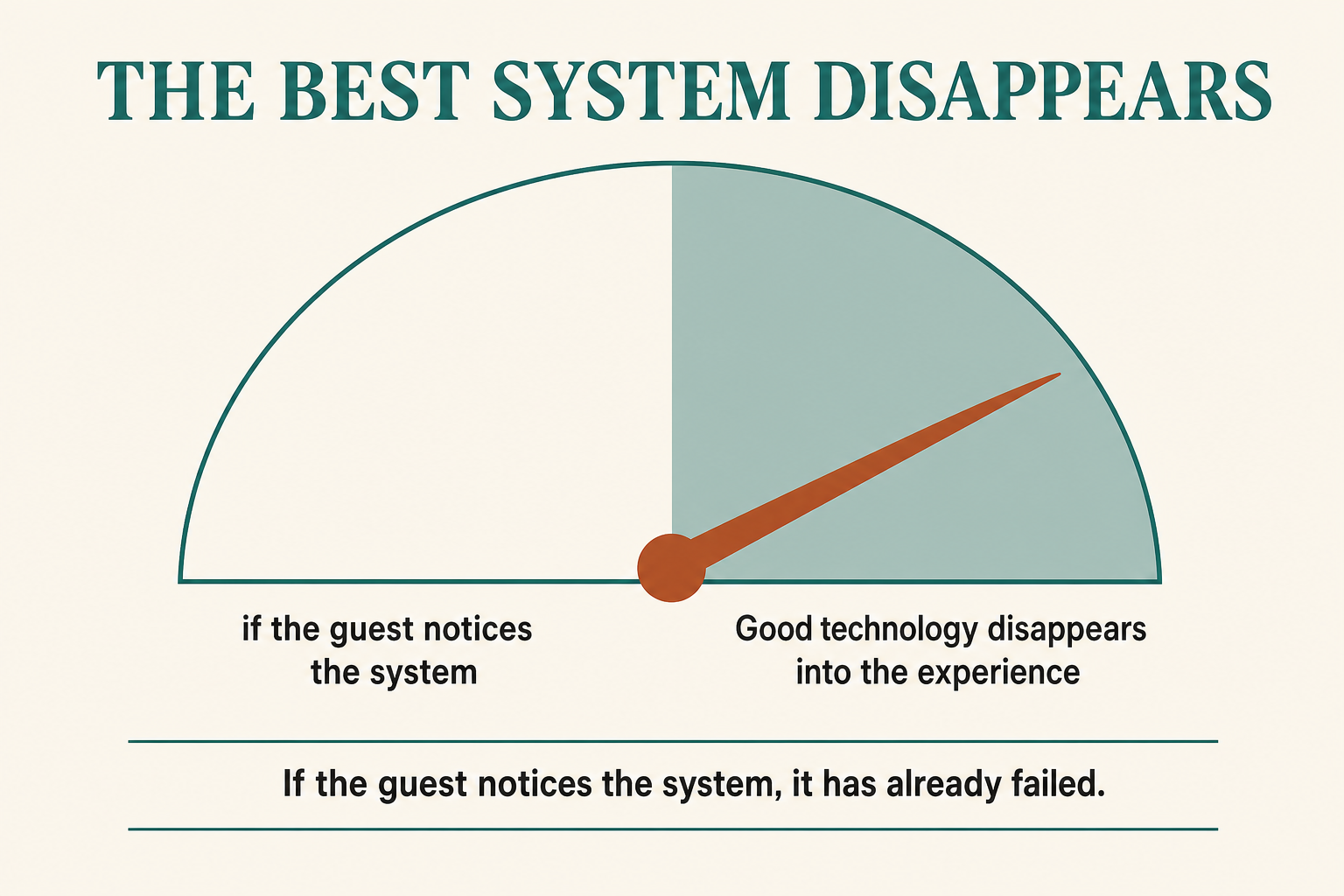
The guest is not evaluating the technology. She is evaluating whether she has to think at all.
That is the gap. Owners build systems to prove they invested in the property. Guests only register whether the investment cost them any effort.
What "Disappearing" Actually Requires
Here is where it gets counterintuitive: making a system invisible is harder, and more expensive, than making it visible. A panel with forty labeled buttons is a smart-home installer's easiest job. A single interface that quietly does the right thing, for pool, lighting, and fire pits, across different groups, different seasons, different hours of the night, is a much harder problem to solve.
The framework is simple to state and hard to execute: build custom exactly where the guest experience depends on it disappearing, and buy off-the-shelf everywhere else. Not everything on a property deserves custom engineering. Most of it doesn't. Lighting infrastructure, network backbone, the marketing and booking stack behind the scenes, all of that can run on solid, well-configured, off-the-shelf systems. Nobody's weekend improves because the wifi router was custom-built.
But there is usually one point of contact where the guest's hand actually touches the system, and that point is the one that determines whether the whole property reads as effortless or as managed. At a premium rural property, that point is the outdoor experience: the pool, the lighting, the fire pit, the small rituals of a evening outside. That's where the custom integration went, tying those three systems into one interface controllable from a guest's own phone, because that's the one place where friction gets noticed and remembered.
Spend the engineering budget where the guest's hand actually touches the system, not where it photographs well in a listing.
The rest of the stack stayed simple on purpose. Off-the-shelf lighting infrastructure. Standard networking gear, chosen for reliability, not novelty. A conventional CRM and marketing platform running the business side, invisible to the guest entirely because it was never meant to be seen by her in the first place. Every dollar of custom engineering went toward the three or four moments a weekend actually turns on.
Where the Discipline Gets Tested
The test of this discipline isn't the demo. Anyone can make a system work once, in daylight, with the installer standing next to the panel explaining it. The test is a Saturday night in October, four separate groups checked in, nobody on-site, and someone at the fire pit wants it lower while someone else at the pool wants the lights warmer.
That's the scenario the integration had to survive without an owner ever getting a call. Guests adjusting their own environment, independently, at the same time, on hardware none of them installed and none of them understand, and none of them needing to. When it works, the owner hears nothing. Silence is the metric. A property manager who checks the system logs the next morning and finds four independent adjustments, all executed cleanly, all without a single text message asking for help, is looking at the actual return on that investment. Not glowing lights. Fewer calls.
Silence from the guest is not the absence of a signal. It is the signal.
That's the part easy to miss when evaluating whether a piece of technology earned its cost. The metric was never "does it look impressive." The metric was "does the owner's phone stay quiet." A system that reduces owner and staff intervention while making the guest feel more in control, not less, is doing the actual job. Anything that requires an explanation at check-in has already cost you something you can't easily get back.
Where to Look First
Before building or buying anything guest-facing, an owner should be honest about which category the technology actually falls into.
- Where does the guest's hand actually touch the system, and does that specific point need to disappear, or is it fine if it looks like technology?
- What happens at 9 p.m. on a Saturday with no staff on-site and two groups wanting different things from the same shared system?
- If this breaks, does the guest notice a malfunction, or do they just quietly lose the thing that made the property worth the rate?
- Are we building this because it improves the weekend, or because it will look good in a listing photo or a walkthrough?
- Which parts of the stack are we over-engineering that a guest will never see or touch, and could run on something simpler and off-the-shelf?
- When it works perfectly, who hears about it, and if the answer is "no one," are we prepared for that to be the win?
- Does this reduce how often someone has to call us, or does it just add another thing we now have to maintain?
The best technology on a property is the technology no guest can describe afterward, only the feeling it left behind.
Build for the moment the guest's hand actually touches the system. Buy everything else, and let it stay invisible on purpose.