The Operator's Edge Is Not the Industry, It's the Instinct
A specialty valve does not move through a refinery the way a tube of paint moves through a checkout. A guest who books a weekend in the country has nothing in common with a distributor weighing an alloy fitting. The industries do not touch. The buyers do not overlap. The products share no shelf, no catalog, no supply chain.
And yet the same person, walking into all three cold, would find the real problem faster than the specialists already standing inside them.
That sounds like a claim about talent. It is not. It is a claim about what is actually being looked at when an experienced operator looks at a broken business, and why the thing they see does not care what the business sells.
The Trap of Industry Knowledge
Most owners assume the person who knows their industry best will diagnose their problem best. It is a reasonable assumption. It is usually wrong.
Deep industry knowledge tends to load a person with the same explanations everyone else in that industry already carries. They know the standard objections, the standard timelines, the standard reasons a deal stalls. So when something breaks, they reach for the standard cause. They name the loud problem because the loud problem is the one their industry has a name for.
The corner nobody examines is the one their training taught them to walk past.
The specialist sees what the industry has already decided is the problem. That is exactly why they miss it.
An outsider with operating instinct carries no such furniture. They do not know what is supposed to be true, so they watch what is actually happening. They ask whether the thing works before they ask why it should. And the question of whether a thing works is the same question in every industry, even when the answer wears completely different clothes.
What Actually Transfers
The transferable skill is not knowledge. It is a sequence of attention.
The instinct does three things, in order, regardless of the asset:
- It finds where permission actually lives. Not where the conversation is happening, but where the yes or no is structurally made. These are often different places, and the gap between them is where most stalled efforts die.
- It separates the loud problem from the load-bearing one. The thing everyone is complaining about is rarely the thing holding the weight. The instinct ignores volume and follows structure.
- It asks what the customer is actually buying. Not what is being sold. What is being bought, which is frequently a different thing than the seller believes.
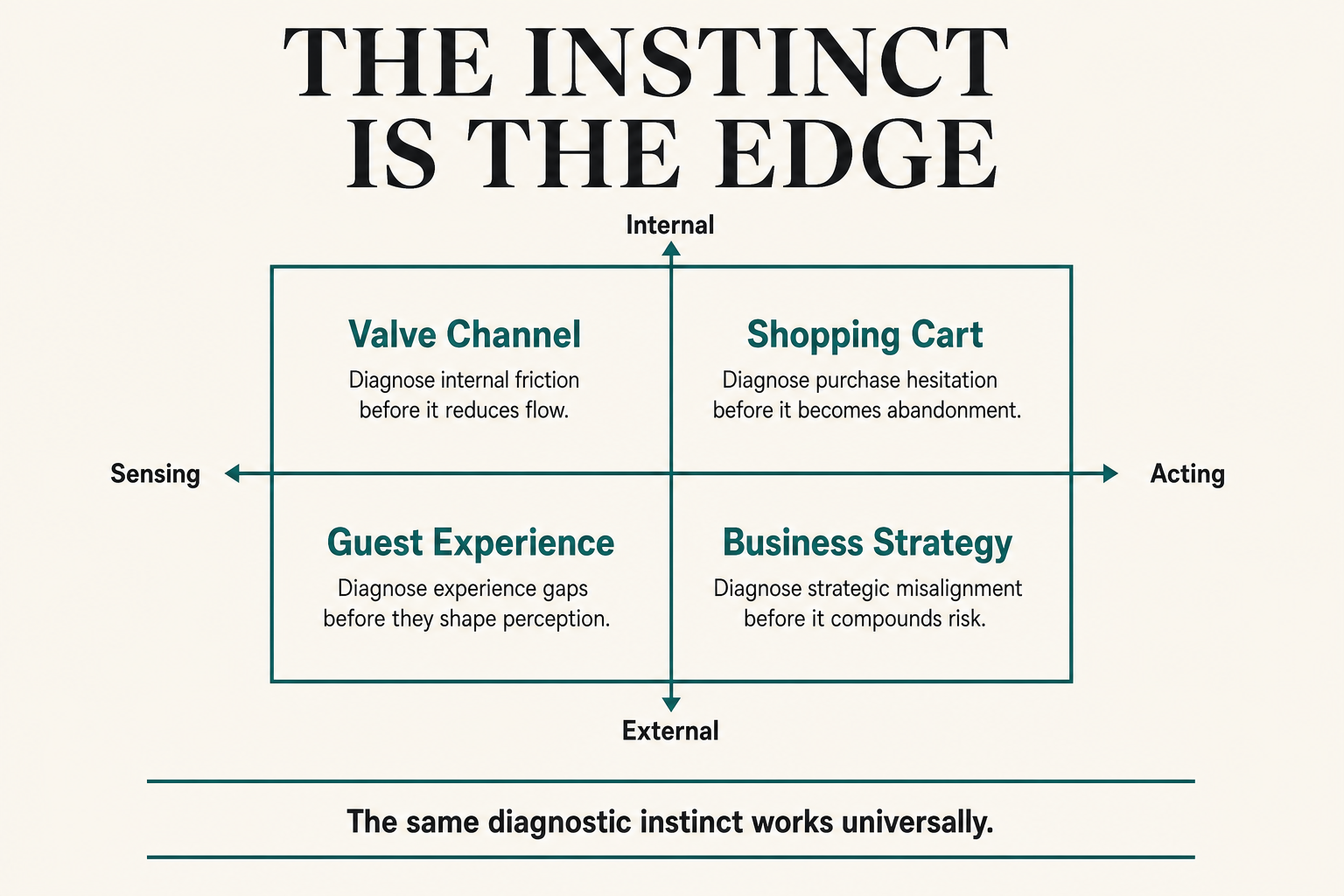
None of those three questions belongs to an industry. A valve, a shopping cart, and a rented villa each answer them differently, but the questions themselves never change. That is the whole point. The operator is not bringing answers across industries. They are bringing the questions, and the questions are portable.
This is why pattern recognition across unrelated sectors is worth more than depth in one. The owner stuck inside a single industry has seen their problem only in the costume their industry dresses it in. The operator who has seen the same structural problem in three costumes recognizes it on sight, before it has finished introducing itself.
You do not bring answers across industries. You bring the questions, and the questions never change.
The depth specialist knows one thing very well. The instinct knows one shape, and recognizes it everywhere.
One Instinct, Three Worlds
Watch the same sequence run in three businesses that have nothing to do with each other.
A specialty valve maker presents to a Fortune 500 distributor. The pitch lands. The distributor is interested, then says go get this approved by our end users so we can buy it. The distributor could advocate. The distributor could not approve. The product had not lost. The relationship had not cooled. Permission simply lived downstream, with the refineries that gate critical-service parts, and approval there runs months to years. The loud story was a sales conversation that went well. The real story was a permission structure that nobody upstream controlled.
An early online art-supply store hits Christmas. Orders surge, and the paper pick lists send pickers walking the warehouse in a bad order, every trip longer than it needed to be. The loud problem looked like volume. The load-bearing problem was the route. The fix was first-generation barcode scanners that ordered the picker's path and validated each pick by scanning the shelf, then the item.
A forty-acre property near Round Top gets designed before a single finish is chosen, around how a group actually uses a weekend. Where they gather. Where someone takes morning coffee. Where everyone lands at sunset. The question was never what a luxury rental should look like. The question was what the guest is actually buying, which is a setting and a level of execution, not a big house with good photography.
Three industries, three costumes, one shape underneath. The instinct read it the same way every time.
Valve channel, shopping cart, guest experience. Where permission lives. Which problem bears the weight. What is actually being bought. The answers were unrecognizable to each other. The sequence was identical.
How to Tell If This Is You
The instinct is not magic, and it is not reserved for outsiders. It is a discipline of attention you can run on your own business this afternoon. Check yourself against these.
- Permission: Can you name the exact person or body that says the final yes, and is that the same place your effort is currently pointed?
- The loud versus the load-bearing: What is everyone complaining about, and is there any evidence it is the thing actually holding the problem in place?
- The real purchase: If you ask three honest customers what they bought, do their answers match what you think you are selling?
- Your blind spots: Which explanations does your industry hand you automatically, and have you ever tested whether they are true here?
- The outside read: When did someone with no industry knowledge last look at this, and did you dismiss what they saw because they did not know the business?
- The standard cause: When something breaks, do you reach for the reason your industry already has a name for, or do you watch what is happening first?
If those questions feel uncomfortable, that discomfort is the signal. It usually means the answer you have been operating on is the industry's answer, not the one in front of you.
The edge that transfers is not what you know about your industry. It is whether you can still see your industry clearly enough to ask the questions it trained you to skip.
Knowledge ages and stays put. Instinct travels. The operator who keeps the questions sharp can walk into a business they have never seen and find the real problem before the experts finish describing the loud one.