
The Owner Is Not the System, Even When the Owner Built It
Ask ten owners what their system does and most will describe what it tracks. Ask what it decides, and the room gets quiet.
That gap is not a technology problem. It is a judgment problem wearing a technology costume.
Every owner who has built something worth running carries a set of decisions in their head that never got written down. When to quote fast and when to wait. Which client gets the benefit of the doubt. What "good enough" actually means on a given day, for a given job.
The system, if there is one, usually just moves paper. The judgment still lives in the owner.
The Question Nobody Asks About Their Own System
Most owners will tell you, without hesitation, that they want to build a business that does not need them every hour of every day.
Then watch what they actually build. A CRM that logs activity but cannot tell a salesperson what to quote. A booking calendar that takes reservations but cannot decide what the guest is allowed to touch. A dashboard that reports what happened, cheerfully, after the moment to act on it has passed.
These systems are not wrong. They are incomplete in a specific way. They capture information. They do not capture judgment.
The tell is simple. If the system goes down, or the owner goes on vacation, does the business slow down because people are waiting on data, or because people are waiting on a decision only the owner knows how to make?
Most owners have never separated those two failure modes. They assume both mean the same thing: the system isn't good enough yet.
A system that only moves information has not replaced the owner. It has just given the owner a faster desk.
What a System Is Actually For
Here is the distinction that matters, and it is easy to miss because both things look like "technology" from the outside.
There is technology that records what the owner would decide. And there is technology that makes the decision the owner would have made, without asking.
The first kind is documentation. Useful, but it still routes back to a person. The second kind is leverage. It is the owner's judgment, extracted from the owner's head, and pressed into something that runs without a heartbeat.
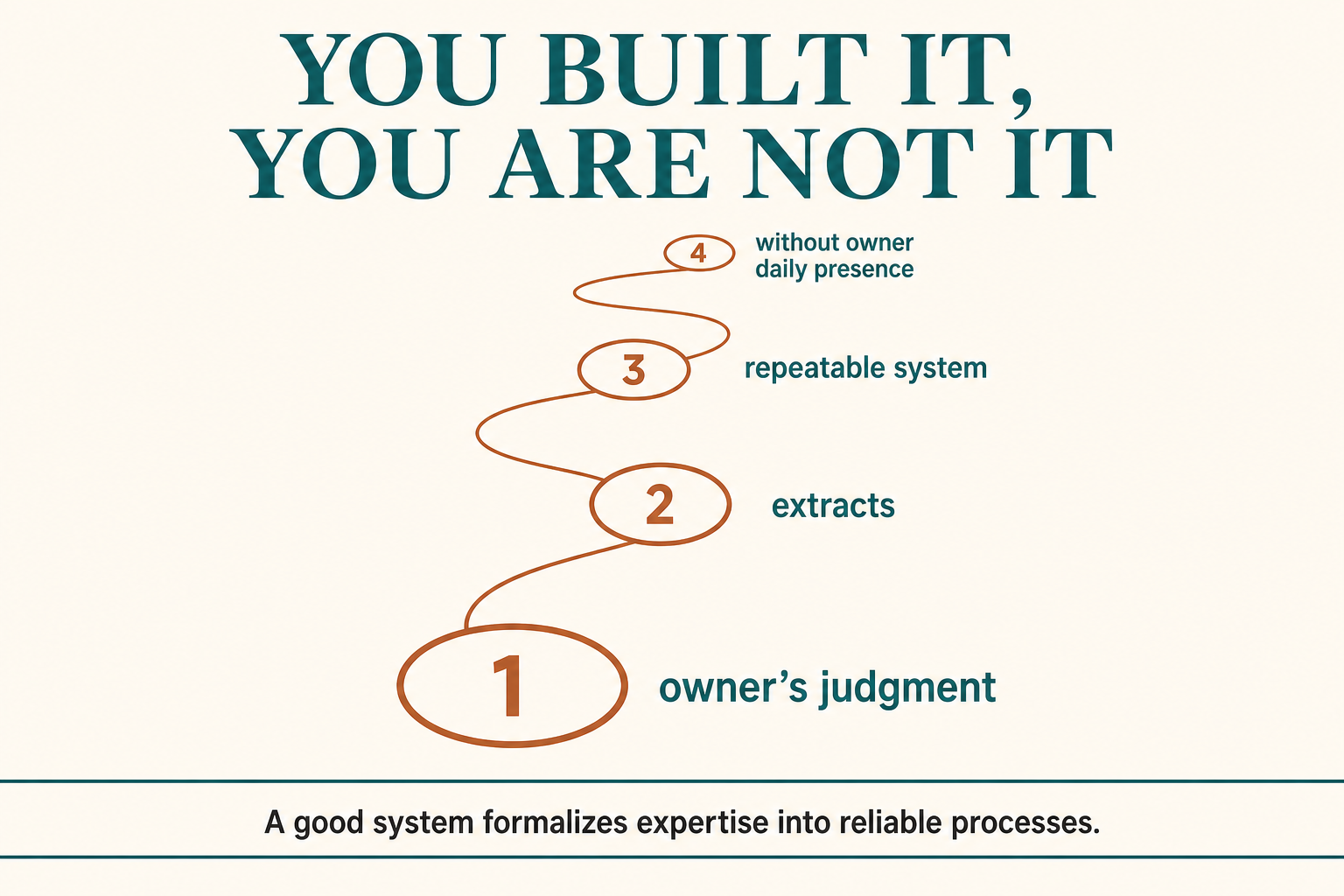
Think about what judgment actually consists of, in most owner-run businesses. It is rarely mystical. It is usually a small number of repeatable calls, made under time pressure, based on information the owner has learned to weigh a certain way.
A quote gets issued fast because the owner has learned, through pattern, what a fair number looks like for that part, that customer, that moment. A guest gets a certain level of access because the owner has learned, through pattern, what a paying guest at that price point expects to be able to do without asking anyone.
Neither of those calls requires the owner personally. They require the pattern the owner has already worked out.
Judgment is not a mystery. It is a pattern the owner has already solved and never written down.
The job of a real system is to find that pattern, encode it as a rule, and let the rule act in the owner's place. Not perfectly. Not forever without revision. But well enough, most of the time, that the business does not stall waiting for a person who is in a meeting, asleep, or simply not in the mood to think about it right now.
This is a different design question than most owners are asking. Most owners ask, "How do I track this better?" The better question is, "Which of my own decisions is repetitive enough to hand to a rule?"
Once you frame it that way, you start looking for the specific moments where the owner's judgment is the bottleneck, not the information.
Where the Judgment Actually Lived
A quoting system built for a valve distribution business was not, at its core, a tracking tool. Salespeople needed to know the status of an inquiry, yes, but the real problem was slower and more expensive: every quote sat waiting on a manufacturer to confirm spec and pricing, and in an industry where buyers default to whoever answers first, that wait was the whole game.
The fix was not a better spreadsheet. It was a historical pricing database, built SKU by SKU, that let the system issue an instant quote based on what that exact part had priced at before. The system was making the pricing call the owner would have made, on the belief that it is better to ask forgiveness than permission, because speed itself was the edge.
A guest-control system built for a short-term rental property carried the same shape, in a completely different setting. The owner's judgment there was about experience: which lighting scene fits sunset on the patio, how the pool and fire pits should behave without a staff member walking over to adjust them. A custom Home Assistant build let guests operate all of it themselves, correctly, without ever needing to find the owner or a caretaker.
Neither system eliminated the owner. Both extracted a specific, repeatable piece of the owner's judgment, the pricing call in one case and the experience standard in the other, and let it run on its own.
The system did not replace the owner's judgment. It just stopped requiring the owner to be present to use it.
That is the actual target. Not a business that runs with no owner in it anywhere. A business where the owner's best calls keep happening on the days the owner is somewhere else entirely.
Where to Look First
Before building or buying anything, an owner should be able to answer these honestly:
- What decision do I make so often that I could describe the rule for it in one sentence?
- When that decision has to happen and I'm not reachable, what actually happens instead: a delay, a guess, or a rule?
- Does my current system store information about this decision, or does it make the decision?
- If I disappeared for a month, which parts of the business would degrade because a person was missing, versus because a judgment call was missing?
- Am I building this system to make myself faster, or to make myself unnecessary for this one specific call?
- What would it look like if this exact decision were made correctly, by someone or something else, a hundred times in a row without me?
A system has done its job when it makes the owner's best decision without the owner making it.
That is not the same as making the owner irrelevant. It is making the owner's judgment portable, so it shows up even on the days the owner does not.