
The Platform Owns the Guest Until You Take Them Back
A guest stays four nights at a property, loves it, books again the following year, brings friends the year after that. Ask them where they stayed and many will say the name of the app, not the name of the place. The booking lived in their phone, the messages lived in a thread inside the platform, the payment cleared somewhere they never saw. They had a wonderful time at a house whose owner they could not name.
That is not an accident. It is the design working exactly as intended. The platform spent years and a great deal of money to sit between you and the person who slept in your bed, and it does the one thing that protects its position. It owns the memory.
What the Platform Quietly Keeps
Platforms are genuinely useful. They create visibility you could not buy on your own, they carry trust you have not yet earned with a stranger, and they deliver volume on a slow week. None of that is in dispute.
The question is what they take in exchange, and the honest answer is most of the relationship. They own the search ranking that decides whether anyone sees you. They own the communication layer, so every message routes through them. They own the cancellation policy, the fee structure, the review that follows you, and the guest's contact information. They own the guest's memory of where they stayed.
Each of those, on its own, looks like a fair trade for distribution. Together they add up to something else. If the only thread connecting you to a guest who loved your property runs through a company that can change its rules tomorrow, you do not have a guest. You have an introduction the platform can revoke.
If the only thread connecting you to a guest runs through the platform, you do not have a guest. You have an introduction the platform can revoke.
Two Kinds of Demand
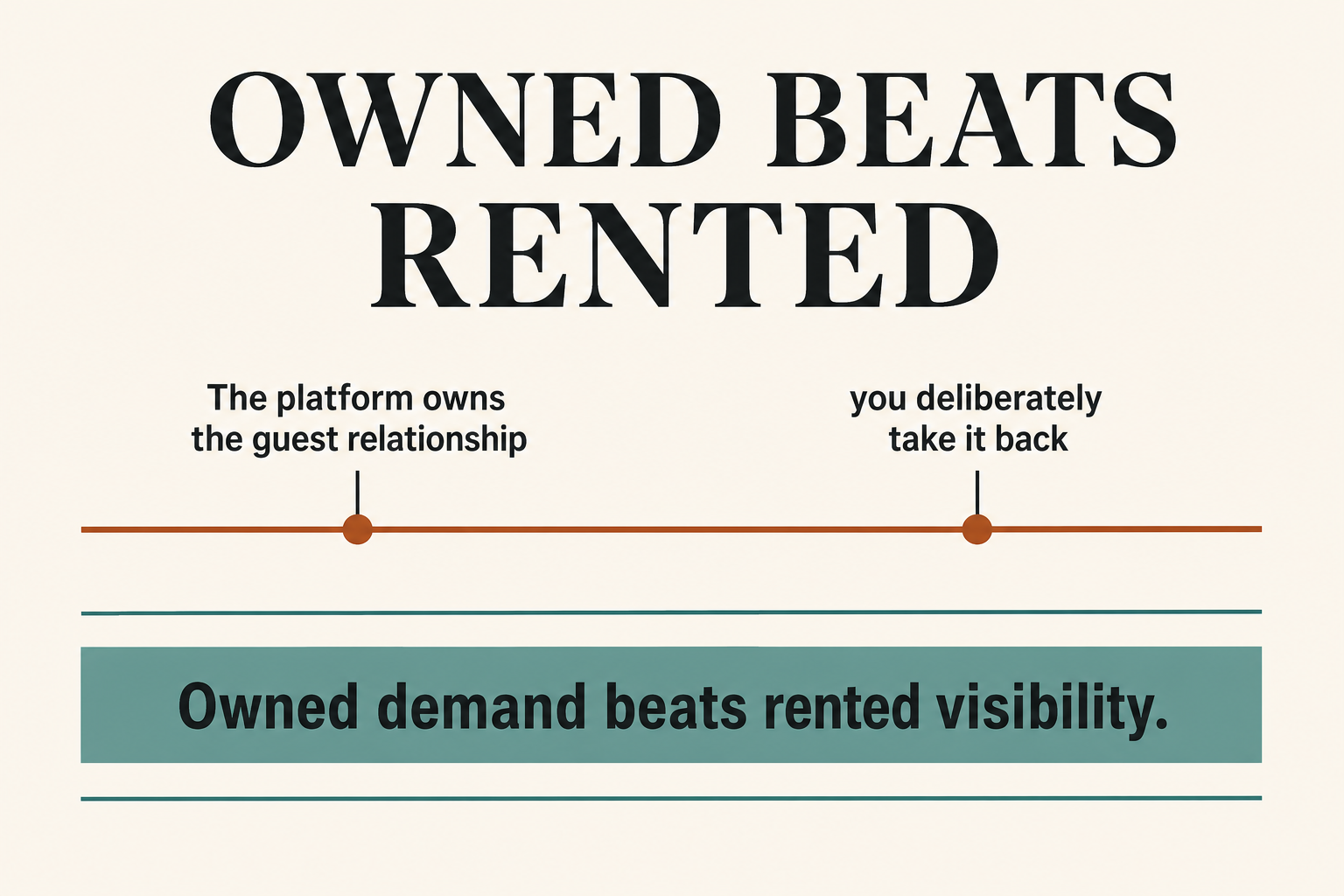
Here is the distinction that decides everything downstream. There is rented visibility, and there is owned demand, and they are not the same business even when they produce the same booking.
Rented visibility is what the platform sells. You pay for it every time, in fees and in margin and in the fact that you compete on the same screen as a hundred near-identical listings. The moment you stop paying, in money or in algorithmic favor, it disappears. You never accumulate anything. Each booking starts from zero.
Owned demand is the guest who comes back to you, by name, on purpose. It is the inquiry that arrives because someone told a friend, or because last year went well and they want next year locked before anyone else gets the dates. It compounds. Every good stay makes the next booking easier and cheaper to win, and over time the relationship, not the listing, becomes the asset that holds value.
The tell between them is in how the guest reaches out. A rented-visibility guest asks one question: is it available, and what does it cost. A owned-demand guest opens differently. They explain what they are trying to create. A family reunion, a women's retreat, a milestone birthday, the weekend before a wedding. They are not pricing a bed count. They are asking whether the setting will hold the thing that matters to them.
A commodity guest asks if it is available. A relationship guest tells you what they are trying to create.
That second guest is worth far more than a single booking, and not because they spend more on one stay. They are worth more because they return, they refer, and they treat the place as somewhere that belongs in their life. That is lifetime value, and you cannot build it through a layer you do not control.
The way you take the guest back is not a clever workaround or a rule you bend. It is the experience itself, run so the relationship has somewhere to live after checkout. The platform can carry the first introduction. What happens inside the stay is yours.
Where the Relationship Actually Forms
At the premium end this becomes concrete fast. A guest paying a high rate is not buying a place to sleep. They are buying confidence that the weekend they have been planning will not go wrong, and they want to know a real person stands behind the property when it counts.
Operating Element Ranch as a premium rental made the line visible. A budget operator sends a template the moment an inquiry lands and considers the job done. For a property where a family is gathering for a once-a-year weekend, the template is the wrong move. The better response understands the purpose of the trip, answers the actual concern instead of the generic one, and gives honest guidance about whether the setting fits.
That is not concierge theater. It is being thoughtful in the few places it changes the outcome. For a women's gathering or a wedding stay, the tone of the reply is part of the product, because it tells the guest a person is paying attention.
Then the stay has to match. The asset gets the attention; operations protect the revenue. Consistency, cleanliness, maintenance, vendor reliability, the small things handled before the guest notices them. At the premium end the same minor inconvenience that is merely annoying in a cheap rental reads as off-brand in a luxury one. You cannot build a premium property and operate it casually.
The asset gets you the attention. Operations are what protect the revenue.
When the experience holds, the guest comes back to you directly the next time, and the platform's grip on the relationship loosens on its own.
How to Tell Who Owns Your Guest
Run your own situation through these. The answers show you how much of your demand you actually own.
- Inquiries: Do guests reach out asking only about availability and price, or do they tell you what they are trying to create?
- Repeat business: When a past guest returns, do they find you again through the platform, or do they come straight to you by name?
- The contact: After a great stay, do you have any way to reach that guest without the platform's permission?
- The response: Does your first reply read like a template, or like a person who understood what the trip is for?
- The standard: Does the way you operate match the level of the asset, or does the experience quietly fall below what the property promised?
- The dependency: If your top platform changed its rules or ranking tomorrow, how much of your bookings would survive?
Distribution is something you rent every month; the guest relationship is the only thing you ever get to keep.
The platform will hold the guest as long as you let it. The work of taking them back is not a trick. It is running the stay well enough that the guest wants to find you on their own.