
The Visible Problem Is Rarely the Real One
A company decides its sales are weak, so it hires more salespeople. Six months later sales have not moved, and now the payroll is heavier. The owner concludes the new hires were the wrong people, and starts the cycle again.
Nobody in that loop ever asked whether selling was the problem.
This is the most expensive pattern in business, and it is almost invisible while it happens. A symptom shows up loud and clear. Someone names it as the problem. Money gets spent fixing the named thing. The symptom persists, because the thing that was named was never the cause. The spend was real. The diagnosis was not.
The trap is that the visible problem is always honest. Sales really are weak. The complaint is true. It just is not the cause.
The Symptom Announces Itself
A symptom is loud by design. It is the part of the problem that touches you directly, so it gets your attention first and hardest. The number that missed. The customer who left. The order that did not close.
Because it reaches you first, you assume it is closest to the source. It usually is not.
The cause sits upstream, quiet, structural, and out of view. It does not announce itself. It does not show up on the dashboard with a red arrow. You only find it by tracing the loud thing back to where it actually started, which takes patience the symptom is actively pushing you to skip.
So most owners skip it. They treat the thing they can see as the thing they can fix, and they spend accordingly.
The visible problem is always honest. It is just rarely the cause.
Trace It Back Before You Spend
There is a discipline that separates owners who fix problems from owners who fund them. It is not complicated. It is just unnatural under pressure.
Before spending a dollar on the visible problem, ask one question: what would have to be true for this symptom to exist? Then keep asking it backward until you reach something you can act on that the symptom alone never pointed to.
Sales are weak. What would have to be true? Maybe the salespeople are weak. Or maybe the people you are selling to cannot say yes. Or maybe the thing you are selling cannot enter the situation at all without a step you have not taken. Those are three completely different causes, and only one of them is fixed by hiring.
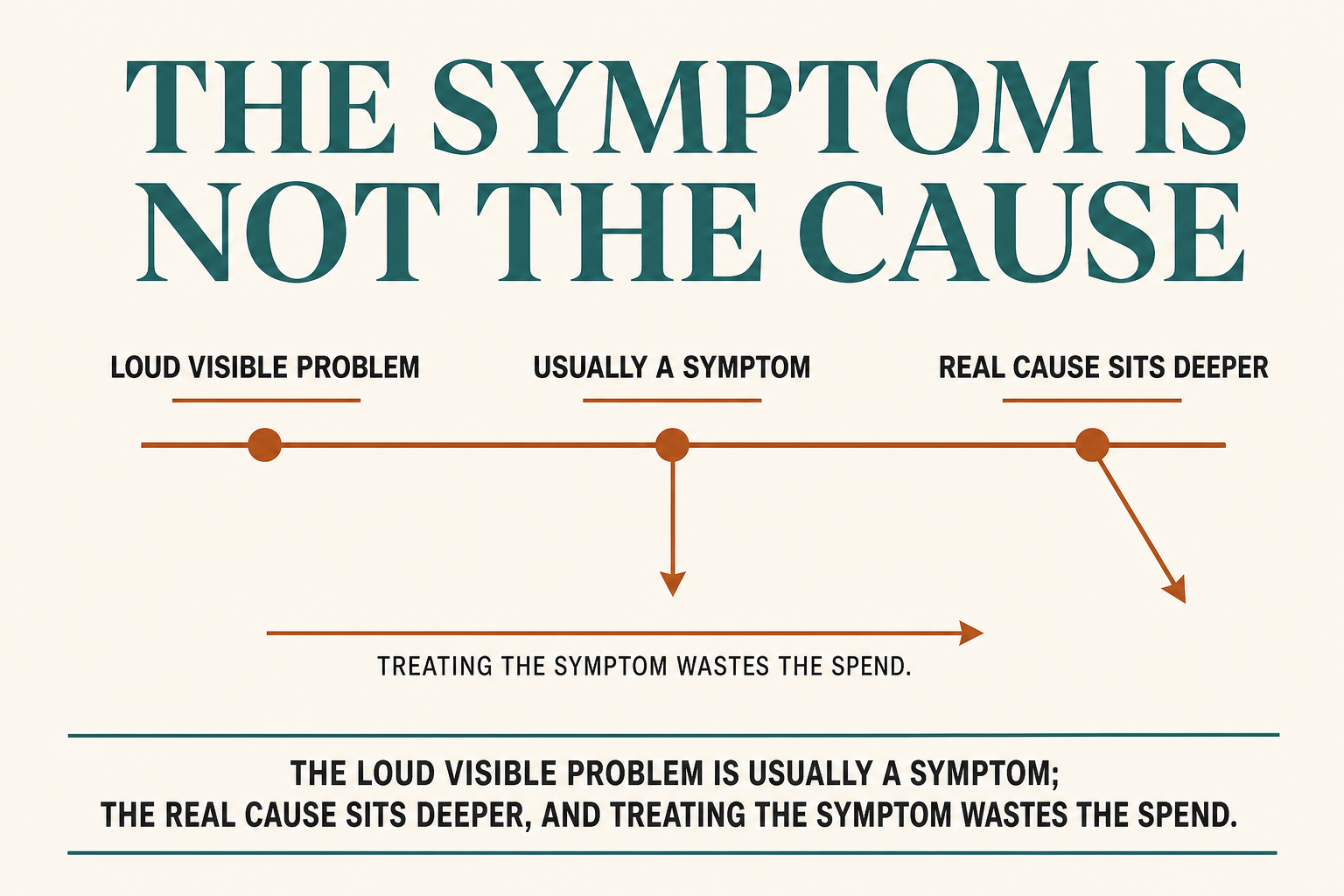
The framework is a sequence, and the order is the whole point.
First, separate the symptom from the cause. Write down the loud problem in one sentence. Then write down, honestly, whether you actually know what produces it, or whether you are assuming. Most owners cannot tell the difference between the two without forcing themselves to write both lines.
Second, find where permission actually lives. Many commercial problems are not preference problems at all. They are permission problems. The person who likes your offer and the person who can authorize it are often not the same person, and they are often not even in the same building.
Third, match the spend to the cause, not the symptom. Only after the first two steps do you know what the money is for. Spend before that, and you are funding a guess.
The reason this matters is that spending on the wrong cause does not feel like waste while you do it. It feels like action. It feels responsible. You are doing something about the problem. The cost only becomes visible later, when the symptom returns unchanged and the money is gone.
A symptom you fund instead of diagnose comes back at full strength, and now you are poorer.
What the Valve Actually Needed
Consider a manufacturer of specialty and alloy valves, the critical-service kind, trying to enter the U.S. market. The visible problem looked simple. Not enough buyers. The natural response was to go find buyers, knock on doors, present the product, build preference.
So that is what got done first, before the structure was read correctly.
Then came a presentation to a Fortune 500 distributor. It landed well. They were genuinely interested in the product. And then they said the thing that revealed everything: go get this approved by our customers, the end users, so we can actually buy it.
The distributor liked the valve. The distributor could not buy the valve. The permission to purchase lived downstream, with the end users who would never allow an unapproved critical-service component into service. Some of those approvals took months. Some took years.
The visible problem had been "we need buyers." The real problem was "the people who can say yes are not the people we are talking to, and there is a gated process we have not entered." Every door knocked before that was understood was effort spent on the symptom.
The distributor wanted it and still could not buy it, because permission lived somewhere the selling never reached.
The fix was not more selling. It was to stop selling to preference, understand the approval path, and follow it. Different problem, different spend, different result.
How to Tell If This Is You
Before you fund the loud problem, run it through these. If you cannot answer them cleanly, you are about to spend on a symptom.
- The cause test. Can you state, in one sentence, the mechanism that produces the problem? If you can only describe what you see, you have a symptom, not a diagnosis.
- The permission test. Does the person you are selling to actually have the authority to say yes? Or does the real yes live somewhere upstream or downstream that you have not mapped?
- The "what would have to be true" test. Trace the symptom back at least two steps. Does each step hold, or are you assuming a link you have never checked?
- The spend-match test. Name exactly what the money is supposed to change. If it changes the symptom but not the cause, the symptom will return.
- The repeat test. Have you spent on this problem before? If the same complaint keeps coming back after you fund it, you have been treating the symptom every time.
- The skip test. Are you rushing past diagnosis because the symptom feels urgent? Urgency is exactly how a symptom gets you to fund it.
The money should follow the diagnosis, never the noise.
The loud problem will always feel like the real one, because it is the one touching you. Trace it back first. The cause is almost always quieter, and almost always somewhere you were not looking.