
Time, Not Price, Kills Land Deals
A buyer looks at a piece of raw land and prices it like a number. So many acres, so much per acre, a comparable sale down the road, a spread between what it costs and what it could become. The arithmetic is clean. The land sits there, the price holds, the upside is visible on the back of an envelope.
Then the deal closes and the clock starts. Not the construction clock, which most buyers have priced. The other one. The permitting clock, the entitlement clock, the clock that runs while a county commission decides whether to put the item on next month's agenda. That clock has no fixed length, and it bills the whole time.
The Number Everyone Checks
Land underwriting tends to anchor on two figures: acquisition cost and exit value. Both are knowable. You can comp them, argue them, defend them in a meeting.
What sits between them gets treated as a line item rather than a variable. Carrying cost. Interest on the acquisition loan, property taxes, insurance, the soft cost of capital that could be working somewhere else. On a spreadsheet it is a small monthly number, easy to wave past.
The trouble is that the small monthly number multiplies by a length nobody actually controls. Entitlement is not a task you complete on your own schedule. It is permission granted by people who do not work for you, on a calendar that is not yours, subject to objections you cannot predict.
A rezoning that takes six months and one that takes thirty months can sit behind the identical price per acre. The land looks the same. The return does not.
The price is the part you negotiate. The time is the part that negotiates you.
Where the Real Risk Lives
The discipline most buyers apply to price, they should apply to the calendar. Not as a footnote, as the first question.
Three things drive the entitlement clock, and none of them respond to how good your project is.
First, who holds permission. Sometimes it is a single zoning board. Sometimes it is a board, plus a utility district, plus a state environmental review, plus a neighbor with standing to appeal. Each gate adds time, and the gates run in sequence, not in parallel. You cannot start the second until the first clears.
Second, how predictable the body is. A jurisdiction with clear standards and a track record of approving conforming projects is a known quantity. A jurisdiction where outcomes turn on the mood of the room is not. The second one is not necessarily a no. It is an unknown length, which for underwriting purposes is worse than a longer known one.
Third, what can stop the clock entirely. An appeal, a moratorium, a referendum, a change in the comprehensive plan. These are not slow. They are full stops, and they arrive after you already own the land and are already paying to hold it.
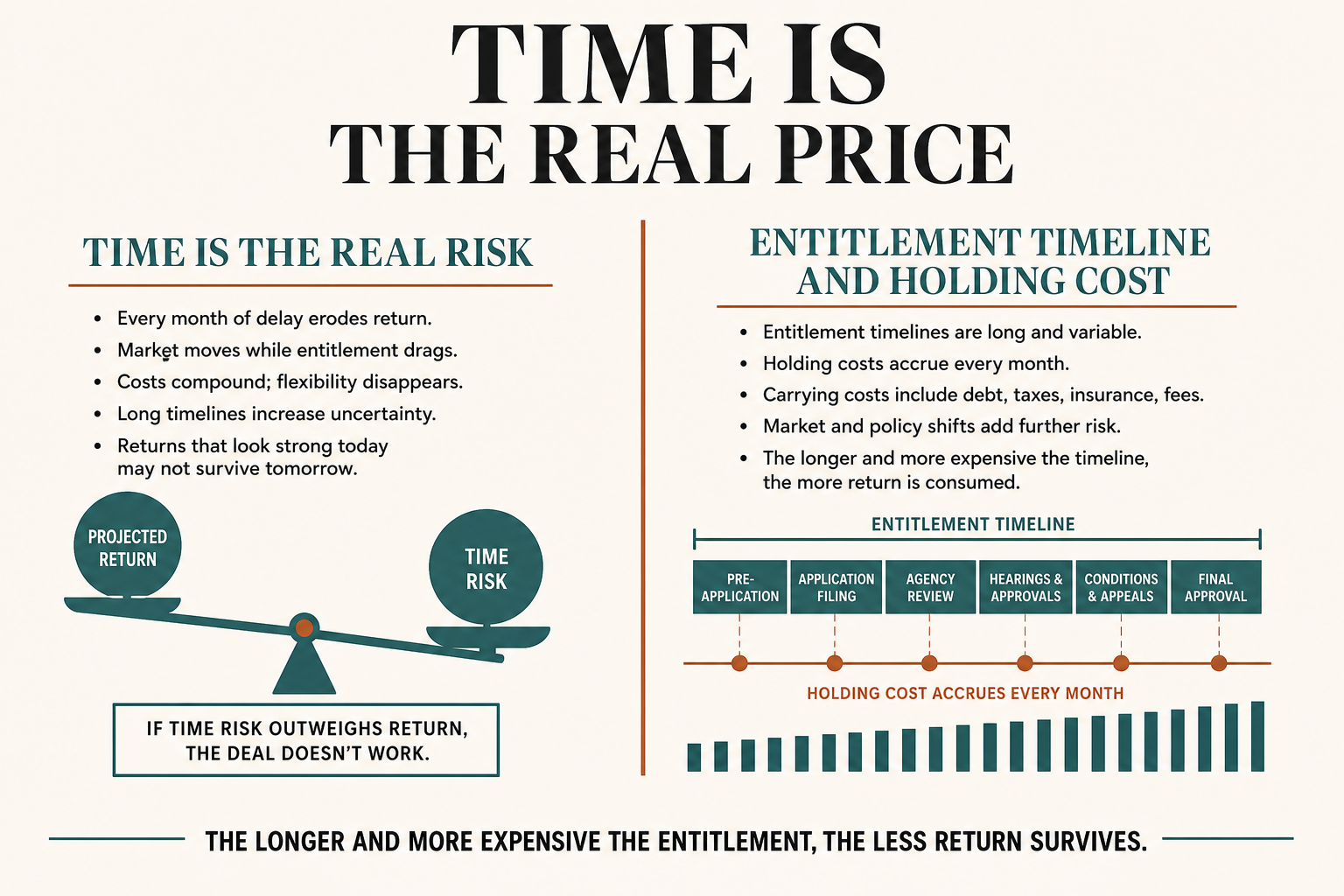
Put those three together and you get the real shape of a land deal. The price sets the floor. The timeline sets the return. A great basis on a parcel that takes four years to entitle can lose to a mediocre basis on one that clears in eight months.
A great basis on a four-year parcel loses to a mediocre basis that clears in eight months.
This is why the most useful work happens before the offer, not after. You are not just buying land. You are buying a position in someone else's approval process, and that process has a meter running.
A Property Built Before the Permits
The instinct to do the slow, expensive work early is not unique to entitlement. It shows up anywhere the cheap path looks identical to the right one until much later.
When we built the Villa at Element Ranch, the easy version was available and obvious. Frame a big house, fit the maximum bedrooms, buy trendy furniture, photograph it well, call it a ranch retreat. That path is fast and cheap, and it produces a commodity that depends entirely on the photos holding up better than the visit.
We did the slower thing first. Before any finish was chosen, we worked out how a group actually moves through the place over a weekend. Where they gather, where someone has coffee alone in the morning, where everyone lands at sunset. That decided the layout, the pool area, the scale of the shared spaces. It cost more, because large common spaces and real sightlines are not the cheapest way to build.
The point of doing it first is that it cannot be added later. You cannot value-engineer a sightline back in after the walls are up. You cannot fake the weight of real materials with a finish budget at the end.
You cannot value-engineer a sightline back in after the walls are up.
Entitlement risk is the same shape, inverted. The cheap path is to price the land and figure out the timeline later. But the timeline, like the layout, is decided early or not at all. By the time you are paying to hold a parcel through an appeal, the decision that mattered was the one you made before you bought.
Where to Look First
Before you sign, before you anchor on price per acre, run the parcel through the clock, not just the comps.
- Who has to say yes: List every body whose approval you need, and whether they act in sequence or in parallel. Count the gates, not just the first one.
- How long it actually takes: Find the last three comparable approvals in this jurisdiction and how many months each ran from application to shovel. Use their calendar, not your hope.
- What the carrying cost is per month: Interest, taxes, insurance, cost of capital. Multiply it by the realistic timeline above, not the optimistic one. That product is your real entry price.
- What can stop it cold: Identify the moratorium, the appeal path, the referendum, the comp-plan change. Ask what it costs you to sit still if one of them hits.
- How predictable the decision-makers are: Conforming project in a by-right jurisdiction, or a discretionary approval that turns on the room. Price the unknown length, not the average one.
- Whether you can walk: Structure the option, the contingency, the entitlement period inside the contract. If the clock runs long, you want an exit before you own the holding cost.
Underwrite the calendar with the same discipline you give the price, because the calendar is where the return actually lives.
A good basis is a starting point, not a deal. The deal is decided by how long someone else takes to let you build, and by how much it costs you to wait.