You Are Buying Permission, Not Land
Two parcels sit across a county road from each other. Same acreage, same soil, same gentle slope down to a creek, same oak cover. One sells for three times the other.
The buyer who pays the premium is not paying for the dirt. The dirt is identical.
He is paying for what the county will let him do with it. One parcel is entitled for a use that produces income. The other is not, and getting it there will take months, public hearings, and a fight he may lose. The land is the same. The permission is not, and the permission is the whole difference in price.
Most buyers know this in theory. Then they walk a site, fall for the view, and start pricing finishes in their head before they have read a single line of the zoning.
The Asset You Cannot See On A Walkthrough
When a developer evaluates a property, the eye does the work. He sees frontage, trees, water, a building pad, the way the light falls in the late afternoon. He feels the place. That feeling is real, and it is also the trap.
None of what he is looking at determines the value. The value lives in a document at the county office and in the unwritten preferences of the people who administer it. What is the parcel zoned for. What variances have been granted nearby, and which were denied. How the neighbors organize when something they dislike comes up for hearing. Whether the use the buyer has in mind is allowed outright, allowed with conditions, or not allowed at all.
A buyer who closes before he understands those things has bought a beautiful constraint. The land will hold whatever the rules permit and nothing more. He can love the site and still be unable to build the thing that justified the price.
He can love the site and still be unable to build the thing that justified the price.
The walkthrough sells the dream. The entitlement decides whether the dream is legal.
Entitlement Is The Asset, Zoning Is A Negotiation
Here is the shift that changes how you buy. Stop thinking of zoning as a fixed fact about the land, like its elevation. Start thinking of it as a position in a negotiation that has not happened yet.
A zoning designation is not weather. It was set by people, for reasons, at a moment in time, and it can be changed by people, for reasons, given enough effort and the right argument. That is what entitlement work actually is. You are not discovering the rules. You are negotiating to move them, and the question is never simply "what is it zoned" but "what could it be zoned, who decides, and what will it cost me in time and risk to get there."
This reframes the entire purchase. The real asset is not the acreage. It is the gap between what the land is permitted to do today and what it could be permitted to do, multiplied by your odds of closing that gap.
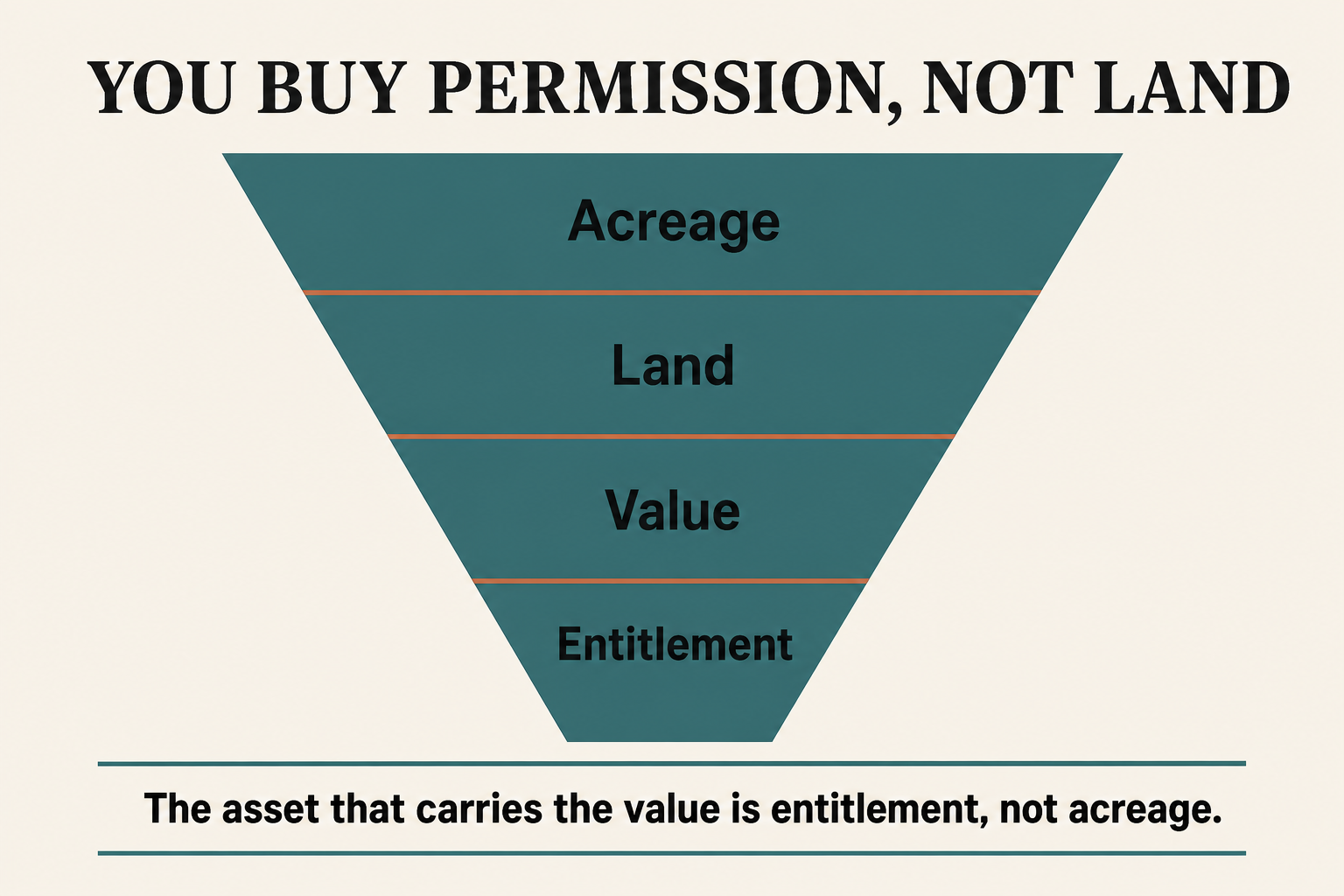
So you underwrite the permission, not the parcel. Three things set the value:
- The current entitlement. What can be built right now, without asking anyone for anything. This is your floor. If the deal only works above the floor, you are betting on a negotiation.
- The achievable entitlement. What the use, the comparable approvals, and the political appetite suggest you could actually win. Not what the code theoretically allows. What this jurisdiction, with these officials and these neighbors, will actually grant.
- The cost of the move. Months of carry, engineering and legal fees, hearings, the chance of denial. Entitlement is rarely free and it is never fast. Price it honestly or it will price you.
A buyer who pays for the achievable entitlement and only owns the current one has overpaid for a fight he has not yet won.
You are not buying land. You are buying the right to do a specific thing in a specific place, and that right has to be earned before it has value.
The dirt was never the point. The permission was always the point.
What The Permission Lets You Build
Consider a roughly 40-acre property near Round Top, Texas, that became a luxury retreat called Element Ranch. The land was the obvious thing. The view, the scale, the quiet. Anyone walking it could feel the appeal.
But the asset that produces a rate well above comparable rural properties was never the acreage. It was the permission to build a private estate on it, designed around how a group actually moves through a weekend. Where people gather. Where someone takes morning coffee. Where the group lands at sunset, when the light moves through the main living spaces out toward the pool and the land.
That experience cost more to build. Large shared spaces and strong sightlines are not the cheapest way to use a footprint. Substantial materials are not the value-engineered choice. But the easy version, a big house with trendy furniture, call it a ranch retreat, is a commodity that depends on good photography.
The land gave them the setting. What they were allowed and willing to build on it gave them the rate.
The lesson runs upstream of construction, all the way to the purchase. Buy a parcel for what it permits, then build what the permission makes possible, and refuse the cut that turns a differentiated asset back into a commodity. The dirt is just where the permission lives.
What To Verify Before You Close
Before you fall for the view, read the value where it actually sits.
- Current entitlement first. What can you build today, with no approvals from anyone? Make the deal work on that floor, or know exactly how much of your price is a bet.
- The achievable, not the theoretical. What has this jurisdiction actually approved nearby, and what has it denied? The code is the ceiling. The pattern of decisions is the truth.
- The decision-makers. Who grants the change you need, and do they want what you want to build, or merely tolerate it?
- The opposition. Who shows up at hearings, and how organized are they when a use like yours comes up?
- The cost of the move. Carry, engineering, legal, hearings, and the real probability of denial. Put a number on each.
- The downside parcel. If the entitlement fight fails, what is the land worth at its current permission, and can you live there?
You are not buying land. You are buying permission, and until the permission is secured, you own a hope with a deed attached.
Underwrite the permission. Build what it lets you build. The dirt will hold whatever the rules allow, and not one thing more.