
You Are Selling Into Two Different Businesses
Two purchase orders land on the same desk, signed by the same buyer, for the same product line. One is needed by Thursday because a pump seal failed and a line is down. The other is part of a plant expansion that will not break ground for fourteen months, and the buyer is still collecting comparisons.
Same company. Same buyer. Same valve, even.
A seller who treats these as one account, with one approach and one timeline, will lose at least one of them and probably both. The first order wants speed and a known answer. The second wants evidence and is in no hurry to give it. They look like one customer because the name on the invoice matches. They are not one customer. They are two businesses with two different clocks.
The Two Clocks Run On Different Fuel
Maintenance, repair, and operations work runs on urgency and memory. Something broke, or is about to. The buyer reaches for what is already approved, already on the shelf, already trusted. He does not want to evaluate. He wants the line running by the next shift. The fuel is speed, and the question underneath every MRO order is the same: can I get the thing I already know works, now.
Project work runs on a different fuel entirely. Nothing is broken. There is time, often years of it, and the buyer's job is not to move fast but to be defensible. He is assembling a record. He compares, he documents, he routes the decision through engineers and end users who will have to live with the choice long after he is gone.
The mistake is selling speed into the slow clock, or asking the fast clock to wait for evaluation.
A buyer in a hurry and a buyer building a record are not the same person, even when they share a chair.
When you pitch your shortest lead time to a project buyer, you answer a question he has not asked. When you ask an MRO buyer to sit through your differentiation story while his line is down, you are the problem, not the solution. The signals you send are correct for one motion and wrong for the other.
Permission Comes Before Preference
Here is the part most sellers miss, and it separates the two motions more than urgency does.
In the fast clock, you are selling to preference. The buyer already has permission to buy you, because you cleared that hurdle long ago. He prefers you, or he prefers your competitor, and the contest is won on availability, price, and the relationship. Preference is the whole game once you are in.
In the slow clock, preference is not enough and often does not matter yet. Before a project buyer can prefer you, someone downstream has to permit you. In critical-service work, the permission to buy does not live with the person holding the purchase order. It lives with the end user who specifies, approves, and qualifies what is allowed into service.
This is the structure under the noise. A distributor can love your product, present it internally, champion it in the room, and still be unable to buy a single unit. Not because they cooled on you. Because the permission to buy was never theirs to give.
A buyer who likes the product and the conversation can still be structurally unable to buy.
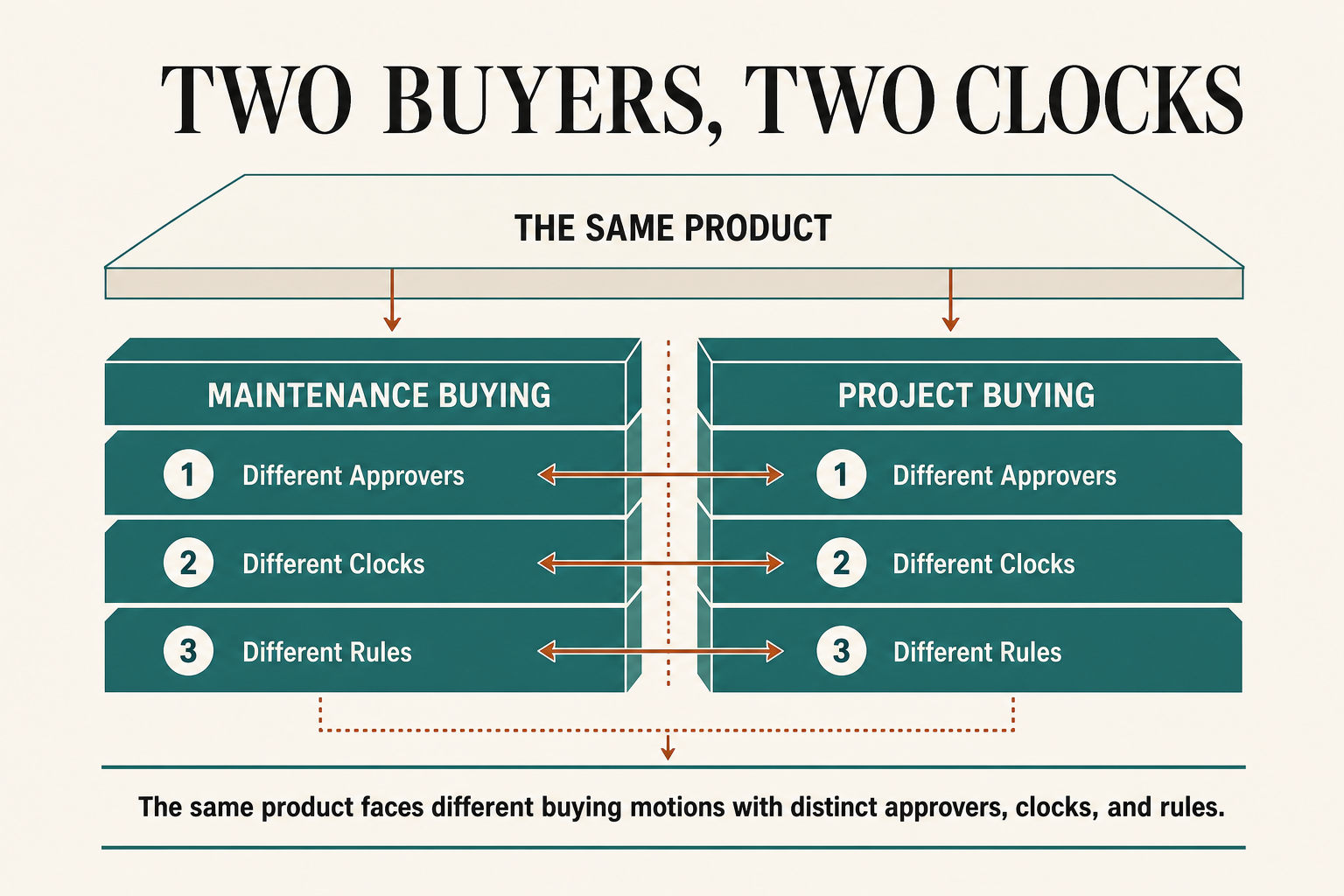
So the two motions are not just two speeds. They are two different maps of where the decision actually lives.
- In MRO, the decision lives with the buyer, and the work is being preferred.
- In project work, the decision lives downstream with the end user, and the work is being permitted.
Sell preference into a permission market and you spend months charming someone who cannot say yes. Sell permission into a preference market and you over-engineer a sale that wanted nothing more than your part number and a ship date. The skill is not working harder in one channel. It is reading which channel you are actually standing in before you open your mouth.
What The Distributor Could Not Do
A Mexican maker of specialty and alloy valves, not commodity valves but critical-service components, set out to enter the U.S. market. The early effort treated entry as a matter of knocking on doors. Find the buyers, make the pitch, win on the merits.
The pitch worked. A Fortune 500 distributor saw a presentation, and it landed. They were genuinely interested. The product was good and they knew it.
Then they said the thing that reorganizes everything. Go get this approved by our customers, the end users, so we can actually buy it.
The distributor liked the valve. The distributor could not purchase the valve. The permission lived downstream, with end users who would not allow an unproven critical-service component into service without their own qualification. And that approval was not quick. Some end users took months. Some took years.
The distributor liked it and still could not buy. The permission lived somewhere else entirely.
The right move was not more selling. It was to stop selling to preference and to first understand the approval process, then follow it. Door-knocking is the MRO motion, the preference motion, applied to a market that ran on permission and a slow clock. The doors opened. They just did not lead to a purchase order, because the purchase order was never the distributor's to write.
How To Tell Which Business You Are In
Before you set a price, a timeline, or a follow-up cadence, find out which clock you are on. The signals are there if you ask.
- Is something broken? If a line is down or about to be, you are in the fast clock and the buyer wants a known answer, not a better one.
- Whose name is on the spec? If an end user or engineer has to approve the part, the buyer in front of you holds preference but not permission.
- What is the buyer's real job here? Restoring service is one job. Building a defensible record is a different job with a different pace.
- How long is the timeline they admit to? Months to years is a permission market. This week is a preference market. The gap tells you everything.
- Can the person you are talking to actually say yes? If they can only advocate, you are not at the decision. You are upstream of it.
- Are you being asked to differentiate, or to confirm? Differentiation belongs to projects. Confirmation belongs to MRO.
- Where does the approval actually live? Name the person. If you cannot, you have not found the sale yet.
One customer can be two businesses, and the channel you misread is the channel you lose.
Read the clock first. Then decide whether the work is to be preferred or to be permitted, because no amount of effort in the wrong motion ever becomes the right one.