
You Cannot Out-Market a Weak Offer
A company doubles its ad spend. Traffic climbs. The cost per click holds, the landing page tests well, the email open rates are healthy. Every number the marketing team owns moves in the right direction.
Revenue barely twitches.
The owner, who paid for all of it, sits with a report full of green metrics and a bank balance that disagrees. Somewhere between the click and the sale, the engine is leaking, and the marketing dashboard is built to show everything except where.
This is one of the most common patterns I see in commercial businesses, and it is almost always misdiagnosed as a marketing problem. More leads, the thinking goes. Better copy. A sharper funnel. The owner pours money into the top because the top is the only part anyone is measuring.
The leak is rarely at the top.
The Message Is Doing Its Job
Start with what is actually working, because it tells you more than what is failing.
The marketing worked. People saw the offer, understood it, and raised their hand. That is the whole purpose of a message, and the numbers confirm it did exactly that. Attention was captured. Interest was real.
Then the prospect looked closely at what was being sold, and stopped.
Owners skip past this because the marketing metrics look like success. Click-through, time on page, cost per lead, all green. But those numbers measure the strength of the message, not the strength of the thing the message points to. A great ad for a mediocre offer produces a lot of qualified people who decline.
You end up paying full price to attract buyers and then handing them a reason to walk.
A great ad for a mediocre offer produces a lot of qualified people who decline.
This is the gap that gets papered over. The conversation says "we have a traffic problem" while the behavior says "people arrive, understand, and pass." Those are opposite diagnoses. One says spend more at the top. The other says fix what they find when they get there.
What an Offer Actually Is
An offer is not a price and it is not a product. It is the full answer to a single question the buyer asks silently: is what I get clearly worth more than what I give up, with little enough risk that I can decide now.
Break that into the parts that carry weight.
The value is legible. The buyer can see, fast, what changes for them. Not features. Outcomes they recognize as theirs. If they have to translate your description into their own situation, most will not bother.
The exchange is favorable. What they pay, in money, time, and effort, sits clearly below what they get. Not slightly below. Obviously below, so the decision is easy rather than close.
The risk is absorbed. The reasons to hesitate are answered before they are voiced. What if it does not fit, what if it fails, what if I look foolish for choosing it. A strong offer has already taken those off the table.
When all three hold, marketing has an easy job. It points at something good and gets out of the way. When even one fails, marketing is asked to do the impossible, which is to talk someone into a deal that does not actually serve them.
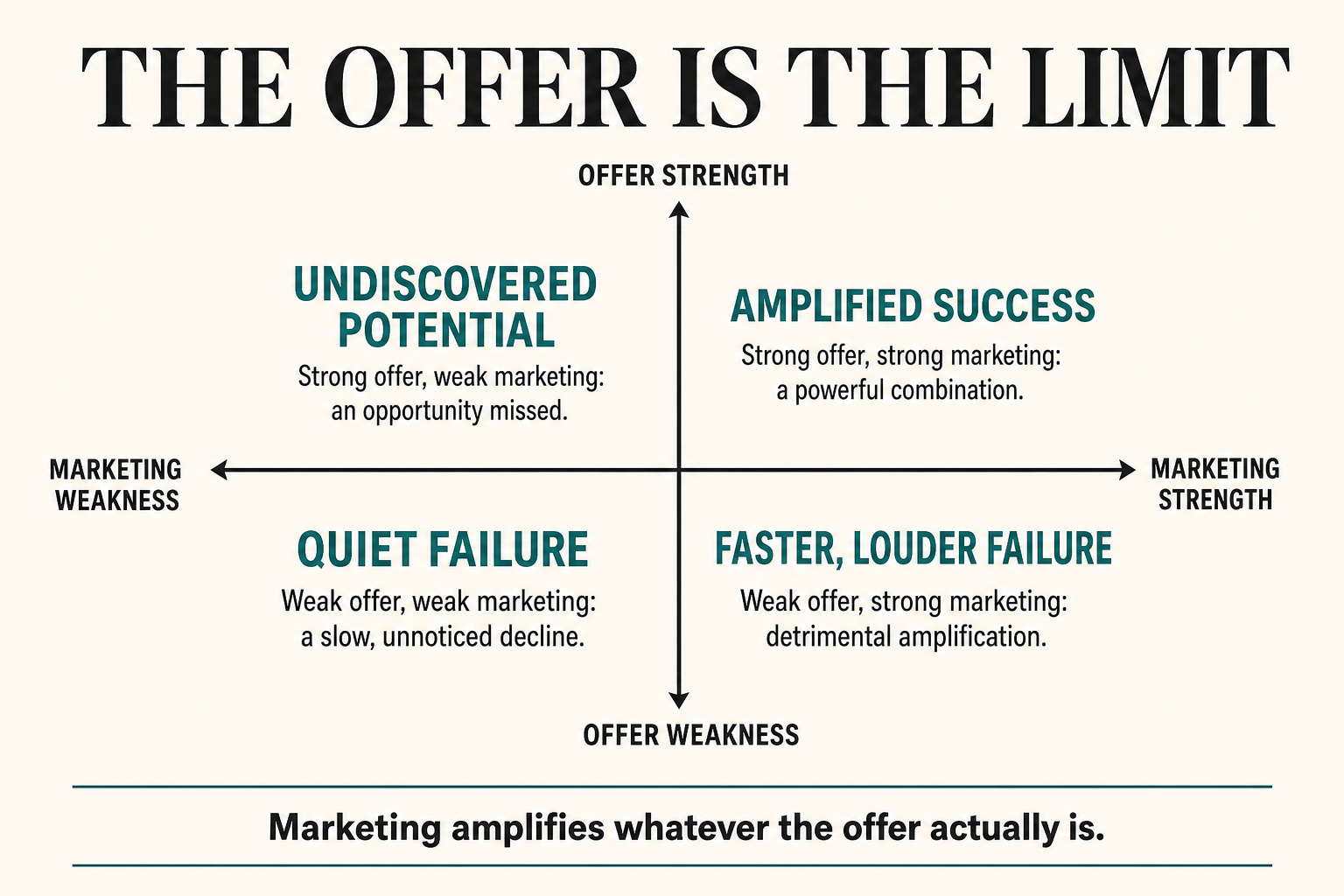
Marketing cannot manufacture worth that the offer does not contain.
This is why spending more so often makes things worse, not just flat. A weak offer that reaches more people produces more declines, more refunds, more support load, more people who tried it and tell others it was not worth it. Volume does not rescue a weak offer. It scales the weakness.
The order is fixed. Get the offer right, then amplify it. Amplify first and you have built a louder machine for losing.
The Spike Tells the Truth
In 1996 I was running an online art-supply retailer, MisterArt.com, with a catalog that ran forty to sixty thousand SKUs. Every one of them had to be digitized, photographed, and copywritten by hand. There was no Shopify, no Stripe, no template. We wrote the cart ourselves and wrote code to drive modems out to the credit-card processors for authorizations. Everything was home grown.
The marketing worked. People came, especially at Christmas, and the orders piled in.
Then the orders hit the back of the house, and the back of the house was paper pick lists. Worse, the lists were not in an efficient pick order, so the pickers wandered the warehouse retracing their own steps. Demand had arrived. The machinery to capture it had not. The front office had made a promise the back office could not keep on time.
The fix was not more marketing. It was first-generation Symbol scanners, programmed to route each picker through the warehouse and to validate every pick by scanning the shelf location and then the UPC. The promise and the delivery finally matched.
Demand exposes the part of the business you were not looking at.
The lesson generalizes past warehouses. A spike in attention does not reward you for the message. It tests everything the message points to. Whatever is weak, the offer, the fulfillment, the experience after the sale, gets revealed under load, not before it.
Where to Look First
Before you approve another dollar of spend, walk these in order. Each is a place the leak hides while the dashboard stays green.
- The decline, not the lead. Of the qualified people who engaged and did not buy, do you know why. If the answer is a guess, you are funding a problem you cannot see.
- The value gap. Can a stranger state what they get, in their own words, in one sentence. If they have to translate, the offer is not legible yet.
- The exchange. Is the trade obviously favorable, or merely defensible. Defensible loses. Obvious wins.
- The unspoken risk. List the three reasons a ready buyer hesitates. If the offer does not answer them, the message cannot.
- The delivery under load. If demand tripled tomorrow, what breaks. The thing that breaks is the thing your marketing is about to expose.
- The order of operations. Are you spending to find the weakness, or spending to scale it. Be honest about which.
Fix the thing being sold before you pay to send more people to look at it.
Marketing is amplification, and amplification is neutral. It makes a strong offer unstoppable and a weak one expensive. Decide which one you have before you turn up the volume.