
You Don't Need to Know the Industry, You Need to Know Where It's Broken
The most common objection to bringing in an outside set of eyes is the most reasonable one. You don't know our industry. You don't know our suppliers, our margins, our regulatory quirks, the way our customers actually decide. All true.
And it usually doesn't matter as much as the person saying it believes.
Because the thing that is actually broken in a business is rarely industry-specific. A handoff that drops information. A decision sitting with someone who has no authority to make it. A process designed for a volume that no longer exists. Strip away the vocabulary, and the failure underneath looks remarkably similar whether you are selling valves, art supplies, or weekends on a ranch.
The industry knowledge tells you what the parts are called. It does not tell you which one is failing.
The Knowledge That Feels Like the Point
Owners overvalue domain fluency because it is the part of the business they can feel. They know the trade language, the personalities, the history of every account. That knowledge is real and it took years to build.
But it sits on top of the problem, not inside it. You can know your industry cold and still misread why a deal stalls, why a season melts down, why a thing that should work doesn't.
Deep familiarity actually works against diagnosis. When you have lived inside a process for a decade, you stop seeing it. The broken handoff has become "just how we do it." The workaround has a name and a person assigned to it, so it stops registering as a workaround at all.
You can know your industry cold and still misread why a deal stalls.
The outsider's advantage is not better knowledge. It is the absence of that scar tissue. They see the workaround as a workaround. They notice that the person blamed for the slow deal is not the person who can speed it up.
What Actually Transfers
What transfers between industries is not answers. It is a sequence of questions, applied without deference to how things are supposedly done.
The first question is always: where does the thing actually stop? Not where people say it stops, where it stops. A sale that everyone assumes is dying on price may be dying somewhere else entirely, in a room no one is looking at.
The second: who has the authority to unstick it, and is that the same person being asked to? These are constantly different. A buyer can love a product, advocate for it internally, and still be structurally unable to approve it, because approval lives downstream with someone he doesn't control.
The third: was this process built for the situation it is now in? Most broken systems were not designed badly. They were designed correctly for a volume, a season, or a customer mix that has since changed.
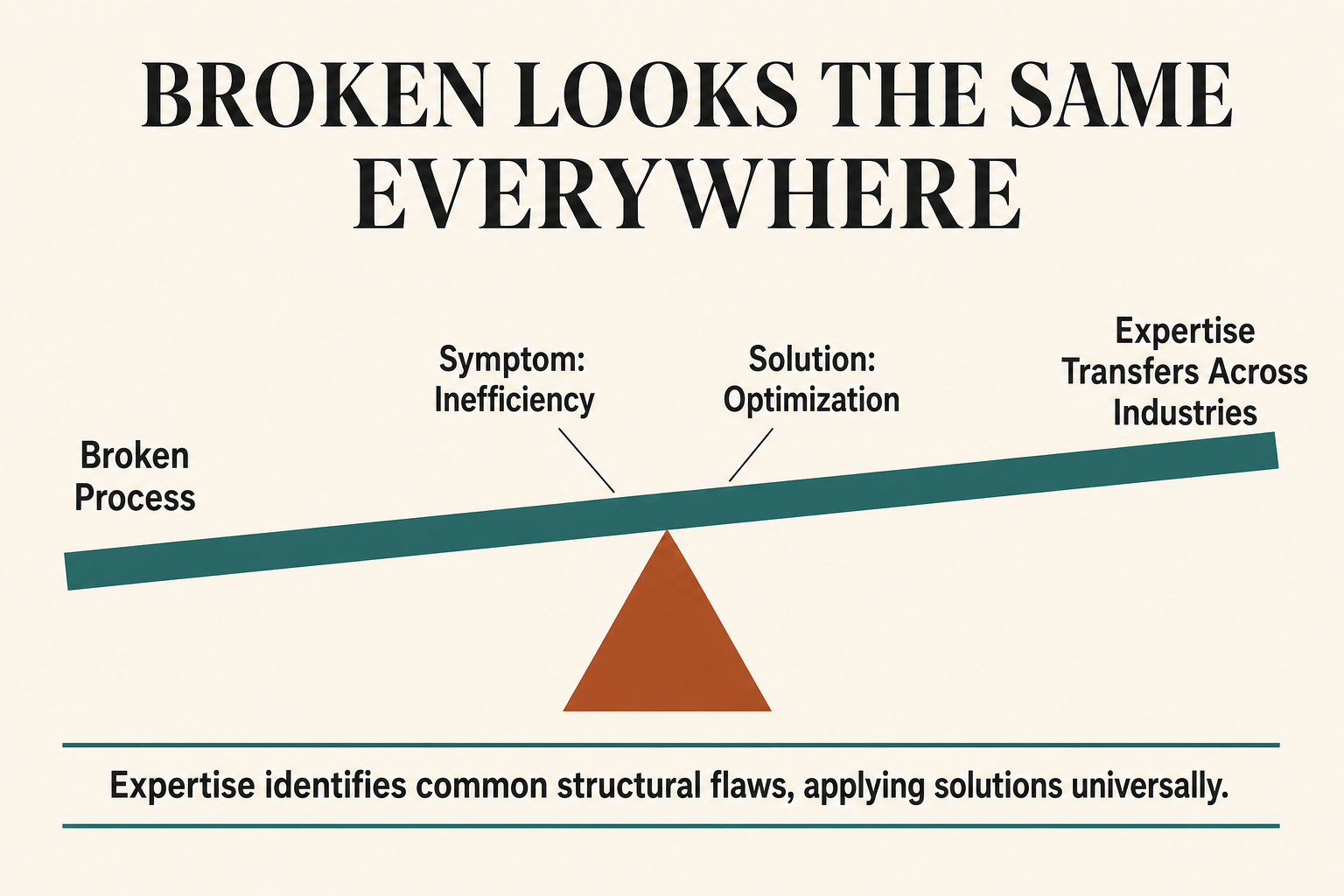
None of those three questions contains a single word of industry vocabulary. They are structural. You can ask them of a refinery, a retail warehouse, or a luxury property and they cut the same way.
The questions are structural. The vocabulary is just paint over the structure.
This is why a pattern recognized in one sector lets you name a problem in another that the owner cannot yet see. The shape repeats. A bottleneck in fulfillment and a bottleneck in approval are the same animal wearing different clothes. Once you have fixed one, you recognize the second on sight, even in a business you have never worked in.
The owner sees a unique problem in a unique industry. The diagnostician sees a category of failure he has met before.
The Same Instinct in Three Worlds
Consider three problems that have nothing to do with one another.
A specialty valve maker presents to a major distributor. It lands well. The distributor is interested, and then says: go get this approved by our end users so we can buy it. The deal had not died on the product or the relationship. It had stopped at a gate, and the gate was held by someone the distributor could not order around. The fix was not a better pitch. It was reading correctly where authority actually lived, which was downstream, with approval timelines measured in months and years.
An e-commerce operation hits its Christmas spike and the warehouse buckles. The instinct says hire more pickers. The real failure was a paper pick list routing people through the building in a bad order. The fix was first-generation scanners that routed the picker and validated each pick against the shelf and the barcode. The problem was never labor. It was a process built for a volume that the season had outgrown.
A rural property gets designed around how a group actually moves through a weekend, where they gather, where someone takes morning coffee, where everyone lands at sunset, before a single finish was chosen. The question underneath was the same one again: what is this actually for, and is it built for that?
A bottleneck in fulfillment and a bottleneck in approval are the same animal wearing different clothes.
Three industries. One instinct. Find where it stops, find who can unstick it, ask what it was built for. The valve, the warehouse, and the ranch share no suppliers, no customers, no regulations. They share a way of being broken, and a way of being read.
How to Tell Which Kind of Problem You Have
Before you decide you need someone who knows your world, check whether the problem is actually about your world at all.
- Where does it stop? Trace the thing to the exact point where it stalls, not where you assume it stalls. The two are usually different rooms.
- Who can unstick it? Name the person with real authority over that point. If you have been pressing someone who cannot actually decide, the industry was never the issue.
- What was it built for? Find the volume, season, or customer mix the process was designed around, and check whether that situation still exists.
- Is the workaround invisible? List the things you do "just because that's how we do it." Each one is a place a problem went into hiding.
- Are you blaming the loud part? The expensive, obvious symptom is rarely the cause. Ask what it is downstream of.
If the answers point to structure, you do not need industry expertise. You need someone who can see the structure clearly, precisely because the vocabulary doesn't slow them down.
The thing that is broken in your business almost certainly isn't unique to your business. The way it's broken has a shape, and the shape travels.
Know your industry. But when something stalls, stop asking who knows the trade, and start asking who can read the structure underneath it.