
When a new option is merely as good as the one already in place, the current choice usually wins. The reason is not laziness. Keeping what already works requires no new explanation, no transition, and no personal ownership of an avoidable change.
Sellers often compare product to product or proposal to proposal. Buyers compare the proposed improvement with the full cost of switching: retraining, integration, approval, disruption, uncertainty, and the possibility that the change becomes their problem.
In one industrial sale, a buyer already had a valve operating reliably in critical service. A new supplier arrived with comparable performance, material, service life, and a slightly better price. The buyer listened and agreed that the alternative looked good. Nothing moved.
The new product had answered the technical comparison and missed the business question: why reopen a decision that was not currently causing pain? The incumbent brought years of service, established paperwork, and organizational comfort. Matching the specification did not match that accumulated advantage.
This is equally true of replacing software, changing accountants, moving banks, hiring a new agency, or asking a team to abandon a familiar process. The alternative does not compete only with the current provider. It competes with the buyer's ability to do nothing.
If the gain is small and the switching burden is real, a tie is not neutral. It belongs to the status quo.
The Tie Goes to the One Already There
We tend to score a sales conversation like a contest between two products. The challenger lays out its specs, the incumbent's specs are known, and we assume the better numbers win. That is not how the buyer is scoring it.
The buyer is not comparing two products. The buyer is comparing two futures.
The buyer is not comparing two products. The buyer is comparing two futures. One future is the line exactly as it runs today, with all its known behavior and its filed approvals. The other future is a change, with the work of qualifying, the risk of an unfamiliar part, and the small but real chance of being the person who swapped a working component and caused a shutdown.
For those two futures to tie on paper, the challenger has to be genuinely as good. But a tie on paper is not a tie in the buyer's mind. The known thing carries no switching cost and no career risk. The new thing carries both.
This is why parity feels like progress to the seller and feels like nothing to the buyer. You closed the gap. You did not give anyone a reason to move.
Why Parity Is Already a Loss
The status quo is not a neutral baseline. It is the strongest competitor in the room, and it never shows up to the meeting. It does not present, it does not discount, it does not return calls. It just keeps running, accruing the one advantage no challenger can match at parity: it is already approved and already working.
That advantage compounds. Every month the incumbent stays in service, it adds another month of proven behavior to its file. The challenger, meanwhile, starts at zero and has to earn its way up through whatever qualification the buyer's organization requires.
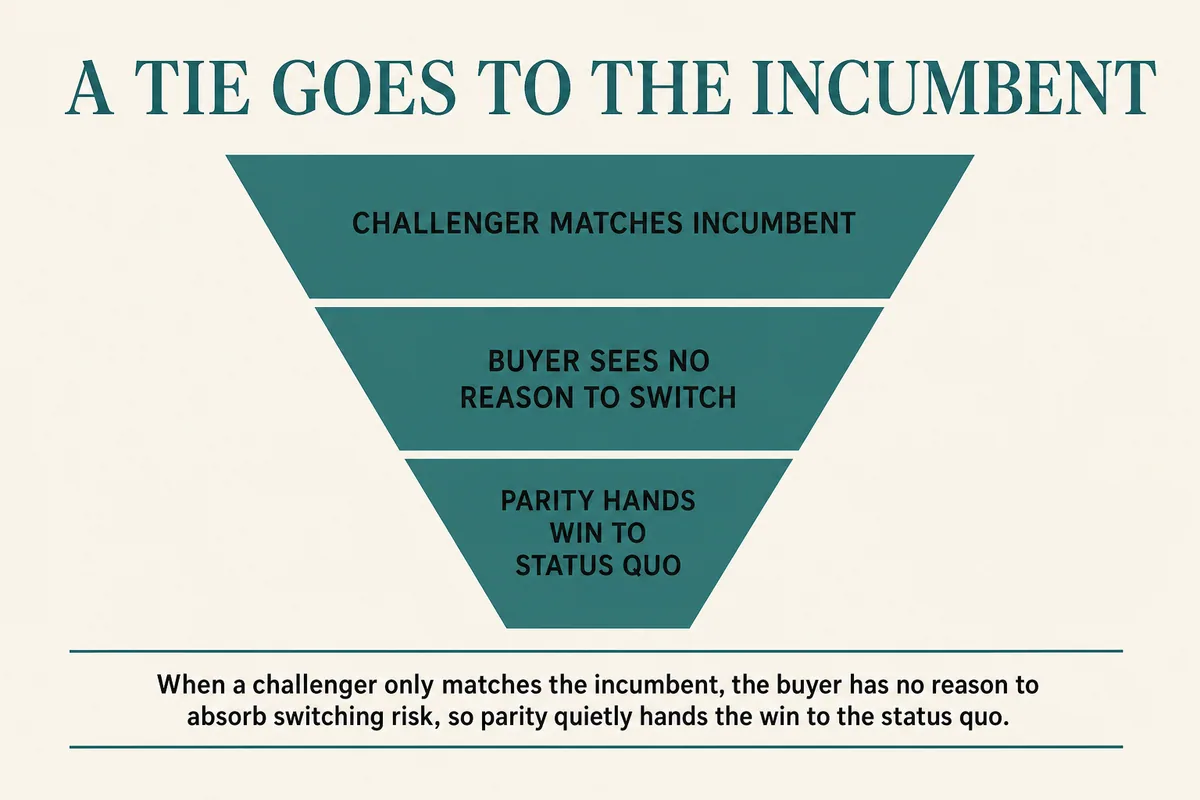
So the real bar is not "as good as." The real bar is "good enough to justify the cost and risk of changing." That gap, between matching and justifying, is where most challengers quietly die. They get to parity, they get the nod, and they mistake the nod for a decision.
Preference is what the buyer feels. Permission is what the system grants. You can win the first and never touch the second.
It helps to separate the two things a buyer can give you. One is preference. The buyer likes your product, your terms, your conversation. The other is permission. The buyer's organization will actually allow the change. These are not the same, and they often live in different people.
When you are at parity, preference is the only thing you can win. And preference, by itself, does not move a working line. The buyer who genuinely likes your product can be completely unable to act on that feeling, because the thing standing in the way is not preference at all. It is the absence of a reason large enough to overcome the system's bias toward staying put.
That bias is rational. The cost of an unnecessary change is borne by the person who made it. The cost of staying the same is borne by no one in particular. A buyer who understands this will default to the incumbent every time the case is close. Close is a win for the thing already there.
What the Distributor Could Not Buy
A Mexican manufacturer of specialty and alloy valves, the critical-service kind, set out to enter the U.S. market. The plan, at first, was to knock on doors and sell to people who would like the product. Effort went into preference.
There was a presentation to a Fortune 500 distributor. It landed well. The distributor was genuinely interested, the product was strong, the conversation was good. Then came the sentence that reorganized everything: go get this approved by our customers, the end users, so that we can actually buy it.
The distributor's interest was real. It was also worthless until someone downstream said yes.
The distributor liked the valve and still could not purchase it. The permission to buy did not live in that room. It lived downstream, with the end users who would not let an unproven critical-service valve into a line without their own approval first. Some of those approvals took months. Some took years.
The fix was not a better pitch. It was to stop selling to preference and to go understand the approval path, then follow it. That is slower, and it is the only thing that converts a strong product into one a distributor can actually order. The product had been competing against the installed valve on specs. The real contest was against the installed valve's approval file, and you do not win that by being equal to it.
How to Tell If You Are Tied
Before you celebrate a warm meeting, run your situation against these. Each one separates a real path to a sale from the comfortable feeling of being liked.
- The reason to switch: Can you name, in one sentence, what the buyer gains that they do not have today? If the honest answer is "the same thing, slightly better," you are at parity and you are losing.
- Preference versus permission: Does the person who likes your product also have the authority to allow the change? If not, who downstream holds that permission, and have you met them?
- The approval path: Do you know the actual qualification process for your kind of product in this account, including who signs and how long it takes? Guessing here is how you spend a year on the wrong door.
- The cost of staying put: From the buyer's side, what does it cost to do nothing? If the answer is "nothing visible," the incumbent already won.
- The risk owner: Who personally absorbs the blame if your product underperforms after a switch? That person sets the real bar, not the one who took your call.
- The file, not the spec: Are you competing against the incumbent's specifications, or against its years of proven service and existing approvals? You can match the first. You cannot match the second at parity.
If your only advantage is that you are as good as what they already have, you have given the buyer a reason to keep what they already have.
Match the incumbent and you tie. Tie, and you lose. The work is to give the buyer something the status quo cannot, and then to find the person allowed to act on it.
◆◆◆